David Wallace - Infinite jest
Здесь есть возможность читать онлайн «David Wallace - Infinite jest» весь текст электронной книги совершенно бесплатно (целиком полную версию без сокращений). В некоторых случаях можно слушать аудио, скачать через торрент в формате fb2 и присутствует краткое содержание. Год выпуска: 2006, Издательство: Back Bay Books, Жанр: Современная проза, на русском языке. Описание произведения, (предисловие) а так же отзывы посетителей доступны на портале библиотеки ЛибКат.

- Название:Infinite jest
- Автор:
- Издательство:Back Bay Books
- Жанр:
- Год:2006
- ISBN:нет данных
- Рейтинг книги:3 / 5. Голосов: 1
-
Избранное:Добавить в избранное
- Отзывы:
-
Ваша оценка:
Infinite jest: краткое содержание, описание и аннотация
Предлагаем к чтению аннотацию, описание, краткое содержание или предисловие (зависит от того, что написал сам автор книги «Infinite jest»). Если вы не нашли необходимую информацию о книге — напишите в комментариях, мы постараемся отыскать её.
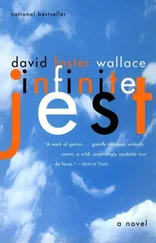
Infinite Jest
On this outrageous frame hangs an exploration of essential questions about what entertainment is, and why it has come to so dominate our lives; about how our desire for entertainment interacts with our need to connect with other humans; and about what the pleasures we choose say about who we are. Equal parts philosophical quest and screwball comedy, Infinite Jest bends every rule of fiction without sacrificing for a moment its own entertainment value. The huge cast and multilevel narrative serve a story that accelerates to a breathtaking, heartbreaking, unfogettable conclusion. It is an exuberant, uniquely American exploration of the passions that make us human and one of those rare books that renew the very idea of what a novel can do.
Infinite jest — читать онлайн бесплатно полную книгу (весь текст) целиком
Ниже представлен текст книги, разбитый по страницам. Система сохранения места последней прочитанной страницы, позволяет с удобством читать онлайн бесплатно книгу «Infinite jest», без необходимости каждый раз заново искать на чём Вы остановились. Поставьте закладку, и сможете в любой момент перейти на страницу, на которой закончили чтение.
Интервал:
Закладка:
‘This is the first real match I’ve seen, after hearing so much about the junior tour,’ Helen Steeply told deLint, trying to cross her legs on a cramped bleacher a few tiers from the top. Aubrey deLint’s smile was notoriously bad, his face seeming to break into crescents and shards, wholly without cheer. It was almost more like a grimace. Orders that deLint keep the mammoth soft-profiler in direct sight at all times were explicit and emphatic. Helen Steeply had a notebook, and deLint was filling in both players’ names on performance charts Schtitt won’t ever let anyone look at.
The P.M. was moving fast from a chilly noon cloud-cover into blue autumn glory, but in the first set it was still very cold, the sun still pale and seeming to flutter as if poorly wired. Hal and Stice didn’t have to stretch and barely warmed up at all, after the run. They’d changed clothes and were both expressionless. Stice was in all-black, Hal in E.T.A. sweats with his left shoe’s upper bulging distended around his AirStirrup brace.
A born net-man, Ortho Stice played with a kind of rigid, liquid grace, like a panther in a back-brace. He was shorter than Hal but better-built and with quicker feet. A southpaw with factory-painted W’s on his Wilson Pro Staff 5.8 si’s.
Hal was left-handed too, which complicated strategy and percentages hideously, deLint told the journalist beside him.
The Darkness’s service motion was in the McEnroe-Esconja tradition, legs splayed, feet parallel, a figure off an Egyptian frieze, side so severely to the net he’s almost facing away. Both arms out straight and stiff on the serve’s downswing. Hal bobbed on his feet’s balls a little in the ad court, waiting. Stice started his service-motion motion in little segments — it looks a little like bad animation — then grimaced, tossed, pivoted netward and served it with a hard flat spang way out to Hal’s forehand, pulling Hal wide. The finish of Stice’s pivot lets his momentum carry him naturally up to net, following the serve. Hal lunged for the serve and chipped a little forehand return down the line and scrambled right to get back into court. The return was lucky, a feeble chip that just cleared the net’s tape, so shallow that Stice had to half-volley it at the service line, still moving in, his backhand two-handed and clumsy for half-volleys; he had to sort of scoop it and hit up soft so it wouldn’t float out deep. Axiom: the man who has to hit up from the net is going to get passed. And Stice’s half-volley landed in the ad court squishy and slow and sat up for Hal, who was waiting for it. Hal’s stick was back for the forehand, waiting, and there was a moment of total mentation as the ball hung there. Statistically, Hal was book to pass a left-handed volleyer cross-court off a ball this ripe, though he also always loved a good humiliating topspin lob, and Stice’s fractional chance at saving the point was to guess what Hal would do — Stice couldn’t crowd the net because Hal would put it up over him; he stayed a couple stick-lengths off the net, leaning for a cross. Everything seemed to hang distended in air now so clear it seemed washed, after the clouds. The bleachers’ people could feel Hal feel Stice letting the point go, inside, figuring it lost, knowing he could only guess and stab, hoping. Little hope of Hal fucking up: Hal Incandenza does not fuck up passes off floater half-volleys. Hal’s forehand’s wind-up was nicely disguised, prepped for either lob or pass. When he hit it so hard his forearm’s musculature stood starkly out it was a pass but not cross-court; he went inside-out on it, a flat forehand as hard as he could from the baseline’s center back toward Stice’s deuce-sideline. Stice had finally guessed lob at the start of the stroke and had half-turned to sprint back for where it would land, and the inside-out pass wrong-footed him; he could do no more than stand there flat-footed and watching as the fresh ball landed a meter fair to get Hal back to deuce in the fifth game. There was applause off thirty hands for the point as a whole, which was faultless and on Hal’s part imaginative, anti-book. One of very few total inspired points from Incandenza, deLint’s chart would show. Neither player’s face moved as a couple people shouted for Hal. The basic ten-level R.A.S.U. [265]from the Universal Bleacher Co. sat right behind the court. At the start it was mostly staff and the A’s who were running alongside when Thode brought Stice and Hal the directive to play. But the stands gradually filled as word got down to the locker rooms that The Darkness was playing 18’s A-2 dead-even in the first set of something Schtitt had actually dispatched a scooter to order. The bleachers’ E.T.A.s hunched forward with hands warmed in the crease between hamstrings and calves, or else gloved and layered and stretched out with their heads and bottoms and heels on three different levels, watching both sky and play. The lozenges of shadow from the court’s mesh fences elongated as the sun wheeled southwest to west. Several sets of legs and sneakers hung swinging from the transom above. Mario allowed himself several reaction-shots from staff and partisans in the bleachers. Aubrey deLint spent the set with the punter’s ca-thected profiler, who allegedly came to see Hal only about Orin but whom Charles Tavis won’t let see Hal yet, even chaperoned, Tavis’s reasons for the reticence too detailed for Helen Steeply to understand, probably, but she was watching from the Show-bleachers’ top row, poised over a notebook, wearing a fuchsia ski cap with a rooster-comb top instead of a pompom top, blowing into her fist, her weight making the bleacher below her bow and inclining deLint oddly toward her. For the spectators not perched on the transom overhead, the players looked waffle-cut by the chain-link fencing. The green windscreens that wrecked spectation were used only in the spring in the weeks right after the Lung’s disassembly. DeLint hadn’t stopped talking into the big lady’s ear.
All the E.T.A. players loved the Show Courts 6–9 because they loved to be watched, and also hated the Show Courts because the transom’s crow’s-nested shadow covered the north halves of the courts around noon and all through the P.M. wheeled around gradually east like some giant hooded shadowed moving presence, brooding. Sometimes just the sight of Schtitt’s little head’s shadow could make a younger kid on the Show Courts clutch and freeze. By Hal and Stice’s seventh game, the sky was cloudless, and the transom’s monolithic shadow, black as ink, gave everyone watching the fantods as it elongated along the nets, completely obscuring Slice when he followed a serve in. Another advantage of the Lung was that it afforded no overhead view, which was one more reason why staff waited as long as possible before its erection. There was no indication Hal even saw it, the shadow, hunched and waiting for Stice.
The Darkness splayed out stiff on the deuce side of the center line, ratcheting slowly into his service motion. He overhit the first serve long and Hal angled it softly off-court, moving two steps in for the second ball. Stice hit his second serve as hard as he could again and netted it, and pursed his thick lips a little as he walked into the net’s shadow to retrieve the ball, and Hal jogged over to the fence behind the next court to get the ball he’d angled over. DeLint was putting a pejorative hieroglyphic in a box on his chart marked STICE.
At just this moment, @1200 meters east and downhill and one level below ground, Ennet House live-in Staff Don Gately lay deeply asleep in his Lone-Rangerish sleeping mask, his snores rattling the deinsulated pipes along his little room’s ceiling.
Four-odd clicks to the northwest in the men’s room of the Armenian Foundation Library, right near the onion-domed Watertown Arsenal, Poor Tony Krause hunched forward in a stall in his ghastly suspenders and purloined cap, his elbows on his knees and his face in his hands, getting a whole new perspective on time and the various passages and personae of time.
Читать дальшеИнтервал:
Закладка:
Похожие книги на «Infinite jest»
Представляем Вашему вниманию похожие книги на «Infinite jest» списком для выбора. Мы отобрали схожую по названию и смыслу литературу в надежде предоставить читателям больше вариантов отыскать новые, интересные, ещё непрочитанные произведения.










Обсуждение, отзывы о книге «Infinite jest» и просто собственные мнения читателей. Оставьте ваши комментарии, напишите, что Вы думаете о произведении, его смысле или главных героях. Укажите что конкретно понравилось, а что нет, и почему Вы так считаете.