David Wallace - Infinite jest
Здесь есть возможность читать онлайн «David Wallace - Infinite jest» весь текст электронной книги совершенно бесплатно (целиком полную версию без сокращений). В некоторых случаях можно слушать аудио, скачать через торрент в формате fb2 и присутствует краткое содержание. Год выпуска: 2006, Издательство: Back Bay Books, Жанр: Современная проза, на русском языке. Описание произведения, (предисловие) а так же отзывы посетителей доступны на портале библиотеки ЛибКат.
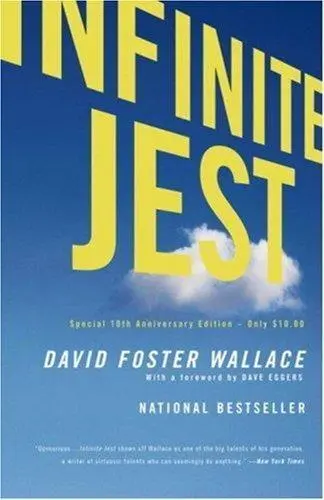
- Название:Infinite jest
- Автор:
- Издательство:Back Bay Books
- Жанр:
- Год:2006
- ISBN:нет данных
- Рейтинг книги:3 / 5. Голосов: 1
-
Избранное:Добавить в избранное
- Отзывы:
-
Ваша оценка:
Infinite jest: краткое содержание, описание и аннотация
Предлагаем к чтению аннотацию, описание, краткое содержание или предисловие (зависит от того, что написал сам автор книги «Infinite jest»). Если вы не нашли необходимую информацию о книге — напишите в комментариях, мы постараемся отыскать её.
Infinite Jest
On this outrageous frame hangs an exploration of essential questions about what entertainment is, and why it has come to so dominate our lives; about how our desire for entertainment interacts with our need to connect with other humans; and about what the pleasures we choose say about who we are. Equal parts philosophical quest and screwball comedy, Infinite Jest bends every rule of fiction without sacrificing for a moment its own entertainment value. The huge cast and multilevel narrative serve a story that accelerates to a breathtaking, heartbreaking, unfogettable conclusion. It is an exuberant, uniquely American exploration of the passions that make us human and one of those rare books that renew the very idea of what a novel can do.
Infinite jest — читать онлайн бесплатно полную книгу (весь текст) целиком
Ниже представлен текст книги, разбитый по страницам. Система сохранения места последней прочитанной страницы, позволяет с удобством читать онлайн бесплатно книгу «Infinite jest», без необходимости каждый раз заново искать на чём Вы остановились. Поставьте закладку, и сможете в любой момент перейти на страницу, на которой закончили чтение.
Интервал:
Закладка:
Just at this time, I remember, there was a loud cracking sound and my area of the frame jumped violently as my father’s illness caused him to faint and he lost his balance and pitched forward and lay prone and asleep over his side of the bed frame, which as I rolled away from the frame and rose to my knees I saw was either broken or very badly bent. My father lay facedown in the mixture of the rectangle’s thick dust and the material he’d brought up from his upset stomach. The dust his collapse raised was very thick, and as the new dust rose and spread it attenuated the master bedroom’s daylight as decisively as if a cloud had moved over the sun in the window. My father’s professional wig had detached and lay scalp-up in the mixture of dust and stomach material. The stomach material appeared to be mostly gastric blood until I recalled the tomato juice my father had been drinking. He lay face-down, with his bottom high in the air, over the side of the bed frame, which his weight had broken in half. This was how I accounted for the loud cracking sound.
I stood out of the way of the dust and the window’s dusty light, feeling along the line of my jaw and examining my prone father from a distance. I remember that his breathing was regular and wet, and that the dust mixture bubbled somewhat. It was then that it occurred to me that when I’d been supporting the bed’s raised mattress with my chest and face preparatory to its removal from the room, the dihedral triangle I’d imagined the mattress forming with the box spring and my body had not in fact even been a closed figure: the box spring and the floor I had stood on did not constitute a continuous plane.
Then I could hear my mother trying to get the heavy canister vacuum cleaner past the angled Simmons Beauty Rest in the hall, and I went to help her. My father’s legs were stretched out across the clean blue carpet between his side of the frame and my mother’s white dresser. His feet’s boots were at a pigeon-toed angle, and his bottom’s crack all the way down to the anus itself was now visible because the force of his fall had pulled his white slacks down even farther. I stepped carefully between his legs.
‘Excuse me,’ I said.
I was able to help my mother by telling her to detach the vacuum cleaner’s attachments and hand them one at a time to me over the width of the slumped mattress, where I held them. The vacuum cleaner was manufactured by Regina, and its canister, which contained the engine, bag, and evacuating fan, was very heavy. I reassembled the vacuum and held it while my mother made her way back across the mattress, then handed the vacuum cleaner back to her, flattening myself against the wall to let her pass by on her way into the master bedroom.
‘Thanks,’ my mother said as she passed.
I stood there by the slumped mattress for several moments of a silence so complete that I could hear the street’s lawnmowers all the way out in the hall, then heard the sound of my mother pulling out the vacuum cleaner’s retractable cord and plugging it into the same bedside outlet the steel reading lamps were attached to.
I made my way over the angled mattress and quickly down the hall, made a sharp right at the entrance to the kitchen, crossed the foyer to the staircase, and ran up to my room, taking several stairs at a time, hurrying to get some distance between myself and the vacuum cleaner, because the sound of vacuuming has always frightened me in the same irrational way it seemed a bed’s squeak frightened my father.
I ran upstairs and pivoted left at the upstairs landing and went into my room. In my room was my bed. It was narrow, a twin bed, with a headboard of wood and frame and slats of wood. I didn’t know where it had come from, originally. The frame held the narrow box spring and mattress much higher off the floor than my parents’ bed. It was an old-fashioned bed, so high off the floor that you had to put one knee up on the mattress and clamber up into it, or else jump.
That is what I did. For the first time since I had become taller than my parents, I took several running strides in from the doorway, past my shelves’ collection of prisms and lenses and tennis trophies and my scale-model magneto, past my bookcase, the wall’s still-posters from Powell’s Peeping Tom and the closet door and my bedside’s high-intensity standing lamp, and jumped, doing a full swan dive up onto my bed. I landed with my weight on my chest with my arms and legs out from my body on the indigo comforter on my bed, squashing my tie and bending my glasses’ temples slightly. I was trying to make my bed produce a loud squeak, which in the case of my bed I knew was caused by any lateral friction between the wooden slats and the frame’s interior’s shelf-like slat-support.
But in the course of the leap and the dive, my overlong arm hit the heavy iron pole of the high-intensity standing lamp that stood next to the bed. The lamp teetered violently and began to fall over sideways, away from the bed. It fell with a kind of majestic slowness, resembling a felled tree. As the lamp fell, its heavy iron pole struck the brass knob on the door to my closet, shearing the knob off completely. The round knob and half its interior hex bolt fell off and hit my room’s wooden floor with a loud noise and began then to roll around in a remarkable way, the sheared end of the hex bolt stationary and the round knob, rolling on its circumference, circling it in a spherical orbit, describing two perfectly circular motions on two distinct axes, a non-Euclidian figure on a planar surface, i.e., a cycloid on a sphere:
x,v


x,y
The closest conventional analogue I could derive for this figure was a cycloid, L’Hôpital’s solution to Bernoulli’s famous Brachistochrone Problem, the curve traced by a fixed point on the circumference of a circle rolling along a continuous plane. But since here, on the bedroom’s floor, a circle was rolling around what was itself the circumference of a circle, the cycloid’s standard parametric equations were no longer apposite, those equations’ trigonometric expressions here becoming themselves first-order differential equations.
Because of the lack of resistance or friction against the bare floor, the knob rolled this way for a long time as I watched over the edge of the comforter and mattress, holding my glasses in place, completely distracted from the minor-D shriek of the vacuum below. It occurred to me that the movement of the amputated knob perfectly schematized what it would look like for someone to try to turn somersaults with one hand nailed to the floor. This was how I first became interested in the possibilities of annula-tion.
The night after the chilly and sort of awkward joint Interdependence Day picnic for Enfield’s Ennet House Drug and Alcohol Recovery House, Somer-ville’s Phoenix House, and Dorchester’s grim New Choice juvenile rehab, Ennet House staffer Johnette Foltz took Ken Erdedy and Kate Gompert along with her to this one NA Beginners’ Discussion Meeting where the focus was always marijuana: how every addict at the meeting had gotten in terrible addictive trouble with it right from the first duBois, or else how they’d been strung out on harder drugs and had tried switching to grass to get off the original drugs and but then had gotten in even terribler trouble with grass than they’d been in with the original hard stuff. This was supposedly the only NA meeting in metro Boston explicitly devoted to marijuana. Johnette Foltz said she wanted Erdedy and Gompert to see how completely nonunique and unalone they were in terms of the Substance that had brought them both down.
Читать дальшеИнтервал:
Закладка:
Похожие книги на «Infinite jest»
Представляем Вашему вниманию похожие книги на «Infinite jest» списком для выбора. Мы отобрали схожую по названию и смыслу литературу в надежде предоставить читателям больше вариантов отыскать новые, интересные, ещё непрочитанные произведения.





Обсуждение, отзывы о книге «Infinite jest» и просто собственные мнения читателей. Оставьте ваши комментарии, напишите, что Вы думаете о произведении, его смысле или главных героях. Укажите что конкретно понравилось, а что нет, и почему Вы так считаете.