David Wallace - Infinite jest
Здесь есть возможность читать онлайн «David Wallace - Infinite jest» весь текст электронной книги совершенно бесплатно (целиком полную версию без сокращений). В некоторых случаях можно слушать аудио, скачать через торрент в формате fb2 и присутствует краткое содержание. Год выпуска: 2006, Издательство: Back Bay Books, Жанр: Современная проза, на русском языке. Описание произведения, (предисловие) а так же отзывы посетителей доступны на портале библиотеки ЛибКат.
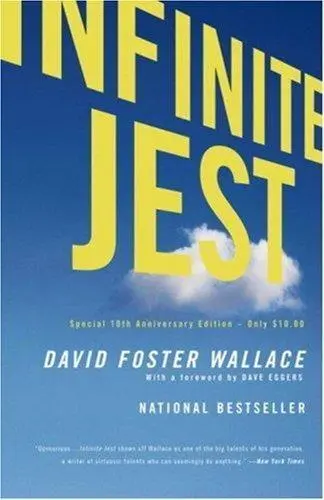
- Название:Infinite jest
- Автор:
- Издательство:Back Bay Books
- Жанр:
- Год:2006
- ISBN:нет данных
- Рейтинг книги:3 / 5. Голосов: 1
-
Избранное:Добавить в избранное
- Отзывы:
-
Ваша оценка:
Infinite jest: краткое содержание, описание и аннотация
Предлагаем к чтению аннотацию, описание, краткое содержание или предисловие (зависит от того, что написал сам автор книги «Infinite jest»). Если вы не нашли необходимую информацию о книге — напишите в комментариях, мы постараемся отыскать её.
Infinite Jest
On this outrageous frame hangs an exploration of essential questions about what entertainment is, and why it has come to so dominate our lives; about how our desire for entertainment interacts with our need to connect with other humans; and about what the pleasures we choose say about who we are. Equal parts philosophical quest and screwball comedy, Infinite Jest bends every rule of fiction without sacrificing for a moment its own entertainment value. The huge cast and multilevel narrative serve a story that accelerates to a breathtaking, heartbreaking, unfogettable conclusion. It is an exuberant, uniquely American exploration of the passions that make us human and one of those rare books that renew the very idea of what a novel can do.
Infinite jest — читать онлайн бесплатно полную книгу (весь текст) целиком
Ниже представлен текст книги, разбитый по страницам. Система сохранения места последней прочитанной страницы, позволяет с удобством читать онлайн бесплатно книгу «Infinite jest», без необходимости каждый раз заново искать на чём Вы остановились. Поставьте закладку, и сможете в любой момент перейти на страницу, на которой закончили чтение.
Интервал:
Закладка:
Sitting here preacher-hatted, with a mouth full of multilayered baklava, Hal knows perfectly well that Mario gets his fetish for cartridges about puppets and entr’actes and audiences from their late father. Himself, during his anticonfluential middle period, went through this subphase of being obsessed with the idea of audiences’ relationships with various sorts of shows. Hal doesn’t even want to think about the grim one about the carnival of eyeballs. [154]But this one other short high-tech one was called ‘The Medusa v. The Odalisque’ and was a film of a fake stage-production at Ford’s Theater in the nation’s capital of Wash. DC that, like all his audience-obsessed pieces, had cost Incandenza a real bundle in terms of human extras. The extras in this one are a well-dressed audience of guys in muttonchops and ladies with paper fans who fill the place from first row to the rear of the balcony’s boxes, and they’re watching an incredibly violent little involuted playlet called ‘The Medusa v. The Odalisque,’ the relatively plotless plot of which is just that the mythic Medusa, snake-haired and armed with a sword and well-polished shield, is fighting to the death or petrification against L’Odalisque de Ste. Thérèse, a character out of old Québecois mythology who was supposedly so inhumanly gorgeous that anyone who looked at her turned instantly into a human-sized precious gem, from admiration. A pretty natural foil for the Medusa, obviously, the Odalisque has only a nail-file instead of a sword, but also has a well-wielded hand-held makeup mirror, and she and the Medusa are basically rumbling for like twenty minutes, leaping around the ornate stage trying to de-map each other with blades and/or de-animate each other with their respective reflectors, which each leaps around trying to position just right so that the other gets a glimpse of its own full-frontal reflection and gets instantly petrified or gemified or whatever. In the cartridge it’s pretty clear from their milky-pixeled translu-cence and insubstantiality that they’re holograms, but it’s not clear what they’re supposed to be on the level of the playlet, whether the audience is supposed to see/(not)see them as ghosts or wraiths or ‘real’ mythic entities or what. But it’s a ballsy fight-scene up there on the stage — having been intricately choreographed by an Oriental guy Himself rented from some commercial studio and put up in the HmH, who ate like a bird and smiled very politely all the time and didn’t have even a word to say to anybody, it seemed, except Avril, to whom the Oriental choreographer had cottoned right off — balletic and full of compelling little cornerings and near-misses and reversals, and the theater’s audience is rapt and clearly entertained to the gills, because they keep spontaneously applauding, as much maybe for the film’s play’s choreography as anything else — which would make it more like spontaneously meta-applauding, Hal supposes — because the whole fight-scene has to be ingeniously choreographed so that both combatants have their respectively scaly and cream-complected backs [155]to the audience, for obvious reasons … except as the shield and little mirror get whipped martially around and brandished at various strategic angles, certain members of the playlet’s well-dressed audience eventually start catching disastrous glimpses of the combatants’ fatal full-frontal reflections, and instantly get transformed into like ruby statues in their front-row seats, or get petrified and fall like embolized bats from the balcony’s boxes, etc. The cartridge goes on like this until there’s nobody left in the Ford’s Theater seats animate enough to applaud the nested narrative of the fight-scene play, and it ends with the two aesthetic foils still rumbling like mad before an audience of varicolored stone. ‘The Medusa v. The Odalisque’ ‘s own audiences didn’t think too much of the thing, because the film audience never does get much of a decent full-frontal look at what it is about the combatants that supposedly has such a melodramatic effect on the rumble’s live audience, and so the film’s audience ends up feeling teased and vaguely cheated, and the thing had only a regional release, and the cartridge rented like yesterday’s newspapers, and it’s now next to impossible to find. But that wasn’t by any stretch of the imagination the James O. Incandenza film that audiences hated the most. The most hated Incandenza film, a variable-length one called The Joke, had only a very brief theatrical release, and then only at the widely scattered last remains of the pre-InterLace public art-film theaters in arty places like Cambridge MA and Berkeley CA. And InterLace never considered it for Pulse-Order rerelease, for obvious reasons. The art-film theaters’ marquees and posters and ads for the thing were all required to say something like ‘THE JOKE’: You Are Strongly Advised NOT To Shell Out Money to See This Film, which art-film habitues of course thought was a cleverly ironic anti-ad joke, and so they’d shell out for little paper theater tickets and file in in their sweater vests and tweeds and dirndls and tank up on espresso at the concession stand and find seats and sit down and make those little pre-movie leg and posture adjustments, and look around with that sort of vacant intensity, and they’d figure the tri-lensed Bolex H32 cameras — one held by a tall stooped old guy and one complexly mounted on the huge head of the oddly forward-listing boy with what looked like a steel spike coming out of his thorax — the big cameras down by the red-lit EXITS on either side of the screen, the patrons figured, were there for like an ad or an anti-ad or a behind-the-scenes metafilmic documentary or something. That is, until the lights went down and the film started up and what was on the wide public screen was just a wide-angled binoculated shot of this very art-film theater’s audience filing in with espressos and finding seats and sitting down and looking around and getting adjusted and saying knowledgeable little pre-movie things to their thick-lensed dates about what the Don’t-Pay-To-See-This ad and Bolex cameras probably signified, artistically, and settling in as the lights dimmed and facing the screen (i.e. now themselves, it turns out) with the coolly excited smiles of highbrow-entertainment expectation, smiles which the cameras and screen’s projection now revealed as just starting to drop from the faces of the audience as the audience saw row after row of itself staring back at it with less and less expectant and more and more blank and then puzzled and then eventually pissed-off facial expressions. The Joke’s total running time was just exactly as long as there was even one cross-legged patron left in the theater to watch his own huge projected image gazing back down at him with the special distaste of a disgusted and ripped-off-feeling art-film patron, which ended up being more than maybe twenty minutes only when there were critics or film-academics in the seats, who studied themselves studying themselves taking notes with endless fascination and finally left only when the espresso finally impelled them to the loo, at which point Himself and Mario would have to frantically pack up cameras and lens-cases and coaxials and run and totter like hell to catch the next cross-country flight from Cambridge to Berkeley or Berkeley to Cambridge, since they obviously had to be there all set up and Bolex’d for each showing at each venue. Mario said Lyle had said Incandenza had confessed that he’d loved the fact that The Joke was so publicly static and simple-minded and dumb, and that those rare critics who defended the film by arguing at convolved length that the simple-minded stasis was precisely the film’s aesthetic thesis were dead wrong, as usual. It’s still unclear whether it was the Eyeball-and-Sideshow thing or ‘The Medusa v…’ or The Joke that had metamorphosized into their late father’s later involvement with the hostilely anti-Real genre of ‘Found Drama,’ which was probably the historical zenith of self-consciously dumb stasis, but which audiences never actually even got to hate, for a-priori reasons.
Читать дальшеИнтервал:
Закладка:
Похожие книги на «Infinite jest»
Представляем Вашему вниманию похожие книги на «Infinite jest» списком для выбора. Мы отобрали схожую по названию и смыслу литературу в надежде предоставить читателям больше вариантов отыскать новые, интересные, ещё непрочитанные произведения.



Обсуждение, отзывы о книге «Infinite jest» и просто собственные мнения читателей. Оставьте ваши комментарии, напишите, что Вы думаете о произведении, его смысле или главных героях. Укажите что конкретно понравилось, а что нет, и почему Вы так считаете.