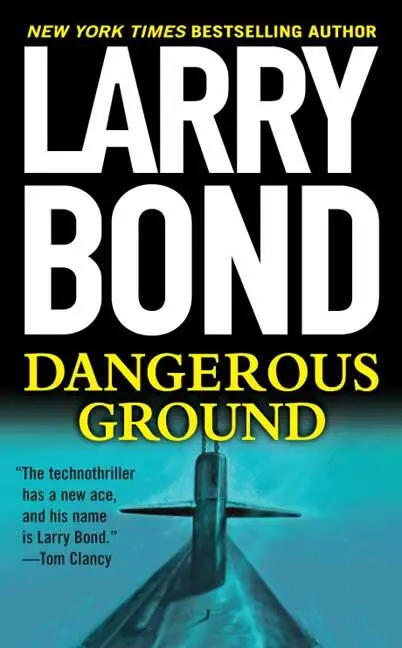
Larry Bond - Dangerous Ground
Здесь есть возможность читать онлайн «Larry Bond - Dangerous Ground» весь текст электронной книги совершенно бесплатно (целиком полную версию без сокращений). В некоторых случаях можно слушать аудио, скачать через торрент в формате fb2 и присутствует краткое содержание. Город: New York, Год выпуска: 2005, ISBN: 2005, Издательство: Forge Books, Жанр: prose_military, thriller_techno, на английском языке. Описание произведения, (предисловие) а так же отзывы посетителей доступны на портале библиотеки ЛибКат.
- Название:Dangerous Ground
- Автор:
- Издательство:Forge Books
- Жанр:
- Год:2005
- Город:New York
- ISBN:978-0765307880
- Рейтинг книги:4 / 5. Голосов: 1
-
Избранное:Добавить в избранное
- Отзывы:
-
Ваша оценка:
Dangerous Ground: краткое содержание, описание и аннотация
Предлагаем к чтению аннотацию, описание, краткое содержание или предисловие (зависит от того, что написал сам автор книги «Dangerous Ground»). Если вы не нашли необходимую информацию о книге — напишите в комментариях, мы постараемся отыскать её.
, a dilapidated submarine that that should have been mothballed decades ago, has been given one last mission by the newly elected president. The task: To sneak illegally into Russia’s coastal waters and recon the leaking nuclear fuel containers hidden on the floor of the Arctic Ocean. More than just an environmental nightmare, this radioactive burial ground houses enough nuclear capability to destroy most of America’s major cities.
The
’s commander, Lowell Hardy, had been looking forward to flag rank and pleasant duty upon the sub’s decommissioning. Now he is trapped in an inconceivably dangerous and illegal mission which could easily end his career, if not his life and the lives of his crew. But it’s the crew who feel Hardy’s tension as he tyrannizes everyone on board to ensure they’ll be ready for anything:
Jerry Mitchell: a former naval pilot with political connections, he is a novice submariner, unprepared for his demanding job as a weapons officer. Central to the
’s mission, Mitchell may be its greatest liability… or its ultimate salvation.
Dr. Joanna Patterson: The senior civilian scientist, appointed by and reporting to the president, she is a world-class expert on nuclear fuel contamination—and every bit as demanding as Hardy. Patterson and her partner, Dr. Emily Davis, soon find themselves battling flaring tempers, faulty machinery, lethal radioactivity, and the raging arctic seas.
The submariners: Seething with rage at their Captain Bligh-like commander and the equally domineering Joanna Patterson, they are also at war with Jerry Mitchell, and one another. Like the captain, they feel they deserve better, not this antiquated relic, not this hostile scientist, not this novice weapons officer, and definitely not this disastrously dangerous mission.
Nor is the mission what it seems. Lurking beneath the frigid, black, radioactive waters is a secret far more deadly than anything naval command could imagine—a secret so menacing the Russian Fleet is hell-bent on destroying the
and all who sail in her.
Dangerous Ground — читать онлайн бесплатно полную книгу (весь текст) целиком
Ниже представлен текст книги, разбитый по страницам. Система сохранения места последней прочитанной страницы, позволяет с удобством читать онлайн бесплатно книгу «Dangerous Ground», без необходимости каждый раз заново искать на чём Вы остановились. Поставьте закладку, и сможете в любой момент перейти на страницу, на которой закончили чтение.
Интервал:
Закладка:
“Dr. Patterson, I went over the crane’s latest inspection results with Lieutenant Mitchell and Senior Chief Foster before we started, and they are within specifications. I then gave them my permission to start loading. If there is a problem, it’s not their fault.”
“I see,” responded Patterson coolly. Then, in a less tense tone, she asked, “Is that crane safe enough to load your equipment?”
“Absolutely,” replied Davis. Without another word, Patterson and Davis rejoined Captain Hardy and his two subordinates.
“Dr. Davis has informed me that this crane is acceptable,” declared Patterson. “But I insist that your people exercise better control of the pallets as they are transferred. Don’t let them swing around so much.”
“As you wish,” responded Hardy. Then, looking at Jerry, he said, “Mr. Mitchell, double the number of guidelines and slow the crane down to keep the pallet’s swing to a minimum.” He looked at Patterson, who still looked unhappy. “And don’t lift the pallet any higher than you have to when you swing it across,” he said, sighing. He looked back again at Patterson, who nodded, still frowning. He walked away quickly.
Patterson also left, leaving Jerry, Foster, Davis, and the others all looking at each other. As little as Jerry knew, he thought the rig had worked fine yesterday. Foster, shaking his head, started barking orders to rig the extra guidelines. They had lost thirty minutes from Patterson’s tiff, but finally resumed bringing the pallets aboard “safely.”
Jerry overheard Seaman Jobin and TM3 Lee talking as they lashed the extra guidelines to the pallet. Troylor Jobin was a Virginia boy and his Southern drawl wrapped around his words like a blanket. “Did you see the way Hardy hopped when she hollered?”
“He certainly didn’t fight her very hard,” Lee agreed.
“All this extra work and time wasted, just on her say-so,” Jobin grumbled. “And we’ve got to put up with that witch for the whole patrol?” He sounded incredulous.
Lee remarked. “I don’t think she’s just a tech rep.”
Jobin nodded agreement. “Bearden says she bragged how she worked for the President. Ah’m thinking she’s calling all the shots.”
Moran walked over, and pretended to check the lashings. “Stow it. Here comes Broomhilda,” he stage-whispered.
Jerry looked over to see Patterson climbing onto the deck. She didn’t bother crossing over to the pier, but seemed to be checking to see if the torpedo gang was following Hardy’s recent orders. When she saw the pallet being rigged with the extra lines, she went back below.
Once she was safely gone, Jobin laughed. “Broomhilda. I like it.”
Hardy, Bair, Richards, and Patterson continued to check on the division’s progress during the day. Jerry took to keeping one eye on the forward escape trunk, or when he was below, on the door to the torpedo room. As soon as Patterson or one of the senior officers approached, he’d intercept them and deliver a quick, cheerful report on how smoothly things were going. The tactic worked about half the time.
Jerry spent the rest of his time dealing with the paperwork and answering Davis’ questions. He also tried to keep track of Foster. While Jerry believed that the Senior Chief would not sabotage the loading operation or the equipment, he wouldn’t pass up a chance to make Jerry look foolish or create a mistake that could be blamed on the officer.
One of the documents Jerry was working with was the Weapon Stowage Record Book. It tallied, by type and serial number, what torpedoes or missiles were stowed where in the torpedo room. He was using it for the mission equipment as well. Jerry had added two of the equipment pallets to the record, but when he went to make an entry for the third, he couldn’t find the book. It was a black three-ring binder and was clearly labeled. He’d parked it on top of the centerline torpedo storage rack, a reasonably flat spot in the middle of the compartment.
He looked around, thinking that it might have been knocked onto the deck, but there was so little deck space in the torpedo room that someone, most likely Jerry, would have tripped over it immediately. He was about to ask for a general search when he stopped himself. He didn’t want to interrupt the loading to look for the record book, and he was sure he’d left it right on top of the console.
Jerry then remembered Foster standing near the aft end of the compartment, away from the loading activity, for several minutes. The senior chief was gone right now. On an impulse, Jerry walked aft and noticed several shadowed crevices among the torpedo racks and other equipment. The third one he checked held the missing notebook.
Jerry had barely retrieved it and begun making his next entry when Foster returned, along with Hardy. Jerry wondered what excuse Foster had used to get the Captain there. A progress report? A question? As he watched Foster, Jerry might have imagined a momentary flash of surprise on the Senior Chief’s face.
Jerry reported their progress to Hardy, who quickly lost interest when he saw that there weren’t any problems. The Senior Chief’s face became a stoic mask. Jerry’s small feeling of triumph was mixed with disappointment at having to waste mental energy on bull like this.
Despite the delays and constant “supervision” by Hardy or Patterson, the torpedomen managed to find their rhythm and the pallets started to come across in a regular fashion. As the support pallets, essentially crates full of supplies, came aboard, they were stowed in spaces normally reserved for torpedoes on the upper centerline rack. Finally the control and display pallet, filled with computers, displays, and power supplies needed to control the ROVs, was lowered into the torpedo room and stored near the Manta control console. The ROVs themselves were placed in the starboard stowage racks along with the winch and maintenance pallets, although putting them in place did not mean they were “installed.” Boxes of cabling and miscellaneous equipment filled corners of the torpedo room. Davis assured Jerry and Foster that the clutter would be gone once everything was hooked up.
Although they’d started at 1330, it was nearly 2000 (eight in the evening) by the time the torpedo division finished bringing the last pallet aboard. By that time, Davis had methodically checked the support pallets and had started on the retrieval winch. Leads had to be run to power the winch, the controls had to be hooked up, and everything had to be tested until it was rock-solid reliable. There were no Radio Shacks where they were going.
Even after the last of the pallets were aboard, the division had a lot of work to do. All the loading gear had to be struck below and stowed. The torpedo loading tray had to be turned back into deck plates, and the weapons shipping hatch closed and inspected. Jerry’s division performed a dozen tasks carefully, using checklists, all under Foster’s careful eye.
They’d broken for dinner, with Lieutenant Washburn, the Supply Officer, checking with Jerry when his men would be able to stop and eat. It was well after the normal mealtime, but Washburn had kept the mess cooks standing by until the torpedo gang could be fed. He’d laid on a good meal for the crew’s last night in port, with roast chicken and mashed potatoes and two kinds of pie for dessert. Jerry was starving by the time they all sat down, and even Emily Davis was ready to stop for a decent meal.
For convenience, they all ate together in the crew’s mess, with Jerry and Davis seated at their own table and the rest of the torpedo division filling two others. Foster sat at the head of the enlisted group.
The men ate quietly, so quietly that Jerry noticed the silence. No grumbling, but no joking either. Jerry was tired and was sure his men were as well, but he wasn’t so exhausted he couldn’t talk. Emily kept up her customary stream of questions, about the boat, the living and eating arrangements for the enlisted men, what the food would be like after they’d been at sea for a month.
Читать дальшеИнтервал:
Закладка:
Похожие книги на «Dangerous Ground»
Представляем Вашему вниманию похожие книги на «Dangerous Ground» списком для выбора. Мы отобрали схожую по названию и смыслу литературу в надежде предоставить читателям больше вариантов отыскать новые, интересные, ещё непрочитанные произведения.











Обсуждение, отзывы о книге «Dangerous Ground» и просто собственные мнения читателей. Оставьте ваши комментарии, напишите, что Вы думаете о произведении, его смысле или главных героях. Укажите что конкретно понравилось, а что нет, и почему Вы так считаете.