John Powys - Atlantis
Здесь есть возможность читать онлайн «John Powys - Atlantis» весь текст электронной книги совершенно бесплатно (целиком полную версию без сокращений). В некоторых случаях можно слушать аудио, скачать через торрент в формате fb2 и присутствует краткое содержание. Год выпуска: 2008, Издательство: Faber Finds, Жанр: Классическая проза, на английском языке. Описание произведения, (предисловие) а так же отзывы посетителей доступны на портале библиотеки ЛибКат.
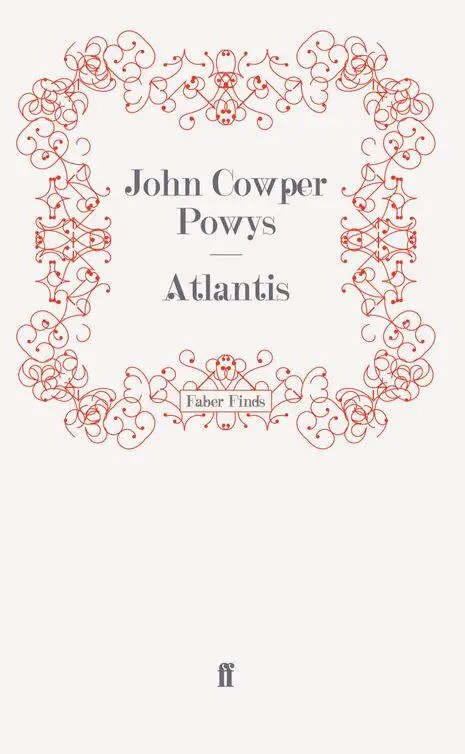
- Название:Atlantis
- Автор:
- Издательство:Faber Finds
- Жанр:
- Год:2008
- ISBN:нет данных
- Рейтинг книги:3 / 5. Голосов: 1
-
Избранное:Добавить в избранное
- Отзывы:
-
Ваша оценка:
Atlantis: краткое содержание, описание и аннотация
Предлагаем к чтению аннотацию, описание, краткое содержание или предисловие (зависит от того, что написал сам автор книги «Atlantis»). Если вы не нашли необходимую информацию о книге — напишите в комментариях, мы постараемся отыскать её.
As usual there is a large cast of human characters but Powys also gives life and speech to inanimates such as a stone pillar, a wooden club,and an olive shoot. The descent to the drowned world of Atlantis towards the end of the novel is memorably described, indeed, Powys himself called it 'the best part of the book'.
Many of Powys's themes, such as the benefits of matriarchy, the wickedness of priests and the evils of modern science which condones vivisection are given full rein in this odd but compelling work.
Atlantis — читать онлайн бесплатно полную книгу (весь текст) целиком
Ниже представлен текст книги, разбитый по страницам. Система сохранения места последней прочитанной страницы, позволяет с удобством читать онлайн бесплатно книгу «Atlantis», без необходимости каждый раз заново искать на чём Вы остановились. Поставьте закладку, и сможете в любой момент перейти на страницу, на которой закончили чтение.
Интервал:
Закладка:
“I’ve heard from some quarter,” he told them all, “that the hundred-armed Monsters, Briareos, Kottos, and Gyes are now swimming about in the sunken cities of Atlantis, feeding upon the innumerable corpses of their drowned populations; and, do you know, the idea has crossed my mind that what the dead Dryad really hoped to bring about was that Typhon should join them down there. But how a fire-breathing creature like Typhon could live under water like those Monsters is as much beyond my comprehension as—”
“As many other things, Master Zeuks!” murmured Okyrhöe with her silvery laugh. And it was during the general amusement that followed this sally that the Fly, having rejoined the Moth in their usual retreat, which was now safely propped up again, implored his lovely friend to listen intently. “For,” said he, “the Pillar is now telling the club what is happening down there.”
“You mean down in Atlantis?” enquired the Moth.
“Certainly I do,” replied the Fly. “For you mustn’t be so absurdly man-loving as to think that because the human population of a continent is drowned with that continent, nothing interesting can go on down there any more. There are the fish, my pretty one, there are the fish. Do try to realize that life doesn’t end, Pyraust darling, when the human race ends. There are philosophers in the world — I won’t at this moment emphasize their names or their species — who hold the view that it will only be when the tribes of mortal men are sunk into complete oblivion that the real drama of the Cosmos will properly begin.”
“But,” whispered the Moth anxiously, “and forgive my stupidity if this is a silly question, what I cannot see is how this drama of the future will be recorded if there’s nobody to record it.”
“Unrecorded things are as important as recorded things,” said the Fly.
“But who hears of them?” commented the Moth sadly.
CHAPTER VIII
“How many are they?”
“How many of what, my beautiful one? Are you speaking of sea-gulls or crows?”
“People of course!” answered the Moth irritably. “Did you think I meant flies?”
“You’d have to count me out if you did,” replied her friend grimly. “For I don’t, and I believe it is a peculiarity shared by most of my species, at any rate those of the male sex, at all like being included in any plural category. Yes, indeed, my lovely one, I believe you’ll find, as your experience thickens and your years increase, that you’ll seldom meet a male who isn’t at heart, though under various circumstances he may not appear so, an ingrained individualist. When I was younger I used to flirt with the wanton notion that to be really ourselves we had to move about in circles. I also played with the spiritual thought, as I understand they call it, that only when there are two or three of us the wind can be cozened and coaxed and cajoled to carry us to particular places, to certain river-banks, for instance, and to certain ponds full of special sorts of rushes, where we can find those extra delicate morsels of refreshment which our exacting senses crave.
“But after all the horrors I’ve seen, and after all the dangers from which I’ve been saved only by my constant and obsequious flattery of the goddess of Chance, I have learnt the supreme lesson of my life, that there is only one thing upon which a Fly can depend, namely himself.”
“Do look what a lot of people there are! There must be more than a thousand! A thousand warriors who are skilled with the spear, not counting women and children!”
It was clear to the fly that his emotional friend was so hopelessly impressed by the number of the listeners that no appeal to reason was possible. So, giving it up, he confined himself to gazing out of the club’s “life-crack” at that awe-inspired mass of islanders and to endeavouring to follow the words of the orator. This shepherd of the people was none other than Nisos’ Father, Krateros Naubolides, who, mounted on an extremely old-fashioned and extremely shaky platform that had been erected by democratic settlers in Ithaca some sixty odd years ago, with the glittering marble Temple of Athene to its West and the deep blue water of the bay to its East, was explaining in a rough homely directness of speech, whose lack of intellectual subtlety and manifest honesty of feeling made his argument formidable, how bad for them it would be to use up all their precious sail-cloth, this divine “othonia” that took such expense to grow, such trouble to weave, and such art to prepare, for the ill-advised and indeed the absolutely crazy purpose of seeing off their aged and infirm king, in times when all experienced rulers were needed at home, on a wild fantastic voyage of his own eccentric fancy.
“It is our King’s actual presence,” Krateros bluntly and crudely shouted, “that we need at this juncture of our Island’s life, not some fabulous glory from a mad adventure undertaken in a demented old warrior’s last days!”
It was clear to the attentive fly that these rough and rude words uttered by a farmer, whose local breed was a good deal more purely local and insular than was that of Odysseus, was making a deep impression upon those among the islanders, both men and women, who were near enough to hear him; for they kept turning their heads to look at one another, and a considerable number of them actually clashed their brazen-pointed spears together in more than ordinary agreement.
Indeed the speaker himself, as the fly could catch in the tone of his voice, took it to be an indication that they were prepared, if this doting old hero went on insisting on his mad scheme, to rise in arms and dethrone both him and his philosophy-besotted son in favour of the more sensible if more insular stock of the House of Naubolides itself.
It was evident to Pontopereia that Odysseus was watching the assembly with inexhaustible attention, and was making, the girl decided, some special calculation with regard, not only to numbers and weapons, but to the quality and significance of the various farming families who were gathered here today, even if some were only represented by a male spearman whose relatives were all on the mainland. He had not dared to change the place of meeting and the girl could clearly see what were the chief impediments to this sort of democratic assembly in an “agora” that was at once old-fashioned in an unseemly, ramshackle, slovenly way, and modernistic in a cold, remote, indifferent way. For one thing, she noticed that however forcibly Odysseus had just now pressed his demand upon them for contributions of sail-cloth as if he were exacting the payment of tribute, it was only those quite near who could catch what he meant because of the purer language he used.
She noticed too that although Krateros Naubolides made himself heard, the agitation he created by the rough boldness of his rejection of the old king’s claim was so great that little groups of men from nearby positions kept hurrying to further-off vantage-grounds where they would ardently enlarge on what had been said.
No sooner had the Father of our young friend Nisos Naubolides swung himself down from the platform of his Ithacan “agora”, an erection that was really much too high to be a suitable speaking-place, than there ensued a rushing to and fro that made of the whole assembly a confusing if not a confounding hubbub of human bodies and human voices.
When “Government by Discussion”, as you might call the flexible and casual manner in which the Ithacan natives had settled their affairs half a century ago, was working well, the population of the island was much smaller, and the half-circle of stone-seats for listeners had a much less extended circumference.
The result of this increase in numbers was that many of the most eloquent speakers took care to avoid the grotesquely elevated wooden erection on the speaking-rock and made their speeches from the ground, which meant that they often had to stand a good deal too near their antagonists, who frequently were a closely-packed crowd of angry and excited spearmen.
Читать дальшеИнтервал:
Закладка:
Похожие книги на «Atlantis»
Представляем Вашему вниманию похожие книги на «Atlantis» списком для выбора. Мы отобрали схожую по названию и смыслу литературу в надежде предоставить читателям больше вариантов отыскать новые, интересные, ещё непрочитанные произведения.






Обсуждение, отзывы о книге «Atlantis» и просто собственные мнения читателей. Оставьте ваши комментарии, напишите, что Вы думаете о произведении, его смысле или главных героях. Укажите что конкретно понравилось, а что нет, и почему Вы так считаете.