Роберт Чамберс - The Hidden Children
Здесь есть возможность читать онлайн «Роберт Чамберс - The Hidden Children» весь текст электронной книги совершенно бесплатно (целиком полную версию без сокращений). В некоторых случаях можно слушать аудио, скачать через торрент в формате fb2 и присутствует краткое содержание. Год выпуска: 2015, Издательство: epubBooks Classics, Жанр: Классическая проза, на английском языке. Описание произведения, (предисловие) а так же отзывы посетителей доступны на портале библиотеки ЛибКат.
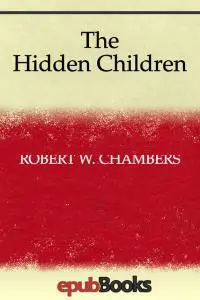
- Название:The Hidden Children
- Автор:
- Издательство:epubBooks Classics
- Жанр:
- Год:2015
- ISBN:нет данных
- Рейтинг книги:3 / 5. Голосов: 1
-
Избранное:Добавить в избранное
- Отзывы:
-
Ваша оценка:
The Hidden Children: краткое содержание, описание и аннотация
Предлагаем к чтению аннотацию, описание, краткое содержание или предисловие (зависит от того, что написал сам автор книги «The Hidden Children»). Если вы не нашли необходимую информацию о книге — напишите в комментариях, мы постараемся отыскать её.
The Hidden Children — читать онлайн бесплатно полную книгу (весь текст) целиком
Ниже представлен текст книги, разбитый по страницам. Система сохранения места последней прочитанной страницы, позволяет с удобством читать онлайн бесплатно книгу «The Hidden Children», без необходимости каждый раз заново искать на чём Вы остановились. Поставьте закладку, и сможете в любой момент перейти на страницу, на которой закончили чтение.
Интервал:
Закладка:
Firing instantly broke out as we entered the smoky zone where the houses were burning. Into it, an our left, galloped Sheldon's light dragoons, who, having but five muskets in the command, went at the Yagers with naked sabres; and suddenly found themselves in touch with the entire Legion cavalry, who set up a Loud bawling:
"Surrender, you damned rebels! Pull up, there! Halt!"
I saw a trooper, one Jared Hoyt, split the skull of a pursuing British dragoon straight across the mouth with a back–handed stroke, as he escaped from the melee; and another, one John Buckhout, duck his head as a dragoon fired at him, and, still ducking and loudly cursing the fellow, rejoin us as we sheered off from the masses of red–jacketed riders, wheeled, and went at the mounted Yagers, who did not stand our charge.
There was much smoke, and the thick, suffocating gloom was lighted only by streaming sparks, so that in the confusion and explosion of muskets it was difficult to manoeuvre successfully and at the same time keep clear of Tarleton's overwhelming main body.
This body was now in full but orderly retreat, driving with it cattle, horses, and some two dozen prisoners, mostly peaceable inhabitants who had taken no part in the affair. Also, they had a wagon piled with the helmets, weapons, and accoutrements of Sheldon's dead riders; and one of their Hussars bore Sheldon's captured standard in his stirrup.
To charge this mass of men was not possible with the two score horsemen left us; and they retreated faster than our militia and Continentals could travel. So all we could do was to hang on their rear and let drive at them from our saddles.
As far as we rode with them, we saw a dozen of their riders fall either dead or wounded from their horses, and saw their comrades lift them into one of the wagons. Also we saw our dragoons and militia take three prisoners and three horses before we finally turned bridle after our last long shot at their rear guard.
For our business here lay not in this affair, and Boyd had disobeyed his orders in not avoiding all fighting. He knew well enough that the bullets from our three rifles were of little consequence to our country compared to the safe accomplishment of our mission hither, and our safe return with the Siwanois. Fortune had connived at our disobedience, for no one of us bore so much as a scratch, though all three of us might very easily have been done to death in the mad flight from the Meeting House, amid that plunging hell of horsemen.
Fortune, too, hung to our stirrup leathers as we trotted into Poundridge, for, among a throng of village folk who stood gazing at the smoking ashes of the Lockwood house, we saw our Siwanois standing, tall, impassive, wrapped in his blanket.
And late that afternoon we rode out of the half–ruined village, northward. Our saddle–bags were full; our animals rested; and, beside us, strode the Sagamore, fully armed and accoutred, lock braided, body oiled and painted for war—truly a terrific shape in the falling dusk.
On the naked breast of this Mohican warrior of the Siwanois clan, which is called by the Delawares "The Clan of the Magic Wolf," outlined in scarlet, I saw the emblem of his own international clan—as I supposed—a bear.
And of a sudden, within me, vaguely, something stirred—some faint memory, as though I had once before beheld that symbol on a dark and naked breast, outlined in scarlet. Where had I seen it before? At Guy Park? At Johnson Hall? Fort Johnson? Butlersbury? Somewhere I had seen that symbol, and in that same paint. Yes, it might easily have been. Every nation of the Confederacy possessed a clan that wore the bear. And yet—and yet—this bear seemed somehow different—and yet familiar—strangely familiar to me—but in a manner which awoke within me an unrest as subtle as it was curious.
I drew bridle, and as the Sagamore came up, I said uneasily:
"Brother, and ensign of the great bear clan of many nations, why is the symbol that you wear familiar to me—and yet so strangely unfamiliar?"
He shot a glance of lightning intelligence at me, then instantly his features became smoothly composed and blank again.
"Has my brother never before seen the Spirit Bear?" he asked coldly.
"Is that a clan, Mayaro?"
"Among the Siwanois only." "That is strange," I muttered. "I have never before seen a Siwanois. Where could I have seen a Siwanois? Where?"
But he only shook his head.
Boyd and Mount had pricked forward; I still lingered by the Mohican. And presently I said:
"That was a brave little maid who bore our message to you."
He made no answer.
"I have been wondering," I continued carelessly, "whether she has no friends—so poor she seems—so sad and friendless, Have you any knowledge of her?"
The Indian glanced at me warily, "My brother Loskiel should ask these questions of the maid herself."
"But I shall never see her again, Sagamore. How can I ask her, then?"
The Indian remained silent. And, perhaps because I vaguely entertained some future hope of loosening his tongue in her regard, I now said nothing more concerning her, deeming that best. But I was still thinking of her as I rode northward through the deepening dusk.
A great weariness possessed me, no doubt fatigue from the day's excitement and anxiety. Also, for some hours, that curious battle–hunger had been gnawing at my belly so that I had liked to starve there in my saddle ere Boyd gave the signal to off–saddle for the night.
Chapter IV
A Tryst
Above the White Plains the territory was supposed to be our own. Below, seventeen thousand red–coats held the city of New York; and their partisans, irregulars, militia, refugee–corps, and Legion–horsemen, harried the lines. Yet, except the enemy's cruisers which sometimes strayed far up the Hudson, like impudent hawks circling within the very home–yard, we saw nothing of red–rag or leather–cap north of our lines, save only once, when Lieutenant–Colonel Simcoe nearly caught us.
His Excellency's army lay in position all around us, now, from West Point down the river; and our light–horsemen patrolled as far south as the unhappy country from which we had retired through the smoke of Bedford's burning farms and the blaze of church and manor at Poundridge. That hilly strip was then our southern frontier, bravely defended by Thomas and Lockwood, shamefully neglected by Sheldon, as we had seen. For which he was broke, poor devil, and a better man set there to watch the red fox Tarleton, to harry Emmeriek, and to throw the fear o' God into that headlong blockhead, Simcoe, a brave man, but so possessed by hatred for "Mr." Washington that every move he made was like a goaded bull—his halts merely the bewilderment of baffled fury, his charges blind and bellowing.
I know how he conducted, not from hearsay alone, but because at sunrise on our second day northward, before we struck the river–road, we had like to have had a brush with him, his flankers running afoul of us not far beyond a fortified post heavily held by our Continentals.
It was the glimpse of cannon and levelled bayonets that bewildered him; and his bawling charge sheered wide o' the shabby Continental battle–line, through which we galloped into safety, our Indian sticking to my crupper like a tree–cat with every claw. And I remember still the grim laughter that greeted us from those unshaven, powder–blackened ranks, and how they laughed, too, as they fired by platoons at the far glimmer of Simcoe's helmets through the chestnut trees.
And in the meantime, all the while, even from the very first evening when we off–saddled in the rocky Westchester woods and made our first flying–camp, I had become uneasy concerning the Siwanois—uncertain concerning his loyalty to the very verge of suspicion.
Читать дальшеИнтервал:
Закладка:
Похожие книги на «The Hidden Children»
Представляем Вашему вниманию похожие книги на «The Hidden Children» списком для выбора. Мы отобрали схожую по названию и смыслу литературу в надежде предоставить читателям больше вариантов отыскать новые, интересные, ещё непрочитанные произведения.






Обсуждение, отзывы о книге «The Hidden Children» и просто собственные мнения читателей. Оставьте ваши комментарии, напишите, что Вы думаете о произведении, его смысле или главных героях. Укажите что конкретно понравилось, а что нет, и почему Вы так считаете.