Edward Morgan Forster - Howards End
Здесь есть возможность читать онлайн «Edward Morgan Forster - Howards End» весь текст электронной книги совершенно бесплатно (целиком полную версию без сокращений). В некоторых случаях можно слушать аудио, скачать через торрент в формате fb2 и присутствует краткое содержание. Жанр: Классическая проза, на английском языке. Описание произведения, (предисловие) а так же отзывы посетителей доступны на портале библиотеки ЛибКат.
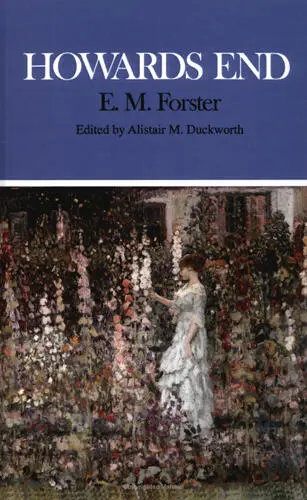
- Название:Howards End
- Автор:
- Жанр:
- Год:неизвестен
- ISBN:нет данных
- Рейтинг книги:3 / 5. Голосов: 1
-
Избранное:Добавить в избранное
- Отзывы:
-
Ваша оценка:
Howards End: краткое содержание, описание и аннотация
Предлагаем к чтению аннотацию, описание, краткое содержание или предисловие (зависит от того, что написал сам автор книги «Howards End»). Если вы не нашли необходимую информацию о книге — напишите в комментариях, мы постараемся отыскать её.
Howards End — читать онлайн бесплатно полную книгу (весь текст) целиком
Ниже представлен текст книги, разбитый по страницам. Система сохранения места последней прочитанной страницы, позволяет с удобством читать онлайн бесплатно книгу «Howards End», без необходимости каждый раз заново искать на чём Вы остановились. Поставьте закладку, и сможете в любой момент перейти на страницу, на которой закончили чтение.
Интервал:
Закладка:
"One can but see," he remarked, adding, "as Ibsen says, 'things happen.'" He was itching to talk about books and make the most of his romantic hour. Minute after minute slipped away, while the ladies, with imperfect skill, discussed the subject of reinsurance or praised their anonymous friend. Leonard grew annoyed—perhaps rightly. He made vague remarks about not being one of those who minded their affairs being talked over by others, but they did not take the hint. Men might have shown more tact. Women, however tactful elsewhere, are heavy-handed here. They cannot see why we should shroud our incomes and our prospects in a veil. "How much exactly have you, and how much do you expect to have next June?" And these were women with a theory, who held that reticence about money matters is absurd, and that life would be truer if each would state the exact size of the golden island upon which he stands, the exact stretch of warp over which he throws the woof that is not money. How can we do justice to the pattern otherwise?
And the precious minutes slipped away, and Jacky and squalor came nearer. At last he could bear it no longer, and broke in, reciting the names of books feverishly. There was a moment of piercing joy when Margaret said, "So you like Carlyle," and then the door opened, and "Mr. Wilcox, Miss Wilcox" entered, preceded by two prancing puppies.
"Oh, the dears! Oh, Evie, how too impossibly sweet!" screamed Helen, falling on her hands and knees.
"We brought the little fellows round," said Mr. Wilcox.
"I bred 'em myself."
"Oh, really! Mr. Bast, come and play with puppies."
"I've got to be going now," said Leonard sourly.
"But play with puppies a little first."
"This is Ahab, that's Jezebel," said Evie, who was one of those who name animals after the less successful characters of Old Testament history.
"I've got to be going."
Helen was too much occupied with puppies to notice him.
"Mr. Wilcox, Mr. Ba—Must you be really? Good-bye!"
"Come again," said Helen from the floor.
Then Leonard's gorge arose. Why should he come again? What was the good of it? He said roundly: "No, I shan't; I knew it would be a failure."
Most people would have let him go. "A little mistake. We tried knowing another class—impossible." But the Schlegels had never played with life. They had attempted friendship, and they would take the consequences. Helen retorted, "I call that a very rude remark. What do you want to turn on me like that for?" and suddenly the drawing-room re-echoed to a vulgar row.
"You ask me why I turn on you?"
"Yes."
"What do you want to have me here for?"
"To help you, you silly boy!" cried Helen. "And don't shout."
"I don't want your patronage. I don't want your tea. I was quite happy. What do you want to unsettle me for?" He turned to Mr. Wilcox. "I put it to this gentleman. I ask you, sir, am to have my brain picked?"
Mr. Wilcox turned to Margaret with the air of humorous strength that he could so well command. "Are we intruding, Miss Schlegel? Can we be of any use or shall we go?"
But Margaret ignored him.
"I'm connected with a leading insurance company, sir. I receive what I take to be an invitation from these—ladies" (he drawled the word). "I come, and it's to have my brain picked. I ask you, is it fair?"
"Highly unfair," said Mr. Wilcox, drawing a gasp from Evie, who knew that her father was becoming dangerous.
"There, you hear that? Most unfair, the gentleman says. There! Not content with"—pointing at Margaret—"you can't deny it." His voice rose: he was falling into the rhythm of a scene with Jacky. "But as soon as I'm useful it's a very different thing. 'Oh yes, send for him. Cross-question him. Pick his brains.' Oh yes. Now, take me on the whole, I'm a quiet fellow: I'm law-abiding, I don't wish any unpleasantness; but I—I—"
"You," said Margaret—"you—you—"
Laughter from Evie, as at a repartee.
"You are the man who tried to walk by the Pole Star."
More laughter.
"You saw the sunrise."
Laughter.
"You tried to get away from the fogs that are stifling us all—away past books and houses to the truth. You were looking for a real home. "
"I fail to see the connection," said Leonard, hot with stupid anger.
"So do I." There was a pause. "You were that last Sunday—you are this today. Mr. Bast! I and my sister have talked you over. We wanted to help you; we also supposed you might help us. We did not have you here out of charity—which bores us—but because we hoped there would be a connection between last Sunday and other days. What is the good of your stars and trees, your sunrise and the wind, if they do not enter into our daily lives? They have never entered into mine, but into yours, we thought—Haven't we all to struggle against life's daily greyness, against pettiness, against mechanical cheerfulness, against suspicion? I struggle by remembering my friends; others I have known by remembering some place—some beloved place or tree—we thought you one of these."
"Of course, if there's been any misunderstanding," mumbled Leonard, "all I can do is to go. But I beg to state—" He paused. Ahab and Jezebel danced at his boots and made him look ridiculous. "You were picking my brain for official information—I can prove it—I—He blew his nose and left them.
"Can I help you now?" said Mr. Wilcox, turning to Margaret. "May I have one quiet word with him in the hall?"
"Helen, go after him—do anything— anything —to make the noodle understand."
Helen hesitated.
"But really—" said their visitor. "Ought she to?"
At once she went.
He resumed. "I would have chimed in, but I felt that you could polish him off for yourselves—I didn't interfere. You were splendid, Miss Schlegel—absolutely splendid. You can take my word for it, but there are very few women who could have managed him."
"Oh yes," said Margaret distractedly.
"Bowling him over with those long sentences was what fetched me," cried Evie.
"Yes, indeed," chuckled her father; "all that part about 'mechanical cheerfulness'—oh, fine!"
"I'm very sorry," said Margaret, collecting herself. "He's a nice creature really. I cannot think what set him off. It has been most unpleasant for you."
"Oh, I didn't mind." Then he changed his mood. He asked if he might speak as an old friend, and, permission given, said: "Oughtn't you really to be more careful?"
Margaret laughed, though her thoughts still strayed after Helen. "Do you realize that it's all your fault?" she said. "You're responsible."
"I?"
"This is the young man whom we were to warn against the Porphyrion. We warn him, and—look!"
Mr. Wilcox was annoyed. "I hardly consider that a fair deduction," he said.
"Obviously unfair," said Margaret. "I was only thinking how tangled things are. It's our fault mostly—neither yours nor his."
"Not his?"
"No."
"Miss Schlegel, you are too kind."
"Yes, indeed," nodded Evie, a little contemptuously.
"You behave much too well to people, and then they impose on you. I know the world and that type of man, and as soon as I entered the room I saw you had not been treating him properly. You must keep that type at a distance. Otherwise they forget themselves. Sad, but true. They aren't our sort, and one must face the fact."
"Ye-es."
"Do admit that we should never have had the outburst if he was a gentleman."
"I admit it willingly," said Margaret, who was pacing up and down the room. "A gentleman would have kept his suspicions to himself."
Mr. Wilcox watched her with a vague uneasiness.
"What did he suspect you of?"
"Of wanting to make money out of him."
"Intolerable brute! But how were you to benefit?"
Читать дальшеИнтервал:
Закладка:
Похожие книги на «Howards End»
Представляем Вашему вниманию похожие книги на «Howards End» списком для выбора. Мы отобрали схожую по названию и смыслу литературу в надежде предоставить читателям больше вариантов отыскать новые, интересные, ещё непрочитанные произведения.




Обсуждение, отзывы о книге «Howards End» и просто собственные мнения читателей. Оставьте ваши комментарии, напишите, что Вы думаете о произведении, его смысле или главных героях. Укажите что конкретно понравилось, а что нет, и почему Вы так считаете.