John Steinbeck - Sweet Thursday
Здесь есть возможность читать онлайн «John Steinbeck - Sweet Thursday» весь текст электронной книги совершенно бесплатно (целиком полную версию без сокращений). В некоторых случаях можно слушать аудио, скачать через торрент в формате fb2 и присутствует краткое содержание. Год выпуска: 2008, ISBN: 2008, Издательство: Penguin Classics, Жанр: Классическая проза, на английском языке. Описание произведения, (предисловие) а так же отзывы посетителей доступны на портале библиотеки ЛибКат.
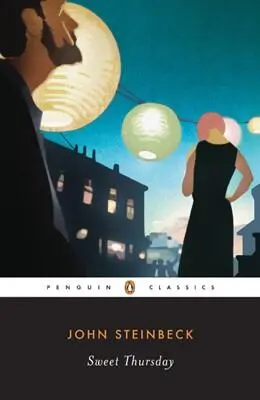
- Название:Sweet Thursday
- Автор:
- Издательство:Penguin Classics
- Жанр:
- Год:2008
- ISBN:1-4362-4126-X
- Рейтинг книги:5 / 5. Голосов: 1
-
Избранное:Добавить в избранное
- Отзывы:
-
Ваша оценка:
Sweet Thursday: краткое содержание, описание и аннотация
Предлагаем к чтению аннотацию, описание, краткое содержание или предисловие (зависит от того, что написал сам автор книги «Sweet Thursday»). Если вы не нашли необходимую информацию о книге — напишите в комментариях, мы постараемся отыскать её.
Cannery Row
Sweet Thursday — читать онлайн бесплатно полную книгу (весь текст) целиком
Ниже представлен текст книги, разбитый по страницам. Система сохранения места последней прочитанной страницы, позволяет с удобством читать онлайн бесплатно книгу «Sweet Thursday», без необходимости каждый раз заново искать на чём Вы остановились. Поставьте закладку, и сможете в любой момент перейти на страницу, на которой закончили чтение.
Интервал:
Закладка:
Hazel fought down panic, and then he remembered his Fate—a sacrifice to Washington where he would have to eat oysters. “All right, Mack,” he said softly. “I’ll have to do her myself.”
He turned and walked out of the door with quiet dignity.
Mack rolled up on one elbow. “Did you hear what that crazy bastard said? Oh, what the hell! Can’t do no worse than I done. Mother, make my bed soon, for I’m sick to the death and I fain would lie down.”
“You’re already down,” said Whitey No. 2.
31
The Thorny Path of Greatness
When people change direction it is a rare one who does not spend the first half of his journey looking back over his shoulder. Hazel had chosen, or had been forced to choose, a new path. He had said, “I’ll have to do her myself.” It had seemed easy. But, sitting under the sheltering branches of the black cypress tree, he had to admit he didn’t know who or what in the hell “she” was. He thought with longing of the old time when he was a dope, when he was cared for and thought for and loved. He had paid off, of course, by accepting ridicule, but it had been a lovely time, a warm time.
Doc had said long ago, “I like to have you sit with me, Hazel. You are the well—the original well. A man can give you his deepest secrets. You don’t hear or remember. And if you did, it wouldn’t make any difference because you don’t pay attention. Why, you’re better than a well because you listen—but you don’t hear. You are a priest without penalties, an analyst without diagnosis.”
Those were the good days before Hazel’s responsibility. But responsibility required judgment, the choosing between courses, and what was that but thought? Hazel undertook thought, but he did it secretly. No one knew. He was a little ashamed of it. In the sweet old days he would have sat down under the black cypress and then he would have reclined with his head on his arm and in less than a minute he would have been asleep. The new Hazel clasped his knees with his arms and mourned into the future. His mind climbed and slipped like an ant in the treacherous crater of an ant lion’s trap. He must plan, he must judge, he must choose. No sleep came. He didn’t even itch. He had to do her. But what was she? He never knew how his solution came to him. He dropped off to sleep, forehead on knees, then suddenly his muscles leaped as though under a blow. He had a sense of falling—and there was his course laid out before him. It wasn’t an honorable course, but it was the only one he had. It almost amounted to treachery.
You will remember that it was Hazel’s pleasant social custom to ask questions but not to listen to the answers. People expected that, depended on it. Suppose, he thought, I was to ask and then listen but not let on I’m listening. It was sneaky, but the intention was clean and the end infinitely to be desired.
He would not only listen, he would remember, and he would put all the answers together. Maybe then he would be able to think her and do her. One question would be enough, he thought. Maybe two.
Hazel was weary from his effort. He reclined, put his head on his arm, and slept the good sleep of work well done.
32
Hazel’s Quest
Joe Elegant came cautiously back from his journey ready to take another one at a moment’s notice. He expected reprisals for Hazel’s costume, and there were no reprisals. In gratitude he made popovers at the Bear Flag three evenings in a row—and the girls didn’t even know what they were eating. He wanted to know what had happened but he was afraid to ask. Thus Joe Elegant was glad when Hazel called on him in his little lean-to in the rear of the Bear Flag.
“Sit here,” he said. “I’ll get you a piece of cake.”
While he was gone Hazel regarded the works of Henri the artist on the wall—one from the chicken-feather period and one from the later nutshell time. And he looked at the card table on which Joe Elegant worked at a portable typewriter. There was a neat pile of manuscript on the table, green paper typed with a green ribbon. A sheet of paper was in the machine. It began: “My dear Anthony West, [113] “My dear Anthony West…”: Steinbeck’s satire of Joe Elegant as a novelist continues here in this dig at Anthony West. The British author (1914–87)—novelist, essayist, biographer—published “California Moonshine,” an unflattering review of Steinbeck’s East of Eden, in the September 20, 1952, issue of the New Yorker: “Mr. Steinbeck has written the precise equivalent of those nineteenth-century melodramas in which the villains could always be recognized because they waxed their mustaches and in which the conflict between good and evil operated like a well-run series of professional tennis matches” (p. 125). In a letter to Carlton Sheffield on October 15, 1952, in Steinbeck: A Life in Letters (1975), Steinbeck registered his dismay: “I am interested in Anthony West’s review in the New Yorker [ sic ]. I wonder what made him so angry—and it was a very angry piece. I should like to meet him to find out why he hated and feared this book so much” (p. 458). Clearly, Steinbeck had the last word.
It was sweet of you—”
Joe came back with a wedge of cake and a glass of milk for Hazel, and while Hazel munched and drank, Joe’s large damp eyes bracketed him but never hit him.
“How’d it go?” he asked.
“What?”
“Why, your costume?”
“Fine, fine. Everybody was real surprised.”
“I’ll bet they were. Did Mack say anything?”
“He said I done fine. He almost cried.”
Joe Elegant smiled with quiet malice.
Hazel asked vacuously, “Say, what would you think was the matter with Doc?”
Joe crossed his legs professionally and his fingers rippled through the green-typed green pages. “It’s the whole and the part and the part is the whole,” he said.
“Come again?”
“It’s many things and one thing. Doc’s libido is driving him one way and his conscience is pulling him another. His myth is the sea, the wind, and the tide, and he relates to it by collecting animals. He carries his treasures to his laboratory. He wants to hide them and perhaps to place the dragon Fafnir [114] Fafnir: In German composer Richard Wagner’s Norse-inspired epic of four linked operas, Der Ring das Nibelungen (its first complete production took place in 1876), Fafnir, a giant transformed into a dragon, guards the golden treasure.
on guard.”
Hazel nearly said, “He sells them,” but that would have given him away as listening. “I knew a dame named Fafnir,” he said. “Bertha Fafnir. Third grade. Used to do pitchers of turkeys on the blackboard Thanksgiving. Had starched underskirts, they rustled kind of.”
Joe Elegant scowled faintly at the interruption. “Distill the myth and you get the symbol,” he went on. “The symbol is the paper he wants to write, but that in itself has impurities, needs distillation. Why? Because it is a substitute, that’s why. His symbol is false. That’s why he can’t write his paper. Frustration! He has taken the wrong path. And so he brings in false solutions. ‘I need a microscope,’ he says. ‘I need to go to La Jolla for the spring tides.’ He will not go to La Jolla. He will never write his paper.”
“Why not?”
“Wrong symbol. We must go back to the myth, the sea. The sea is his mother. His mother is dead but she is living. He is carrying treasures from his mother’s womb and trying to save them. Do you understand?”
“Sure,” said Hazel listlessly.
“He needs love. He needs understanding,” said Joe Elegant.
“Who don’t?” Hazel asked.
“I feel that I could help him if he would let me.”
Читать дальшеИнтервал:
Закладка:
Похожие книги на «Sweet Thursday»
Представляем Вашему вниманию похожие книги на «Sweet Thursday» списком для выбора. Мы отобрали схожую по названию и смыслу литературу в надежде предоставить читателям больше вариантов отыскать новые, интересные, ещё непрочитанные произведения.






Обсуждение, отзывы о книге «Sweet Thursday» и просто собственные мнения читателей. Оставьте ваши комментарии, напишите, что Вы думаете о произведении, его смысле или главных героях. Укажите что конкретно понравилось, а что нет, и почему Вы так считаете.