John Steinbeck - Sweet Thursday
Здесь есть возможность читать онлайн «John Steinbeck - Sweet Thursday» весь текст электронной книги совершенно бесплатно (целиком полную версию без сокращений). В некоторых случаях можно слушать аудио, скачать через торрент в формате fb2 и присутствует краткое содержание. Год выпуска: 2008, ISBN: 2008, Издательство: Penguin Classics, Жанр: Классическая проза, на английском языке. Описание произведения, (предисловие) а так же отзывы посетителей доступны на портале библиотеки ЛибКат.
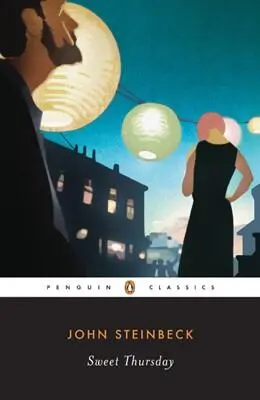
- Название:Sweet Thursday
- Автор:
- Издательство:Penguin Classics
- Жанр:
- Год:2008
- ISBN:1-4362-4126-X
- Рейтинг книги:5 / 5. Голосов: 1
-
Избранное:Добавить в избранное
- Отзывы:
-
Ваша оценка:
Sweet Thursday: краткое содержание, описание и аннотация
Предлагаем к чтению аннотацию, описание, краткое содержание или предисловие (зависит от того, что написал сам автор книги «Sweet Thursday»). Если вы не нашли необходимую информацию о книге — напишите в комментариях, мы постараемся отыскать её.
Cannery Row
Sweet Thursday — читать онлайн бесплатно полную книгу (весь текст) целиком
Ниже представлен текст книги, разбитый по страницам. Система сохранения места последней прочитанной страницы, позволяет с удобством читать онлайн бесплатно книгу «Sweet Thursday», без необходимости каждый раз заново искать на чём Вы остановились. Поставьте закладку, и сможете в любой момент перейти на страницу, на которой закончили чтение.
Интервал:
Закладка:
Doc sat down to wait for the poison to act. He sensed that there was something wrong. What could it be? Had he forgotten something? He felt all right, the small hangover of the morning was gone. Of course! It was the case of Bohemia beer over at the Patrón’s. His subconscious must have been reminding him of the beer. He looked out the window toward the grocery. And there was something wrong with that too. And finally he saw. His windows were clean. He turned and looked around the laboratory. The records were piled neatly on the shelves, not falling all over themselves. The floor was shining, and that smell—that was soap.
He moved to the kitchen. His dishes were clean, the pans scoured and shining. A delicious odor came from a pot on the gas stove. He lifted the lid. Brown meat juice bubbled up through carrots and onions, and a stick of white celery swam like a fish.
Doc went back to his table and sat down. His cot was made up and smooth and the turned-down sheet was clean. Suddenly a sense of desolation came over him—a great sadness that was like warmth. The toes of his lined-up shoes peeked out at him from under the bed.
The poor kid, he thought. Oh, the poor damn kid! I wonder if she’s trying to repay—I hope I haven’t done anything bad. My God, I hope she didn’t misunderstand anything! What did I say? I know I didn’t do anything, but what did I say? I wouldn’t hurt Suzy for the world. He glanced around again. She sure does a job of cleaning, he thought. The stew smells wonderful too. He poured a little more fresh water into the glass dish. The arms of the brittlestars were arranging themselves in small spirals. They hardly moved when the fresh poison was introduced.
The clean laboratory made Doc nervous and apprehensive. And there was something missing from himself, something lost. The lowest voice of all was still. In his black depths he was somehow comforted. He went to the record shelf: not Bach…no, not Buxtehude…not Palestrina [90] Buxtehude…Palestrina: Dietrich Buxtehude (ca. 1637–1707) was a German-Danish organist and a highly regarded composer of the Baroque period. Giovanni Pierluigi da Palestrina (ca. 1525–94) was an influential Italian composer of Renaissance music.
either. His hand strayed to an album not used in a long time. He had opened it before he knew what he was doing. And then he smiled and put the first record on the turntable: Mozart’s Don Giovanni. [91] Mozart’s Don Giovanni: Opera in two acts, based on the legend of Don Juan, with music by Wolfgang Amadeus Mozart (1756–91), and libretto in Italian by Lorenzo Da Ponte (1749–1838), first performed in Prague on October 29, 1787. At the opera’s end, Don Giovanni, unrepentant seducer, is visited by the ghost of a man he has murdered, and is offered the opportunity to save his soul. When he refuses, he is dragged to hell while he is still alive. The concluding chorus delivers the opera’s moral: “Thus do the wicked find their end, dying as they had lived.”
It started its overture, and Doc, still smiling, went to the kitchen and stirred the stew. “Don Giovanni,” he said. “Is that what I think of myself? No! I do not. But why do I feel so good, and so bad?” He looked at his desk. The yellow pads were piled neatly and the pencils were sharpened. “I believe I’ll try.” And at that point there were fumbling steps on his porch and Old Jingleballicks burst in.
It is madness to write about Old Jingleballicks, but since he came in at this point it is necessary. People coming out of a session with Old Jay felt slightly dizzy, and the wise ones, after a time, just didn’t believe it. His name cannot be mentioned, for it occurs on too many bronze plaques that begin, “Donated by—.”
Old Jay was born so rich that he didn’t know he was rich at all. He thought everybody was that way. He was a scientist, but whether brilliant or a screwball nobody ever knew, and since he had contributed to so many learned foundations and financed so many projects and served on so many boards of trustees, nobody dared openly to wonder. He gave millions away but he was likely to sponge on a friend. His scholastic honors were many, and there were people who thought privately and venomously that they were awarded in hope of a donation, that he was, in fact, like a football player whose grades have little relation to his scholarship.
He was a stubby man with a natural tonsure of yellow hair. His eyes were bright as a bird’s eyes, and he was interested in everything. He was so close to reality that he had completely lost touch with realism. Sometimes he amused Doc, and at other times his endless and myopic enthusiasms could drive a man to despair. Old Jingleballicks shouted at everyone under the impression that this made for clarity.
“Did you get my wire?” he cried.
“No.”
“Came for your birthday. Always remember it. Same day they burned Giordano Bruno.” [92] Giordano Bruno: Italian philosopher, priest, astronomer/ astrologer, and occultist. Bruno (1548–1600) is perhaps best known for his system of mnemonics and as an early proponent of the idea of extrasolar planets and extraterrestrial life. Burned at the stake as a heretic for his theological ideas, Bruno is seen by some as a martyr to the cause of free thought.
“It’s not my birthday,” said Doc.
“Well, what day is this?”
“Friday.”
“Oh! Well, I’ll wait over.”
“It’s in December. I only have one cot.”
“All right. I’ll sleep on the floor.” He wandered to the kitchen, took the lid off the pot, and began eating the stew—blowing on it violently to cool it.
“That’s not done,” said Doc, and he was irritated to find that he was shouting back.
“Done enough!” cried Old Jay and went on eating.
Doc said, “Hitzler came through. He said you were seen on a lawn in Berkeley, on your knees, pulling a worm out of the ground with your teeth.”
Old Jay swallowed a half-cooked carrot. “Not so!” he shouted. “Say, this stew’s not done.”
“That’s what I told you.”
“Oh! Well, you see I’ve watched robins getting worms. Little beggars dig in their heels, so to speak. I got to wondering how much actual pull was involved. Had a scale with a clamp in my teeth. Average night crawler resists to the extent of one pound six ounces. I tried forty-eight individuals. Think of it! A three-ounce bird pulls twenty-two ounces, over seven times his own weight. No wonder they eat so much. Just eating keeps them hungry. Like robins?”
“Not particularly,” said Doc. “Are you going to eat all my dinner?”
“I guess so,” said Old Jingleballicks. “But it’s not done. You got anything to drink?”
“I’ll get some beer,” said Doc.
“Fine! Get a lot.”
“Don’t you want to contribute a little?”
“I’m short,” said Old Jay.
Doc said, “You are not. You’re a freeloader.”
“Oh!” said Jingleballicks.
“I said, don’t you want to contribute!”
“I’m a little short,” said Old Jay.
Doc said angrily, “You are not. You’re a freeloader. You never pay. You ran the lab while I was in the Army and damn near bankrupted me. I don’t say you stole most of the museum glass, I just say it’s missing. Did you take those specimen jars?”
“Well, yes,” said Old Jingleballicks. And then he said thoughtfully, “I wish you were a charity or an institution.”
“What!”
“Then I could endow you,” said Old Jingleballicks.
“Well, I’m not an institution. So what do you do? You go to a lot of trouble to keep from paying a couple of dollars for beer.” And suddenly despair and humor crashed head-on in Doc and he burst into weary laughter. “Oh Lord,” he said, “you’re just not possible! You’re a ridiculous idea.”
Читать дальшеИнтервал:
Закладка:
Похожие книги на «Sweet Thursday»
Представляем Вашему вниманию похожие книги на «Sweet Thursday» списком для выбора. Мы отобрали схожую по названию и смыслу литературу в надежде предоставить читателям больше вариантов отыскать новые, интересные, ещё непрочитанные произведения.



Обсуждение, отзывы о книге «Sweet Thursday» и просто собственные мнения читателей. Оставьте ваши комментарии, напишите, что Вы думаете о произведении, его смысле или главных героях. Укажите что конкретно понравилось, а что нет, и почему Вы так считаете.