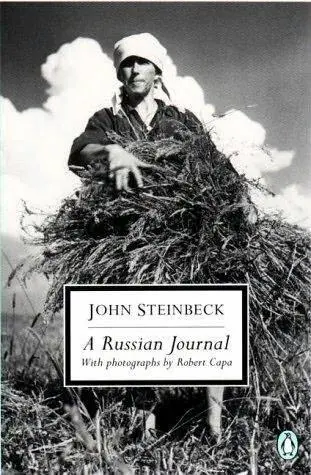
John Steinbeck - A Russian Journal
Здесь есть возможность читать онлайн «John Steinbeck - A Russian Journal» весь текст электронной книги совершенно бесплатно (целиком полную версию без сокращений). В некоторых случаях можно слушать аудио, скачать через торрент в формате fb2 и присутствует краткое содержание. Жанр: Классическая проза, на английском языке. Описание произведения, (предисловие) а так же отзывы посетителей доступны на портале библиотеки ЛибКат.
- Название:A Russian Journal
- Автор:
- Жанр:
- Год:неизвестен
- ISBN:нет данных
- Рейтинг книги:4.5 / 5. Голосов: 2
-
Избранное:Добавить в избранное
- Отзывы:
-
Ваша оценка:
A Russian Journal: краткое содержание, описание и аннотация
Предлагаем к чтению аннотацию, описание, краткое содержание или предисловие (зависит от того, что написал сам автор книги «A Russian Journal»). Если вы не нашли необходимую информацию о книге — напишите в комментариях, мы постараемся отыскать её.
A Russian Journal — читать онлайн бесплатно полную книгу (весь текст) целиком
Ниже представлен текст книги, разбитый по страницам. Система сохранения места последней прочитанной страницы, позволяет с удобством читать онлайн бесплатно книгу «A Russian Journal», без необходимости каждый раз заново искать на чём Вы остановились. Поставьте закладку, и сможете в любой момент перейти на страницу, на которой закончили чтение.
Интервал:
Закладка:
And we were properly impressed and very happy about it, because we'd never gone anyplace in a special plane in our lives, and we rather imagined we could stretch out on the floor and go to sleep. The plane was to leave in one hour. It would take that long to be made ready. Back to the restaurant we went, and had more tea, and more big biscuits.
At the end of an hour we made another inquiry. And it seemed that an engine needed a little work, and it might just possibly be thirty-five minutes more before we took off in our "special plane." Our hosts meanwhile were wilting and dying on the vine. We tried to get them to go back to Tiflis and go to bed, but they were very courteous and they would not. They would see us off to Moscow. Two more glasses of tea, and forty-five minutes, and we inquired again. It seemed, said the commandant, that a delegation of Turks, representing the Turkish government, were on their way to Moscow to take part in the celebration of the eight-hundredth anniversary of that city. And they were going to go on the plane with us, if we did not mind; they were to share our special plane, if we would permit it. Now we have no great liking for the Turkish gov-ernment, but when it was put to us that way, we couldn't refuse a whole sovereign nation's representatives the right to go on our little special plane to Moscow. We were very big about it, we granted the permission.
"Let them board the plane, and they can go with us," we said.
There was just one bit of trouble, they were not here yet. They were still in Tiflis, they would be out in half an hour.
Back to the restaurant we went, and had two more glasses of tea, and more big biscuits. The sun rose, and the air became hot, and the Russian patrol craft took off and came in. We had that sandy feeling under the eyes that comes from complete and overwhelming fatigue. And at the end of an hour we went back to the commandant, and even Mr. Chmarsky was getting quite excited by now. Where were the Turks?
Well, it seemed that their train had not reached Tiflis yet. It had been delayed somewhere along the line, and since they had been promised permission to go on our plane, the commandant did not think that he could very well leave the Turkish delegation stranded here, and would we mind waiting perhaps another half hour.
The level of the tea in our bodies had reached the thorax. And we went back to the restaurant, and drank another glass, and it bubbled out of our mouths. Chmarsky put his head down in his hands, and I reminded him of our definition of gremlins, and of his answer that in the Soviet Union they do not believe in ghosts.
I said, "Mr. Chmarsky, do you believe in ghosts now?"
And he raised weary eyes, and then banged his fists on the table, and ran out to the commandant, shouting.
Our hosts from Tiflis were now squatting on the ground under a tree in the garden of the airport, sound asleep. But we couldn't go to sleep, because our plane was to leave in thirty-five minutes.
Two and a half hours later the Turks' baggage arrived-twenty fat suitcases in a truck-but no Turks. And it developed that after an all-night trip on the train the Turks had felt a little sandy, a little grainy, and they had gone to a hotel to take a bath, and have some breakfast, and rest up a little bit. The commandant was very sorry, it was an international matter, and if we wouldn't mind letting the Turks on our plane, we would make him the happiest man in the world, and incidentally probably save his job and his reputation.
Again we were magnanimous. And we had discovered one scientific truth: we knew exactly how much the human system can hold, and we had reached that point.
At twelve-thirty the Turks arrived. They were fat Turks-four men and two women. We didn't know what they were going to do with twenty great suitcases for a stay of at the most two weeks. We thought perhaps they had brought folding harems with them. They swaggered through the airport, and got in the plane, and the door was about to close when we besieged the plane ourselves. There was a little altercation at the door, but the Turks finally let us in. It turned out that it was not our plane at all, it was the Turks' plane. And we were not letting them ride with us, they were letting us ride with them, and they didn't like it a bit. We didn't want to remind them that we, as American taxpayers, were providing dollars to preserve the democracy of their great state. All we wanted to do was to get on that plane and get the hell out of Tiflis. Mr. Chmarsky was crying a little bit by now, and shaking his fist at everything that moved. He had a plan to write letters to all of the Moscow papers concerning the incident.
We finally were permitted in the plane, and the Turks-they were well-rounded, well-upholstered Turks-settled in their seats with grunts of distaste at our presence. They glanced suspiciously at our luggage. We must say that they were the nicest-smelling Turks we have ever encountered. Everyone of them smelled like a two-dollar haircut. And I have a feeling that while we waited at the hot airport they had been bathing in attar of roses.
We waved heavily to our hosts of Tiflis. They had been very kind and hospitable to us, and we had been of considerable nuisance to them. And our friend the cavalryman-driver waved violently. Nothing tired him out.
It was close in the plane, for the air-conditioning system, as usual, was out of order, and the smell of attar of roses was overwhelming. Our plane lumbered into the air and began to climb rapidly to get through the Caucasus. On the ridges we could see the castles and fortifications of antiquity.
It is a magical place, Georgia, and it becomes dream-like the moment you have left it. And the people are magic people. It is true that they have one of the richest and most beautiful countries in the world, and they live up to it. And we understood thoroughly now why Russians had always said to us, "Until you have seen Georgia, you have seen nothing."
We flew over the Black Sea, and stopped again at Sukhum, and this time our crew did not go swimming. The line of women was still there selling fruit, and we bought a great box of peaches to take to the correspondents in Moscow. We purposely got them firm, so that they would not all ripen at once. The sad thing was that they did not ripen at all. They simply rotted in the condition in which we got them.
We flew over the secondary range of the Caucasus and came down into the interminable flat lands. We did not land at Rostov, but flew directly on to Moscow. And it was cold in Moscow, for the winter was approaching very fast.
Mr. Chmarsky was a very nervous man. This time we had nearly finished him off. And even Chmarsky's gremlin was tired. There were no difficulties at the airport. We were met. The car was waiting, and we got into Moscow without any difficulty at all. We were very happy to see our room in the Savoy, with the crazy monkey, the insane goats, and the impaled fish. The bust of Crazy Ella winked and nodded to us as we walked up the stairs to our room, and the stuffed bear on the second floor drew himself up and saluted us.
Capa got into the bathtub with an old British financial report, and I went to sleep while he was still there. For all I know he spent the night in the tub.
CHAPTER 9
Moscow WAS IN A STATE of feverish activity. Great gangs of men were covering the buildings with gigantic posters and portraits of the national heroes, acres in extent. The bridges were strung with electric light globes. The walls of the Kremlin and its towers, and even its battlements, were outlined in electric lights. Every public building was floodlighted. In every public square dance stands had been put up, and in some of the squares little booths, made to look like Russian fairy-tale houses, had been erected for the sale of sweets, and ice-cream, and souvenirs. A special little dangling metal buttonhole ornament was official, and everyone wore one of them. Delegations from many countries were arriving almost hourly. The busses and trains were loaded. The roads were full of people coming into the city, carrying not only their clothes, but food for several days. They have been hungry so often that they take no chances when they move, and everyone carries a few loaves of bread. Bunting and flags and paper flowers were on every building. The individual commissariats had their signs on the buildings housing their offices. The subway trust put up a huge map of the subways of Moscow, and at the bottom a little subway train that ran back and forth. This attracted crowds, who stared at it all day and late into the night. Wagons and trucks loaded with foodstuffs, with cabbages, with melons, with tomatoes, with cucumbers, rolled into the city-the gifts of the collective farms to the city on its eight-hundredth anniversary.
Читать дальшеИнтервал:
Закладка:
Похожие книги на «A Russian Journal»
Представляем Вашему вниманию похожие книги на «A Russian Journal» списком для выбора. Мы отобрали схожую по названию и смыслу литературу в надежде предоставить читателям больше вариантов отыскать новые, интересные, ещё непрочитанные произведения.











Обсуждение, отзывы о книге «A Russian Journal» и просто собственные мнения читателей. Оставьте ваши комментарии, напишите, что Вы думаете о произведении, его смысле или главных героях. Укажите что конкретно понравилось, а что нет, и почему Вы так считаете.