John Steinbeck - A Russian Journal
Здесь есть возможность читать онлайн «John Steinbeck - A Russian Journal» весь текст электронной книги совершенно бесплатно (целиком полную версию без сокращений). В некоторых случаях можно слушать аудио, скачать через торрент в формате fb2 и присутствует краткое содержание. Жанр: Классическая проза, на английском языке. Описание произведения, (предисловие) а так же отзывы посетителей доступны на портале библиотеки ЛибКат.
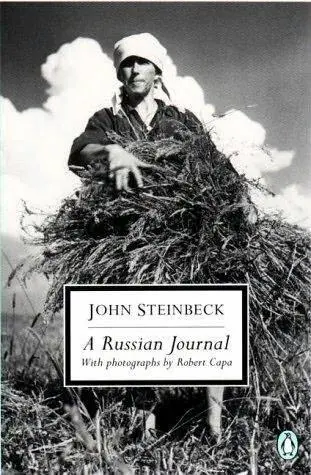
- Название:A Russian Journal
- Автор:
- Жанр:
- Год:неизвестен
- ISBN:нет данных
- Рейтинг книги:4.5 / 5. Голосов: 2
-
Избранное:Добавить в избранное
- Отзывы:
-
Ваша оценка:
A Russian Journal: краткое содержание, описание и аннотация
Предлагаем к чтению аннотацию, описание, краткое содержание или предисловие (зависит от того, что написал сам автор книги «A Russian Journal»). Если вы не нашли необходимую информацию о книге — напишите в комментариях, мы постараемся отыскать её.
A Russian Journal — читать онлайн бесплатно полную книгу (весь текст) целиком
Ниже представлен текст книги, разбитый по страницам. Система сохранения места последней прочитанной страницы, позволяет с удобством читать онлайн бесплатно книгу «A Russian Journal», без необходимости каждый раз заново искать на чём Вы остановились. Поставьте закладку, и сможете в любой момент перейти на страницу, на которой закончили чтение.
Интервал:
Закладка:
As we drove back toward Moscow a great black cloud turned over, and the rain began to fall on the city.
Probably the hardest thing in the world for a man is the simple observation and acceptance of what is. Always we warp our pictures with what we hoped, expected, or were afraid of. In Russia we saw many things that did not agree with what we had expected, and for this reason it is very good to have photographs, because a camera has no preconceptions, it simply sets down what it sees.
We had to wait about Moscow for our permits to leave the city and to travel through the country.
We went, on invitation, to see the temporary head of the press bureau. He was dressed in a gray uniform with the square shoulder boards of the Foreign Office. His eyes were bright blue, like turquoises.
Capa spoke fervently about taking pictures. So far he had not been able to. The chief of the press bureau assured us that he would do his best to get the permits for photography as soon as possible. Our meeting was formal and very courteous.
Later we went to visit the Lenin Museum. Room after room of the scraps of a man's life. I suppose there is no more documented life in history. Lenin must have thrown nothing away. Rooms and cases are full of bits of his writings, bills, diaries, manifestoes, pamphlets; his pens and pencils, his scarves, his clothing, everything is there. And around the walls are huge paintings of every incident of his life, from his boyhood on. Every incident of the Revolution in which he took part is recorded in monster paintings around the wall. His books are sunk in white marble frames, about the walls also, and the titles are in bronze. There are statues of Lenin in every possible pose, and later, in the pictures of his life, Stalin enters. But in the whole museum there is not one picture of Trotsky. Trotsky, as far as Russian history is concerned, has ceased to exist, and in fact never did exist. This is a kind of historical approach which we cannot understand. This is history as we wish it might have been rather than as it was. For there is no doubt that Trotsky exerted a great historical effect on the Russian Revolution. There is also no doubt that his removal and his banishment were of great historical impor-tance. But to the young Russians he never existed. To the children who go into the Lenin Museum and see the history of the Revolution there is no Trotsky, good or bad.
The museum was crowded. There were groups of Soviet soldiers; there were children; there were tourists from the various republics, and each group had its lecturer, and each lecturer had a pointer, with which he or she indicated the various subjects under discussion.
While we were there a long line of war orphans came in, little boys and girls from about six to thirteen, scrubbed and dressed in their best clothes. And they too went through the museum and gazed with wide eyes at this documented life of the dead Lenin. They looked in wonder at his fur cap, and his fur-collared overcoat, at his shoes, the tables he wrote on, the chairs he sat in. Everything about this man is here, everything except humor. There is no evidence that he ever, in his whole life, had a light or a humorous thought, a moment of whole-hearted laughter, or an evening of fun… There can be no doubt that these things existed, but perhaps historically he is not permitted to have them.
In this museum one gets the idea that Lenin himself was aware of his place in history. Not only did he save every scrap of his thinking and his writing, but the photographs of him are there by the hundreds. He was photographed everywhere, in all conditions, and at every age, almost as though he had anticipated that there would someday be a museum called the Lenin Museum.
There is a hush over the place. People speak in whispers, and the lecturers with their pointers talk in a curious melodic litany. For this man has ceased to be a man in the Russian mind. He is no longer of flesh, but of stone, and bronze, and marble. The bald head and the pointed mustache are everywhere in the Soviet Union. The intent, squinting eyes look out of canvas and peep out of plaster.
In the evening we went to a party at the American club, a place where Embassy employees and soldiers and sailors from the Military and Naval Attaches offices go for recreation. There was a viperine punch, made of vodka and grapefruit juice, a fine reminder of prohibition days. A little swing band was led by Ed Gilmore, who is a swing aficionado. He once called his organization the Kremlin Krows, but since this name was slightly frowned on it was changed to the Moscow River Rats.
After the solemnity of the afternoon in the Lenin Museum the slight violence and noise and laughter of this party were a pleasure to us.
Among the girls at this party were a number of the now-famous wives of Americans and Britons who are not permitted to leave the Soviet Union. Pretty and rather sad girls. They cannot join their husbands in England or America, and so they are employed by their embassies until some final decision is reached.
There are many things we cannot understand about the Soviet Union, and this is one of them. There are not more than fifty of these women. They are no good to the Soviet Union. They are suspected. Russians do not associate with them, and yet they are not permitted to leave. And on these fifty women, these fifty unimportant women, the Soviet Union has got itself more bad publicity than on any other single small item. Of course this situation cannot arise again, since by a new decree no Russian may marry a foreigner. But here they sit in Moscow, these sad women, no longer Russians, and they have not become British or American. And we cannot understand the reasoning which keeps them here. Perhaps it is just that the Russians do not intend to be told what to do about anything by anyone else. It might be as simple as that. When Clement Attlee personally requested that they be sent out of Russia, he was told, in effect, to mind his own business. It is just one more of the international stupidities which seem to be on the increase in the world. Sometimes it seems that the leaders of nations are little boys with chips on their shoulders, daring each other to knock them off.
It was a good party at the American club, a good noisy party, and it made us feel a little homesick. All of the people there were homesick too, for Russia is not very kind to foreigners, particularly if they happen to be employees of foreign governments. And although we had not been long in the Soviet Union, the lipstick, the mascara, and the colored nails of the girls looked good to us.
The following afternoon we went to the air show. While there were some civilian events, most of the show was given by the Soviet Air Force. Different branches of the Soviet armed forces have their days. There is Tank Day, Infantry Day, and Navy Day, and this was the Air Force Day. Since it was semi-military, we were told that no cameras would be permitted. This seemed a little ridiculous to us, because every military attache, from every embassy, would be there, people who really know about airplanes. We didn't know an airplane from a hole in the ground. It was very probable that every military attache would be sketching and understanding what he saw, and we wouldn't.
A car came for us. We went out a long avenue lined with flags, miles of them, red flags and Air Force flags. The highway was bordered with large portraits of Stalin, and Marx, and Lenin. Hundreds of thousands of people moved toward the airfield on trains and on busses, and other hundreds of thousands went on foot.
Our places were in the grandstand, which was a mistake. We should have been on the great green field where literally millions of people stood to watch the show. It was a hot day, and there was no cover from the sun. On the flat green field were pavilions where soft drinks were sold, and little cakes. When we were seated, a low hum started, and it grew to a great roaring. It was all of the people standing there greeting Stalin, who had just arrived. We couldn't see him, we couldn't see his box, because we were on the wrong side of the grandstand. The response to his arrival was not a cheer but a buzz, like that of millions of bees.
Читать дальшеИнтервал:
Закладка:
Похожие книги на «A Russian Journal»
Представляем Вашему вниманию похожие книги на «A Russian Journal» списком для выбора. Мы отобрали схожую по названию и смыслу литературу в надежде предоставить читателям больше вариантов отыскать новые, интересные, ещё непрочитанные произведения.






Обсуждение, отзывы о книге «A Russian Journal» и просто собственные мнения читателей. Оставьте ваши комментарии, напишите, что Вы думаете о произведении, его смысле или главных героях. Укажите что конкретно понравилось, а что нет, и почему Вы так считаете.