Mark Twain - A Tramp Abroad
Здесь есть возможность читать онлайн «Mark Twain - A Tramp Abroad» весь текст электронной книги совершенно бесплатно (целиком полную версию без сокращений). В некоторых случаях можно слушать аудио, скачать через торрент в формате fb2 и присутствует краткое содержание. Жанр: Классическая проза, Юмористическая проза, на английском языке. Описание произведения, (предисловие) а так же отзывы посетителей доступны на портале библиотеки ЛибКат.
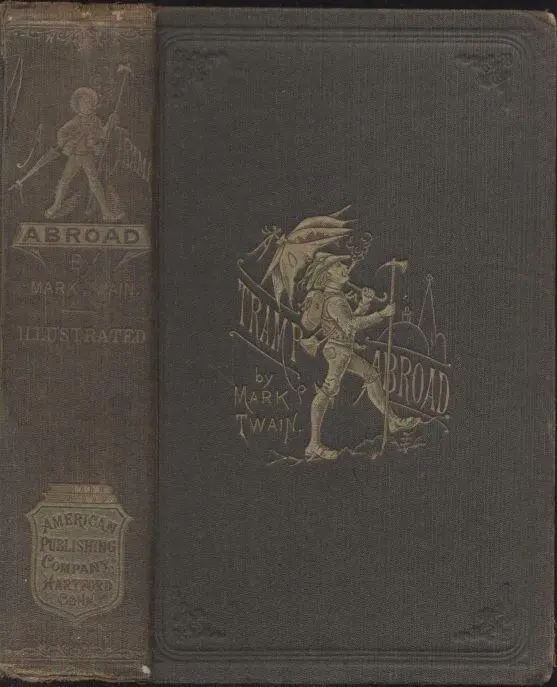
- Название:A Tramp Abroad
- Автор:
- Жанр:
- Год:неизвестен
- ISBN:нет данных
- Рейтинг книги:5 / 5. Голосов: 1
-
Избранное:Добавить в избранное
- Отзывы:
-
Ваша оценка:
A Tramp Abroad: краткое содержание, описание и аннотация
Предлагаем к чтению аннотацию, описание, краткое содержание или предисловие (зависит от того, что написал сам автор книги «A Tramp Abroad»). Если вы не нашли необходимую информацию о книге — напишите в комментариях, мы постараемся отыскать её.
A Tramp Abroad — читать онлайн бесплатно полную книгу (весь текст) целиком
Ниже представлен текст книги, разбитый по страницам. Система сохранения места последней прочитанной страницы, позволяет с удобством читать онлайн бесплатно книгу «A Tramp Abroad», без необходимости каждый раз заново искать на чём Вы остановились. Поставьте закладку, и сможете в любой момент перейти на страницу, на которой закончили чтение.
Интервал:
Закладка:
The account translated from the Icelandic says that the mountainlike ruins of this majestic glacier so covered the sea that as far as the eye could reach no open water was discoverable, even from the highest peaks. A monster wall or barrier of ice was built across a considerable stretch of land, too, by this strange irruption:
"One can form some idea of the altitude of this barrier of ice when it is mentioned that from Hofdabrekka farm, which lies high up on a fjeld, one could not see Hjorleifshofdi opposite, which is a fell six hundred and forty feet in height; but in order to do so had to clamber up a mountain slope east of Hofdabrekka twelve hundred feet high."
These things will help the reader to understand why it is that a man who keeps company with glaciers comes to feel tolerably insignificant by and by. The Alps and the glaciers together are able to take every bit of conceit out of a man and reduce his self-importance to zero if he will only remain within the influence of their sublime presence long enough to give it a fair and reasonable chance to do its work.
The Alpine glaciers move—that is granted, now, by everybody. But there was a time when people scoffed at the idea; they said you might as well expect leagues of solid rock to crawl along the ground as expect leagues of ice to do it. But proof after proof was furnished, and the finally the world had to believe.
The wise men not only said the glacier moved, but they timed its movement. They ciphered out a glacier's gait, and then said confidently that it would travel just so far in so many years. There is record of a striking and curious example of the accuracy which may be attained in these reckonings.
In 1820 the ascent of Mont Blanc was attempted by a Russian and two Englishmen, with seven guides. They had reached a prodigious altitude, and were approaching the summit, when an avalanche swept several of the party down a sharp slope of two hundred feet and hurled five of them (all guides) into one of the crevices of a glacier. The life of one of the five was saved by a long barometer which was strapped to his back—it bridged the crevice and suspended him until help came. The alpenstock or baton of another saved its owner in a similar way. Three men were lost—Pierre Balmat, Pierre Carrier, and Auguste Tairraz. They had been hurled down into the fathomless great deeps of the crevice.
Dr. Forbes, the English geologist, had made frequent visits to the Mont Blanc region, and had given much attention to the disputed question of the movement of glaciers. During one of these visits he completed his estimates of the rate of movement of the glacier which had swallowed up the three guides, and uttered the prediction that the glacier would deliver up its dead at the foot of the mountain thirty-five years from the time of the accident, or possibly forty.
A dull, slow journey—a movement imperceptible to any eye—but it was proceeding, nevertheless, and without cessation. It was a journey which a rolling stone would make in a few seconds—the lofty point of departure was visible from the village below in the valley.
The prediction cut curiously close to the truth; forty-one years after the catastrophe, the remains were cast forth at the foot of the glacier.
I find an interesting account of the matter in the HISTOIRE DU MONT BLANC, by Stephen d'Arve. I will condense this account, as follows:
On the 12th of August, 1861, at the hour of the close of mass, a guide arrived out of breath at the mairie of Chamonix, and bearing on his shoulders a very lugubrious burden. It was a sack filled with human remains which he had gathered from the orifice of a crevice in the Glacier des Bossons. He conjectured that these were remains of the victims of the catastrophe of 1820, and a minute inquest, immediately instituted by the local authorities, soon demonstrated the correctness of his supposition. The contents of the sack were spread upon a long table, and officially inventoried, as follows:
Portions of three human skulls. Several tufts of black and blonde hair. A human jaw, furnished with fine white teeth. A forearm and hand, all the fingers of the latter intact. The flesh was white and fresh, and both the arm and hand preserved a degree of flexibility in the articulations.
The ring-finger had suffered a slight abrasion, and the stain of the blood was still visible and unchanged after forty-one years. A left foot, the flesh white and fresh.
Along with these fragments were portions of waistcoats, hats, hobnailed shoes, and other clothing; a wing of a pigeon, with black feathers; a fragment of an alpenstock; a tin lantern; and lastly, a boiled leg of mutton, the only flesh among all the remains that exhaled an unpleasant odor. The guide said that the mutton had no odor when he took it from the glacier; an hour's exposure to the sun had already begun the work of decomposition upon it.
Persons were called for, to identify these poor pathetic relics, and a touching scene ensued. Two men were still living who had witnessed the grim catastrophe of nearly half a century before—Marie Couttet (saved by his baton) and Julien Davouassoux (saved by the barometer). These aged men entered and approached the table. Davouassoux, more than eighty years old, contemplated the mournful remains mutely and with a vacant eye, for his intelligence and his memory were torpid with age; but Couttet's faculties were still perfect at seventy-two, and he exhibited strong emotion. He said:
"Pierre Balmat was fair; he wore a straw hat. This bit of skull, with the tuft of blond hair, was his; this is his hat. Pierre Carrier was very dark; this skull was his, and this felt hat. This is Balmat's hand, I remember it so well!" and the old man bent down and kissed it reverently, then closed his fingers upon it in an affectionate grasp, crying out, "I could never have dared to believe that before quitting this world it would be granted me to press once more the hand of one of those brave comrades, the hand of my good friend Balmat."
There is something weirdly pathetic about the picture of that white-haired veteran greeting with his loving handshake this friend who had been dead forty years. When these hands had met last, they were alike in the softness and freshness of youth; now, one was brown and wrinkled and horny with age, while the other was still as young and fair and blemishless as if those forty years had come and gone in a single moment, leaving no mark of their passage. Time had gone on, in the one case; it had stood still in the other. A man who has not seen a friend for a generation, keeps him in mind always as he saw him last, and is somehow surprised, and is also shocked, to see the aging change the years have wrought when he sees him again. Marie Couttet's experience, in finding his friend's hand unaltered from the image of it which he had carried in his memory for forty years, is an experience which stands alone in the history of man, perhaps.
Couttet identified other relics:
"This hat belonged to Auguste Tairraz. He carried the cage of pigeons which we proposed to set free upon the summit. Here is the wing of one of those pigeons. And here is the fragment of my broken baton; it was by grace of that baton that my life was saved. Who could have told me that I should one day have the satisfaction to look again upon this bit of wood that supported me above the grave that swallowed up my unfortunate companions!"
No portions of the body of Tairraz, other than a piece of the skull, had been found. A diligent search was made, but without result. However, another search was instituted a year later, and this had better success. Many fragments of clothing which had belonged to the lost guides were discovered; also, part of a lantern, and a green veil with blood-stains on it. But the interesting feature was this:
Читать дальшеИнтервал:
Закладка:
Похожие книги на «A Tramp Abroad»
Представляем Вашему вниманию похожие книги на «A Tramp Abroad» списком для выбора. Мы отобрали схожую по названию и смыслу литературу в надежде предоставить читателям больше вариантов отыскать новые, интересные, ещё непрочитанные произведения.









Обсуждение, отзывы о книге «A Tramp Abroad» и просто собственные мнения читателей. Оставьте ваши комментарии, напишите, что Вы думаете о произведении, его смысле или главных героях. Укажите что конкретно понравилось, а что нет, и почему Вы так считаете.