Jane Austen - Pride and Prejudice
Здесь есть возможность читать онлайн «Jane Austen - Pride and Prejudice» — ознакомительный отрывок электронной книги совершенно бесплатно, а после прочтения отрывка купить полную версию. В некоторых случаях можно слушать аудио, скачать через торрент в формате fb2 и присутствует краткое содержание. Жанр: Классическая проза, на английском языке. Описание произведения, (предисловие) а так же отзывы посетителей доступны на портале библиотеки ЛибКат.
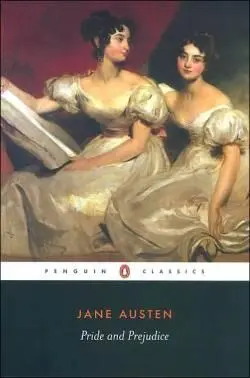
- Название:Pride and Prejudice
- Автор:
- Жанр:
- Год:неизвестен
- ISBN:нет данных
- Рейтинг книги:4.5 / 5. Голосов: 2
-
Избранное:Добавить в избранное
- Отзывы:
-
Ваша оценка:
Pride and Prejudice: краткое содержание, описание и аннотация
Предлагаем к чтению аннотацию, описание, краткое содержание или предисловие (зависит от того, что написал сам автор книги «Pride and Prejudice»). Если вы не нашли необходимую информацию о книге — напишите в комментариях, мы постараемся отыскать её.
Pride and Prejudice — читать онлайн ознакомительный отрывок
Ниже представлен текст книги, разбитый по страницам. Система сохранения места последней прочитанной страницы, позволяет с удобством читать онлайн бесплатно книгу «Pride and Prejudice», без необходимости каждый раз заново искать на чём Вы остановились. Поставьте закладку, и сможете в любой момент перейти на страницу, на которой закончили чтение.
Интервал:
Закладка:
But no such happy marriage could now teach the admiring multitude what connubial felicity really was. An union of a different tendency, and precluding the possibility of the other, was soon to be formed in their family.
How Wickham and Lydia were to be supported in tolerable independence, she could not imagine. But how little of permanent happiness could belong to a couple who were only brought together because their passions were stronger than their virtue, she could easily conjecture.
Mr. Gardiner soon wrote again to his brother. To Mr. Bennet's acknowledgments he briefly replied, with assurance of his eagerness to promote the welfare of any of his family; and concluded with entreaties that the subject might never be mentioned to him again. The principal purport of his letter was to inform them that Mr. Wickham had resolved on quitting the militia.
"It was greatly my wish that he should do so," he added, "as soon as his marriage was fixed on. And I think you will agree with me, in considering the removal from that corps as highly advisable, both on his account and my niece's. It is Mr. Wickham's intention to go into the regulars; and among his former friends, there are still some who are able and willing to assist him in the army. He has the promise of an ensigncy in General —'s regiment, now quartered in the North. It is an advantage to have it so far from this part of the kingdom. He promises fairly; and I hope among different people, where they may each have a character to preserve, they will both be more prudent. I have written to Colonel Forster, to inform him of our present arrangements, and to request that he will satisfy the various creditors of Mr. Wickham in and near Brighton, with assurances of speedy payment, for which I have pledged myself. And will you give yourself the trouble of carrying similar assurances to his creditors in Meryton, of whom I shall subjoin a list according to his information? He has given in all his debts; I hope at least he has not deceived us. Haggerston has our directions, and all will be completed in a week. They will then join his regiment, unless they are first invited to Longbourn; and I understand from Mrs. Gardiner, that my niece is very desirous of seeing you all before she leaves the South. She is well, and begs to be dutifully remembered to you and your mother.-Yours, etc.,
"E. GARDINER."
Mr. Bennet and his daughters saw all the advantages of Wickham's removal from the —shire as clearly as Mr. Gardiner could do. But Mrs. Bennet was not so well pleased with it. Lydia's being settled in the North, just when she had expected most pleasure and pride in her company, for she had by no means given up her plan of their residing in Hertfordshire, was a severe disappointment; and, besides, it was such a pity that Lydia should be taken from a regiment where she was acquainted with everybody, and had so many favourites.
"She is so fond of Mrs. Forster," said she, "it will be quite shocking to send her away! And there are several of the young men, too, that she likes very much. The officers may not be so pleasant in General-'s regiment."
His daughter's request, for such it might be considered, of being admitted into her family again before she set off for the North, received at first an absolute negative. But Jane and Elizabeth, who agreed in wishing, for the sake of their sister's feelings and consequence, that she should be noticed on her marriage by her parents, urged him so earnestly yet so rationally and so mildly, to receive her and her husband at Longbourn, as soon as they were married, that he was prevailed on to think as they thought, and act as they wished. And their mother had the satisfaction of knowing that she would be able to show her married daughter in the neighbourhood before she was banished to the North. When Mr. Bennet wrote again to his brother, therefore, he sent his permission for them to come; and it was settled, that as soon as the ceremony was over, they should proceed to Longbourn. Elizabeth was surprised, however, that Wickham should consent to such a scheme, and had she consulted only her own inclination, any meeting with him would have been the last object of her wishes.
Chapter 51
Their sister's wedding day arrived; and Jane and Elizabeth felt for her probably more than she felt for herself. The carriage was sent to meet them at —, and they were to return in it by dinner-time. Their arrival was dreaded by the elder Miss Bennets, and Jane more especially, who gave Lydia the feelings which would have attended herself, had she been the culprit, and was wretched in the thought of what her sister must endure.
They came. The family were assembled in the breakfast room to receive them. Smiles decked the face of Mrs. Bennet as the carriage drove up to the door; her husband looked impenetrably grave; her daughters, alarmed, anxious, uneasy.
Lydia's voice was heard in the vestibule; the door was thrown open, and she ran into the room. Her mother stepped forwards, embraced her, and welcomed her with rapture; gave her hand, with an affectionate smile, to Wickham, who followed his lady; and wished them both joy with an alacrity which shewed no doubt of their happiness.
Their reception from Mr. Bennet, to whom they then turned, was not quite so cordial. His countenance rather gained in austerity; and he scarcely opened his lips. The easy assurance of the young couple, indeed, was enough to provoke him. Elizabeth was disgusted, and even Miss Bennet was shocked. Lydia was Lydia still; untamed, unabashed, wild, noisy, and fearless. She turned from sister to sister, demanding their congratulations; and when at length they all sat down, looked eagerly round the room, took notice of some little alteration in it, and observed, with a laugh, that it was a great while since she had been there.
Wickham was not at all more distressed than herself, but his manners were always so pleasing, that had his character and his marriage been exactly what they ought, his smiles and his easy address, while he claimed their relationship, would have delighted them all. Elizabeth had not before believed him quite equal to such assurance; but she sat down, resolving within herself to draw no limits in future to the impudence of an impudent man. She blushed, and Jane blushed; but the cheeks of the two who caused their confusion suffered no variation of colour.
There was no want of discourse. The bride and her mother could neither of them talk fast enough; and Wickham, who happened to sit near Elizabeth, began inquiring after his acquaintance in that neighbourhood, with a good humoured ease which she felt very unable to equal in her replies. They seemed each of them to have the happiest memories in the world. Nothing of the past was recollected with pain; and Lydia led voluntarily to subjects which her sisters would not have alluded to for the world.
"Only think of its being three months," she cried, "since I went away; it seems but a fortnight I declare; and yet there have been things enough happened in the time. Good gracious! when I went away, I am sure I had no more idea of being married till I came back again! though I thought it would be very good fun if I was."
Her father lifted up his eyes. Jane was distressed. Elizabeth looked expressively at Lydia; but she, who never heard nor saw anything of which she chose to be insensible, gaily continued, "Oh! mamma, do the people hereabouts know I am married to-day? I was afraid they might not; and we overtook William Goulding in his curricle, so I was determined he should know it, and so I let down the side-glass next to him, and took off my glove, and let my hand just rest upon the window frame, so that he might see the ring, and then I bowed and smiled like anything."
Elizabeth could bear it no longer. She got up, and ran out of the room; and returned no more, till she heard them passing through the hall to the dining parlour. She then joined them soon enough to see Lydia, with anxious parade, walk up to her mother's right hand, and hear her say to her eldest sister, "Ah! Jane, I take your place now, and you must go lower, because I am a married woman."
Читать дальшеИнтервал:
Закладка:
Похожие книги на «Pride and Prejudice»
Представляем Вашему вниманию похожие книги на «Pride and Prejudice» списком для выбора. Мы отобрали схожую по названию и смыслу литературу в надежде предоставить читателям больше вариантов отыскать новые, интересные, ещё непрочитанные произведения.


Обсуждение, отзывы о книге «Pride and Prejudice» и просто собственные мнения читателей. Оставьте ваши комментарии, напишите, что Вы думаете о произведении, его смысле или главных героях. Укажите что конкретно понравилось, а что нет, и почему Вы так считаете.