Antal Szerb - The Pendragon Legend
Здесь есть возможность читать онлайн «Antal Szerb - The Pendragon Legend» весь текст электронной книги совершенно бесплатно (целиком полную версию без сокращений). В некоторых случаях можно слушать аудио, скачать через торрент в формате fb2 и присутствует краткое содержание. Жанр: Классическая проза, на английском языке. Описание произведения, (предисловие) а так же отзывы посетителей доступны на портале библиотеки ЛибКат.
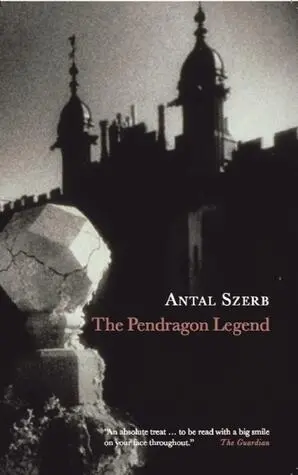
- Название:The Pendragon Legend
- Автор:
- Жанр:
- Год:неизвестен
- ISBN:нет данных
- Рейтинг книги:5 / 5. Голосов: 1
-
Избранное:Добавить в избранное
- Отзывы:
-
Ваша оценка:
The Pendragon Legend: краткое содержание, описание и аннотация
Предлагаем к чтению аннотацию, описание, краткое содержание или предисловие (зависит от того, что написал сам автор книги «The Pendragon Legend»). Если вы не нашли необходимую информацию о книге — напишите в комментариях, мы постараемся отыскать её.
The Pendragon Legend — читать онлайн бесплатно полную книгу (весь текст) целиком
Ниже представлен текст книги, разбитый по страницам. Система сохранения места последней прочитанной страницы, позволяет с удобством читать онлайн бесплатно книгу «The Pendragon Legend», без необходимости каждый раз заново искать на чём Вы остановились. Поставьте закладку, и сможете в любой момент перейти на страницу, на которой закончили чтение.
Интервал:
Закладка:
“I’ve no idea. The fact is, I don’t know very much about him. Osborne and I have only lived here for three years, since our mother died. Before that, I hardly ever saw him. All I know is that he’s the most magnificent being on earth. The great aristocrats of the past must have been like him. They didn’t have to do or say anything remarkable: their mere existence revealed a finer form of life, above and beyond this one. It’s impossible to say why everyone holds him in such high esteem. But if noble blood does stand for anything, he’s the living incarnation of it. I just can’t believe he could have enemies. He’s too far above everyone else for there to be any serious differences; though of course, by the same token, he hasn’t any friends.”
I confess I too felt that the Earl was as she had described him. Some people are born to be served willingly by others.
It isn’t easy to explain these unprovoked sympathies, the whole complex magic that made Llanvygan so deeply attractive to me. No doubt there was an element of snobbery in it, a degree of intellectual curiosity, and a bit of love too. And there do exist in the soul such feudal passions as service, respect and devotion.
Had I been a knight errant, I should have offered my services to the lord of the castle, and asked the lady for a ribbon to wear on my shield. Oh to be that happy man, a knight errant!
I kissed her hand. She stood in the gothic arch of the window gazing at me, transfigured by emotion. She was the maid of the castle, I her knight. I mouthed a few incoherent words, in which there was not just a declaration of love but a blessed revival, from under the rubble of years, of my better self. What a shame that those moments when man is noble and pure and akin to the angels are so transient, so fleeting, while that complicated nonentity the Ego is always with us — of which one can speak only in terms of protective tenderness and gentle irony.
By some miracle, the next few days passed calmly and agreeably. Nothing remarkable happened, and I was able to sleep at night. There was no more talk of midnight riders.
The summer was still magnificent, the park as beautiful as parks always are when one walks in them with a girl. I played a great deal of tennis, swam and sunbathed. In short, I was spending my summer holiday in the shadow of danger every bit as calmly as the rich who disport themselves below snow-laden mountains of deadly height.
In time I even came to feel at home in the Llanvygan library, and picked up my studies where I had left off in the British Museum.
The library was particularly rich in seventeenth-century material. Mystical tracts which I knew of only from bibliographical references, things that were not even in the British Museum, I now held reverently in my hands.
The number of German works of the period was very striking. With singular emotion I turned the pages of Simon Studion’s unpublished Naometria , and first editions of Paracelsus, Weigel and Johann Valentin Andreae, volumes which Asaph Pendragon must have brought back with him after his early years in that country. Over these texts he would have mused and deliberated with his friend Robert Fludd: their cabbalistic symbols were still visible above the archaic gothic script. As I sat there in the gathering dusk, an insignificant mortal in the shadow of the vast ranks of books, the centuries passed before me in procession, in reverse order. Where are the Stuarts, and where is Cromwell now? But books live on, as does man’s eternal thirst for them.
It seemed as if I had only to open a door to see directly into the era of Asaph Pendragon. Every now and then I was overwhelmed by a strange, disconcerting happiness. I felt preternaturally old, a relic from the age of folios staring out in astonishment at the mankind of today.
In short, I was in a lyrical mood. I kept breaking off to construct, with much labour, a sonnet in English. Let us suppose: I was in love with Cynthia. That might be one way of approaching the truth, at the expense of a double lie. I wasn’t in love, and not with Cynthia.
As a rule I don’t fall in love, though it did happen to me once when I was very young. Even if the rather pleasing solemnity I now felt pulsing in my veins could really be termed love, it was not Cynthia I was in love with, but the Lady of the Castle, the maid of Llanvygan.
A woman’s worth is furnished by her background, her reputation (good or bad), the lovers she has had, and the world of otherness she has come from. Love is like an old-fashioned landscape painting: in the foreground a diminutive figure, the woman who is loved; behind her mountains and rivers, a rich, grand scenery, charged with meaning.
Cynthia’s scenery was Llanvygan and Pendragon, Welsh legend and English history. Whoever married Cynthia would find himself related, however distantly, to the deathless pentameters of Shakespeare and Milton.
But the real Cynthia was simple, warm-hearted and natural, as all true aristocrats are when you get to know them. She had no interest in ‘society’, nor was she self-centred and demanding the way young girls are who have been spoilt. Because of her mother’s recent death she had ‘come out’ rather later than usual, and rarely mixed with people.
She was sincerely and unaffectedly pleased that I was at Llanvygan, where she had passed so many sad and lonely months, and our friendship grew daily more intimate. She was fond of, rather than passionate about, sport, but she was as enthusiastic a walker as I was and enjoyed displaying her knowledge of folklore while showing me round the local places of interest.
She was extremely communicative. By degrees I got to know all about the garden parties she had attended, and all about her friends. Those who did not go in for folklore ranked rather lower in her esteem. There was only one person she really adored, an older woman, whose name she did not tell me. She surrounded this attachment with a element of romantic secretiveness, and I was instantly jealous.
I had good reason, as the tones in which she spoke of this woman were those of love. In her naiveté, and as the person in question was a woman, Cynthia did not conceal her feelings. The relationship greatly exercised my imagination and, to tease me, she became even more secretive.
She came on several occasions to seek me out in the library, but never for more than a short time. She was unwilling to disturb my studies, and I did not betray to what an extent they were lyrical in nature. I had a reputation to maintain.
Once however she caught me in the act. I had piled a stack of old books in front of me and was staring in a trance-like half-dream at the coat of arms with its rose cross on the leather binding.
“What are you doing?” she asked in alarm.
“The Rose Cross … ” I murmured.
“Doctor, I’ve always wanted to ask you to tell me about the Rosicrucians. All I know is that my ancestors belonged to the movement.”
“That’s almost all anyone knows, Cynthia. Every source agrees that a secret society — the forerunners of the Freemasons — took the name, in Germany, in the seventeenth century. They wanted to make gold. The idea spread to England. Robert Fludd and your ancestor Asaph Pendragon, the sixth Earl, were their leaders. They described themselves as invisible and to this day some strange impenetrability guards their memory. Every time you think you’ve finally pinned them down you discover it’s a fabrication or a fable. Descartes, who was alive at exactly that time, scoured the length and breadth of Germany hoping to meet a live Rosicrucian, and never once succeeded … ”
“But you, surely, know all about them, Doctor.”
“It’s very kind of you to say so, but nothing can be known for certain. Look at this: I’ve a pile here of four books which their contemporaries considered authentic Rosicrucian documents. This massive tome is the Chymische Hochzeit Christiani Rosencreutz. ”
Читать дальшеИнтервал:
Закладка:
Похожие книги на «The Pendragon Legend»
Представляем Вашему вниманию похожие книги на «The Pendragon Legend» списком для выбора. Мы отобрали схожую по названию и смыслу литературу в надежде предоставить читателям больше вариантов отыскать новые, интересные, ещё непрочитанные произведения.




Обсуждение, отзывы о книге «The Pendragon Legend» и просто собственные мнения читателей. Оставьте ваши комментарии, напишите, что Вы думаете о произведении, его смысле или главных героях. Укажите что конкретно понравилось, а что нет, и почему Вы так считаете.