Louis Couperus - Inevitable
Здесь есть возможность читать онлайн «Louis Couperus - Inevitable» весь текст электронной книги совершенно бесплатно (целиком полную версию без сокращений). В некоторых случаях можно слушать аудио, скачать через торрент в формате fb2 и присутствует краткое содержание. Год выпуска: 2013, ISBN: 2013, Издательство: Pushkin Press, Жанр: Классическая проза, на английском языке. Описание произведения, (предисловие) а так же отзывы посетителей доступны на портале библиотеки ЛибКат.
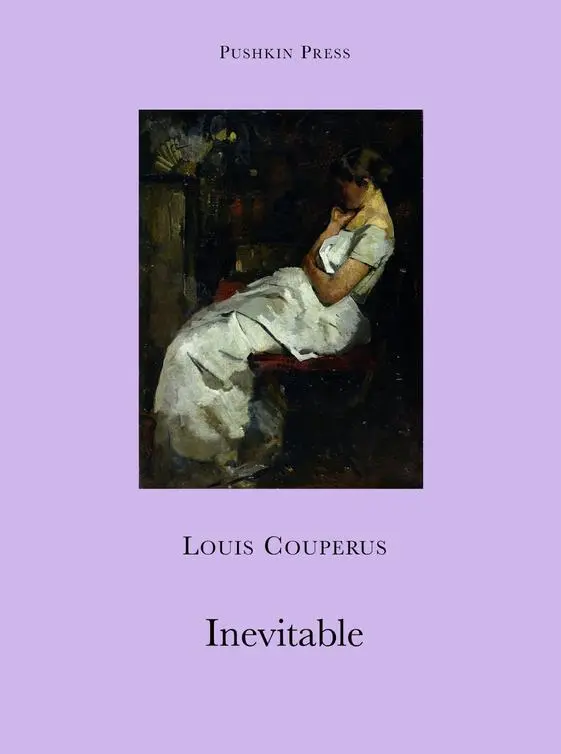
- Название:Inevitable
- Автор:
- Издательство:Pushkin Press
- Жанр:
- Год:2013
- ISBN:9781908968562
- Рейтинг книги:4 / 5. Голосов: 1
-
Избранное:Добавить в избранное
- Отзывы:
-
Ваша оценка:
Inevitable: краткое содержание, описание и аннотация
Предлагаем к чтению аннотацию, описание, краткое содержание или предисловие (зависит от того, что написал сам автор книги «Inevitable»). Если вы не нашли необходимую информацию о книге — напишите в комментариях, мы постараемся отыскать её.
Inevitable — читать онлайн бесплатно полную книгу (весь текст) целиком
Ниже представлен текст книги, разбитый по страницам. Система сохранения места последней прочитанной страницы, позволяет с удобством читать онлайн бесплатно книгу «Inevitable», без необходимости каждый раз заново искать на чём Вы остановились. Поставьте закладку, и сможете в любой момент перейти на страницу, на которой закончили чтение.
Интервал:
Закладка:
“A week!” she whispered. “A whole week since I’ve seen you, Duco, my darling! I can’t do without you for so long. With everything I thought and did, and admired, I thought of you and of how beautiful you would find it here. You’ve been here before, as a tourist. Oh, but this is different. What makes it so nice is staying, not passing through, but staying. That lake, that cathedral, those hills! Those rooms inside. Neglected but so beautiful. The three courtyards are run-down, the fountains are crumbling … But the style of the atrium, the gloominess of the dining-room, the poetry of this pergola … Duco, isn’t this pergola like a classical ode? We’ve sometimes read Horace together, you translated those poems for me so beautifully, you improvised so wonderfully! How handsome you are, you know so much, you have such a beautiful sensibility. I love your eyes, your voice, and all of you, everything that is you … I can’t tell you, Duco. I have gradually surrendered to your every word, to your love of Rome, your love of museums, to the way you see the skies that you wash onto your watercolours. You’re so wonderfully calm, almost like this lake. Oh, don’t laugh, don’t push me away: I haven’t seen you for a week, I need to speak to you like this. Am I exaggerating? I don’t feel ordinary here, there’s something in that air, that sky, that light that makes me speak like this. It’s so beautiful that I can’t believe it’s ordinary life, ordinary reality … Do you remember in Sorrento on the terrace of that hotel, when we looked out over the sea, over the pearly sea, with Naples so white in the distance, I felt the same way then too, but did not dare put it into words: it was in the morning, there were people around us, who though we could not see them could see us and whom I was aware of around us: but now we’re alone, and now I want to say it to you, in your arms, at your breast: I’m so happy! I love you so much! I feel that my soul, everything that is best in me is you! You’re laughing, but you don’t believe me. Do you? Do you believe me?”
“Yes, I believe you, I’m not laughing at you, I’m just laughing. I’m so happy about you and about my art. You’ve taught me to work, you’ve roused me from my dreams! I’m so happy about Banners : I have letters from London, which I can let you read tomorrow. I owe everything to you. It’s scarcely believable that this is ordinary life. Life was so quiet in Rome. I didn’t see anyone, I worked a bit — but not much; and I ate alone in the osteria . The two Italians, you know, were sorry for me, I think. Oh, it was a terrible week. I can no longer do without you. Do you remember our first walks and conversations in Borghese, and on the Palatine? What strangers we still were to each other, not fitting together. But I felt at once, I think, that something beautiful would grow between us …”
She said nothing, and remained against his chest. The cricket chirped again in a kind of long vibrato. But apart from that everything slept …
“Between us …” she repeated as if in a fever, and she surrendered completely.
The whole night slept, and while they breathed their lives in each other’s arms, above their heads the enchanted caryatids — fauns and nymphs — bore in their sleep the leafy canopy of the pergola, between them and the star-strewn sky.
XXXVIII
GILIO FOUND THE VACATION in San Stefano dreadful. Every morning at six o’clock he had to be ready to attend mass with Prince Ercole, Urania and the marchesa in the castle chapel. Afterwards he had too much time on his hands. He had gone cycling a few times with Robert Hope, but the young Westerner was too energetic for him, as was his sister, Urania. He flirted and argued with Cornélie a little, but secretly he was still insulted, and angry with himself and her. He remembered when she first arrived that evening at Palazzo Ruspoli; when she had interrupted his rendezvous with Urania. And in the golden camera degli sposi she had again proved too strong for him! He seethed when he thought of it, and he hated her and swore to the great gods that he would be avenged. He cursed his own indecision. He was too weak to force her with the strength of his passion and he should never have had to force her: he was used to people giving in. And he was forced to hear from her, the Dutch woman, that his temperament was not compatible with hers! What was it with that woman? What did she mean by that? He was so unused to thinking, such a thoughtless child with an easy-going Italian nature, so used to letting himself be swayed by his whim and impulse, that he scarcely understood her — although he suspected the sense of her words — scarcely understood her diffidence. Why was she like this with him, the foreign woman with her new devilish ideas, who did not bother about the world, who was not interested in marriage, who lived with a painter, as his mistress! She had no religion, and no morals— he knew all about religion and morals — she was a devil; she was demonic: didn’t she know all about the manoeuvres of Lucia Belloni, and hadn’t Aunt Lucia warned him the other day that she was dangerous, demonic, a devil? She was a witch! Why did she refuse him? Hadn’t he seen her silhouette crossing the courtyard last night in the moonlight, clearly next to the figure of Van der Staal, and hadn’t he seen them opening the door to the terrace with the pergola on it? And had he not watched sleeplessly for an hour, two hours, until he had seen them return, closing the door behind them? And why did she love only him, that painter? Oh, he hated him with all the burning hatred of his jealousy, he hated her, because of her exclusivity, her contempt, all her joking and flirting, as if he were a jester, a clown! What was he asking? The favour of her love such as she granted her lover! He was not asking for anything serious; no oaths, no lifelong bonds; he was asking for so little: the occasional hour of love. It didn’t matter: he had never attached much importance to it. And she refused him it. No, he didn’t understand her, but he did understand that she despised him, and he, he hated both her and him. And he was in love with her with all the violence of his thwarted passion. In the boredom of the vacation, which was forced upon him by his wife in her new-found love for their dilapidated eyrie, his hatred and the thought of revenge was something for his empty mind to occupy itself with. Outwardly he was his old self again, and he flirted with Cornélie, and indeed more than before, in order to tease Van der Staal. And when his cousin, the Countess di Rosavilla, his ‘white’ cousin — lady-in-waiting to the queen — came to visit them for a few days, he flirted with her too, and tried to awaken Cornélie’s jealousy, which he failed to do, and he consoled himself with the countess. She compensated him for his disappointment. She was no longer a young woman, but had the cold, sculptural, slightly stupid looks of a Juno: she had bulging Juno eyes: she was one of the leaders of fashion at the Quirinal and in the ‘white’ world, and her romantic reputation was common knowledge. She had never had a liaison with Gilio lasting more than an hour. She had simple ideas about love, fairly black and white. Her cheerful perversity amused Gilio. And as they flirted in corners, touching toes under her gown, Gilio told her about Cornélie, Duco and the adventure in the camera degli sposi, and he asked his cousin if she understood? No, the Countess di Rosavilla didn’t really understand either. Temperament? Well, perhaps she— questa Cornelia —preferred blond or brown: there were women who were choosy … And Gilio laughed. It was so simple, l’amore, there wasn’t much to talk about.
Читать дальшеИнтервал:
Закладка:
Похожие книги на «Inevitable»
Представляем Вашему вниманию похожие книги на «Inevitable» списком для выбора. Мы отобрали схожую по названию и смыслу литературу в надежде предоставить читателям больше вариантов отыскать новые, интересные, ещё непрочитанные произведения.










Обсуждение, отзывы о книге «Inevitable» и просто собственные мнения читателей. Оставьте ваши комментарии, напишите, что Вы думаете о произведении, его смысле или главных героях. Укажите что конкретно понравилось, а что нет, и почему Вы так считаете.