Louis Couperus - Inevitable
Здесь есть возможность читать онлайн «Louis Couperus - Inevitable» весь текст электронной книги совершенно бесплатно (целиком полную версию без сокращений). В некоторых случаях можно слушать аудио, скачать через торрент в формате fb2 и присутствует краткое содержание. Год выпуска: 2013, ISBN: 2013, Издательство: Pushkin Press, Жанр: Классическая проза, на английском языке. Описание произведения, (предисловие) а так же отзывы посетителей доступны на портале библиотеки ЛибКат.
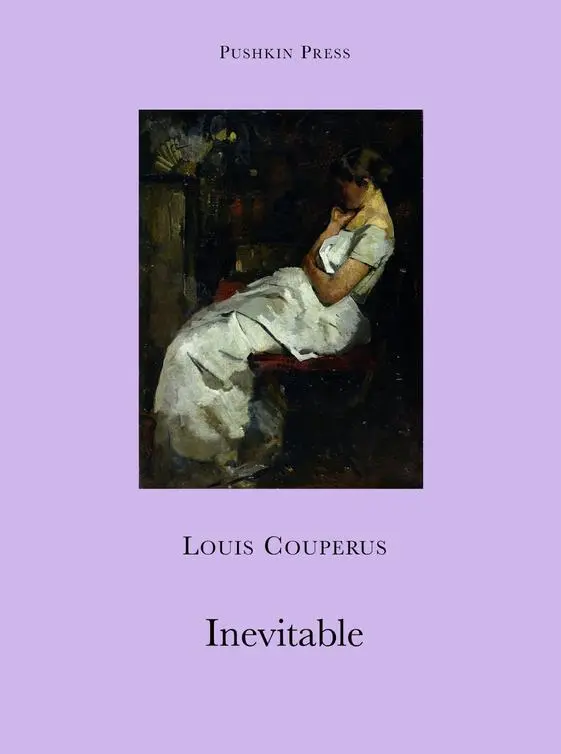
- Название:Inevitable
- Автор:
- Издательство:Pushkin Press
- Жанр:
- Год:2013
- ISBN:9781908968562
- Рейтинг книги:4 / 5. Голосов: 1
-
Избранное:Добавить в избранное
- Отзывы:
-
Ваша оценка:
Inevitable: краткое содержание, описание и аннотация
Предлагаем к чтению аннотацию, описание, краткое содержание или предисловие (зависит от того, что написал сам автор книги «Inevitable»). Если вы не нашли необходимую информацию о книге — напишите в комментариях, мы постараемся отыскать её.
Inevitable — читать онлайн бесплатно полную книгу (весь текст) целиком
Ниже представлен текст книги, разбитый по страницам. Система сохранения места последней прочитанной страницы, позволяет с удобством читать онлайн бесплатно книгу «Inevitable», без необходимости каждый раз заново искать на чём Вы остановились. Поставьте закладку, и сможете в любой момент перейти на страницу, на которой закончили чтение.
Интервал:
Закладка:
But she must warn Urania.
And, exhausted, she fell asleep.
XV
CORNÉLIE’S SUSPICION about Mrs Van der Staal’s opinion of her relationship with Duco proved true: Mrs Van der Staal had a serious talk with her, saying that if she went on in this way she would compromise herself, and added that she had spoken to Duco in the same vein. But Cornélie answered quite haughtily and stated nonchalantly that after having respected convention and nevertheless having become deeply unhappy, henceforth she no longer bothered about it, and that she enjoyed Duco’s conversation without allowing herself to be prevented by what ‘one’ did and thought. And anyway, she asked Mrs Van der Staal, who was ‘one’? The three or four people they knew at Belloni? Who else knew her? Where else did she go? What did she care about The Hague? And she laughed sarcastically, loftily parrying Mrs Van der Staal’s arguments. As a result their relationship cooled: she did not come to Belloni to dine that evening, stung in her easily offended over-sensitivity. The next day, meeting Duco at their table in the osteria , she asked what he thought about his mother’s reprimand. He smiled vaguely, eyebrows raised, obviously not realising the mediocre truth of his mother’s words, saying that those were mama’s ideas, naturally perfectly good and current in the circles mama and his sisters moved in, but which he did not delve into too deeply, and which did not bother him, unless Cornélie thought that mama was right. And Cornélie erupted sarcastically, shrugging her shoulders and asked in the name of whom and what they should allow themselves to be prevented from continuing their friendly relations. They ordered half a flask between them, and had a protracted and enjoyable meal, like two comrades, two students. He said that he had thought about her pamphlet; he spoke — to please her — about the position of modern woman, about girls. She criticised the upbringing Mrs Van der Staal was giving his sisters, the insubstantial, glittering education and that eternal going out and looking for a husband. She spoke from experience, she said. That day they walked along the Appian Way and visited the Catacombs, guided by a Trappist. Then they took a carriage, drove back to Rome and had tea at Razotti’s patisserie. When Cornélie got home, she felt in a pleasant mood, light-hearted and cheerful. She did not go out again, banked up her fire with wood for the night, which was becoming chilly, and dined alone on some bread and jelly so as not to have to go out to a restaurant. In her peignoir with her hands behind her head, she stared into the nicely burning wood, and let the evening glide past. She was happy with her life, so free, free of everything and everyone. She had a little money, and could go on living like this. She did not have many needs. Her life in rooms and modest restaurants did not cost much. She did not need outfits. She felt content. Duco was a good friend; how lonely she would be without him. But, her life must acquire a purpose … What? What? The Women’s Movement …? But how, abroad? Working on it was so difficult … She would send her pamphlet to a new women’s magazine, recently founded. But what then? The fact was that she was not in Holland and did not want to go to Holland: and yet it would definitely be easier to become active there, and exchange views with others. But here in Rome … A languor came over her, in the warmth of her snug room. Duco had helped her arrange her sitting-room. He really was a cultured person, even if he was not modern. He knew a lot about history, about Italy, and talked really well. The way he explained Italy to her, she found the country interesting after all.
The only problem was that he was not modern. He had no sense of the politics of Italy, nor of the battle between the Quirinal and the Vatican; nor of anarchism, which was rearing its head in Milan, nor of the turbulence in Sicily … A goal; so difficult to have a goal …
And in her evening languor after a pleasant day, she did not feel the lack of a goal, she savoured the gentle delight of letting her thoughts glide along with the languorous evening hours, in selfish contentment. She looked at the pages of her pamphlet, strewn over her large desk: a table for working at: they lay there yellow in the light of her reading lamp: none of them had yet been copied out, but she did not feel like doing it now: she threw a log into the hearth, and the fire smoked and revived. It was so cosy abroad using logs of wood for fires … And she thought of her husband. Sometimes she missed him. Would she not have been able to manage him with a little tact and patience? He had after all been very nice to her at the time of their engagement. He was coarse, but he was not evil. He sometimes swore at her, but perhaps he had not really meant it. He waltzed beautifully, he spun you round with him so firmly … He was a handsome fellow, and she admitted she was in love with him, only because of his handsome face, his handsome body. There was something in his eyes and his mouth that she could not resist. When he spoke she had been unable to resist looking at his mouth. Anyway, it was over now … Perhaps life in The Hague had been too monotonous for her nature. She liked travel, seeing new people, developing new thoughts, and she had never been able to put down roots in her coterie. And now she was free, free of all bonds, all people. What did she care if Mrs Van der Staal was angry … And Duco was modern after all in his indifference to convention. Or was it just the artist in him; or was it indifferent to him, as an un-modern man, as it was to her, a modern woman? A man had more leeway. It was not as easy for a man to compromise himself. Modern woman … She repeated it proudly. A sense of pride pierced her languor. She stood up, stretched her arms, saw her slim figure in the mirror, her delicate face, rather pale, eyes large, grey and shining beneath strikingly long lashes; her dark blond hair in a loose, dishevelled bun; her fractured lily-like figure extremely appealing in the crumpled folds of her old peignoir , pale-pink and faded. Where was her path? She felt not only a worker and a striver, she felt very complex; she felt a woman too, she felt a great deal of femininity in herself, like a languor, that threatened to paralyse her energy. And she wandered round the room, unable to decide whether to go to bed, and staring into the glowing embers of the fire that had died down, she thought of her future, of who and what she would become, and how and where she would go, along which of life’s arabesques, wending her way through what woods, winding down what avenues, crossing what other arabesques of what other questing souls?
XVI
FOR SOME TIME it had been an idée fixe of Cornélie’s that she must speak to Urania Hope, and one morning she wrote a note asking to see her that afternoon. Miss Hope agreed and at five o’clock Cornélie found her at home in her beautiful, expensive apartment at Belloni: a blaze of light, flowers everywhere; Urania, hammering on the piano, in a house-dress of Venetian lace, while a sumptuous tea of cakes, sandwiches and sweets had been laid out. Cornélie had written in her note that she wished to speak to Miss Hope alone on an important subject and asked immediately if they would be alone, undecided now that Urania received her so grandly. But Urania put her mind at rest: she was only at home to Mrs De Retz and was very curious to know what Cornélie wished to talk to her about. Cornélie reminded Urania of her first warning and when Urania laughed she took her hand and gave her such a serious look, that she made an impression on the American’s girl’s light-hearted nature and Urania became intrigued. Now she suddenly found it very important — a secret, an intrigue, a danger in Rome! — and the two whispered together. And Cornélie, no longer afraid in this atmosphere of increasing familiarity, confessed to her what she had overheard at the Christmas ball through the chink in the door: the machinations of the marchesa and her nephew, whom she was determined to marry off to a rich heiress for the sake of the prince’s father, who appeared to have promised her a considerable sum for such a marriage. Then she spoke about the conversion of Miss Taylor, engineered by Rudyard, who seemed unable to exert his influence on her, Urania — being unable to gain a hold over her unsuspecting but airy butterfly nature, and — as Cornélie suspected — as a result had incurred the disapproval of his clerical superiors, and had disappeared, without being able to pay what he owed the marchesa . Now he seemed to have been replaced by the two monsignori , who looked more distinguished, more worldly, and were more emollient, with more smiles. And Urania, staring this danger in the face, at those layers hidden beneath her feet, which Cornélie suddenly revealed to her, was now truly alarmed, went pale and promised to be on her guard. In fact she would have preferred to tell her chambermaid to pack at once in order to leave Rome as soon as possible, and go to another town to another pensione , where the nobility was well represented: the nobility was so adorable! And Cornélie, seeing that she had made an impact, went on, talked about herself, talked about marriage, and said that she had written a pamphlet against marriage and about the Social Situation of the Divorced Woman. And she talked of the unhappiness she had been through, and of the Women’s Movement in Holland. And once she got into the swing, she could no longer hold herself in check, and became more and more impassioned and intense, until Urania found her very clever — a very clever girl — to be able to reason like that and write about a “ question brulante ”. She put a heavy emphasis on the first syllables of the French words and admitted that she would like to have the vote, and as she spoke unfolded the long train of her lace tea-gown. Cornélie spoke of the injustice of the law, which leaves a woman nothing, but takes everything from her, forces her completely into the power of the man, and Urania agreed with her and offered her the dish of fine sweets. And over a second cup of tea they talked excitedly, both at the same time, the one not hearing what the other was arguing, and Urania said that it was a shame. From a general discussion, they returned to their own interests: Cornélie described the character of her husband, too coarse to understand a woman’s nature, unable to accept that a woman should stand alongside him and not below him. And again she returned to the Jesuits, on the dangers lurking in Rome for rich girls on their own, to that crone of a marchesa , and to that prince: titled bait, cast out by the Jesuits, to win a soul and to improve the finances of an impoverished Italian house — one that had remained loyal to the Pope and did not serve the king. They were both so heated and excited that they did not hear a knock at the door, and only looked up when the door slowly opened. They started, looked up, and both went pale when they saw the Prince of Forte-Braccio enter. He apologised with a smile, said that he had seen the light on in Miss Urania’s drawing-room, that the doorman had tried to bar his way but that he had forced his way in. He sat down and despite everything they had just discussed, Urania was delighted that the prince was sitting there and had accepted a cup of tea and consented to eat a cake.
Читать дальшеИнтервал:
Закладка:
Похожие книги на «Inevitable»
Представляем Вашему вниманию похожие книги на «Inevitable» списком для выбора. Мы отобрали схожую по названию и смыслу литературу в надежде предоставить читателям больше вариантов отыскать новые, интересные, ещё непрочитанные произведения.











Обсуждение, отзывы о книге «Inevitable» и просто собственные мнения читателей. Оставьте ваши комментарии, напишите, что Вы думаете о произведении, его смысле или главных героях. Укажите что конкретно понравилось, а что нет, и почему Вы так считаете.