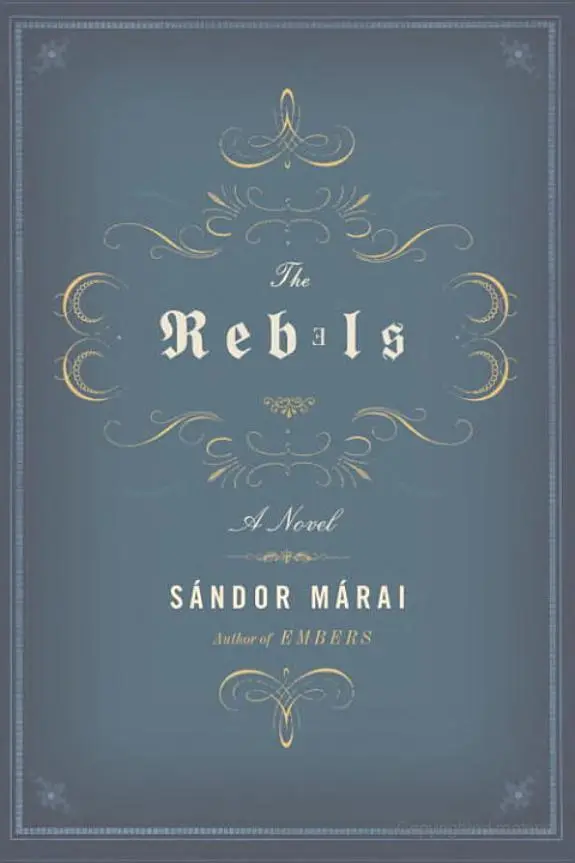
Sandor Marai - The Rebels
Здесь есть возможность читать онлайн «Sandor Marai - The Rebels» весь текст электронной книги совершенно бесплатно (целиком полную версию без сокращений). В некоторых случаях можно слушать аудио, скачать через торрент в формате fb2 и присутствует краткое содержание. Год выпуска: 2004, ISBN: 2004, Издательство: Knopf Doubleday Publishing Group, Жанр: Классическая проза, на английском языке. Описание произведения, (предисловие) а так же отзывы посетителей доступны на портале библиотеки ЛибКат.
- Название:The Rebels
- Автор:
- Издательство:Knopf Doubleday Publishing Group
- Жанр:
- Год:2004
- ISBN:9780307267405
- Рейтинг книги:3 / 5. Голосов: 1
-
Избранное:Добавить в избранное
- Отзывы:
-
Ваша оценка:
The Rebels: краткое содержание, описание и аннотация
Предлагаем к чтению аннотацию, описание, краткое содержание или предисловие (зависит от того, что написал сам автор книги «The Rebels»). Если вы не нашли необходимую информацию о книге — напишите в комментариях, мы постараемся отыскать её.
is a haunting story of a group of alienated boys on the cusp of adult life—and possibly death—during World War I.
It is the summer of 1918, and four boys approaching graduation are living in a ghost town bereft of fathers, uncles, and older brothers, who are off fighting at the front. The boys know they will very soon be sent to join their elders, and in their final weeks of freedom they begin acting out their frustrations and fears in a series of subversive games and petty thefts. But when they attract the attention of a stranger in town—an actor with a traveling theater company—their games, and their lives, begin to move in a direction they could not have predicted and cannot control, and one that reveals them to be strangers to one another. Resisting and defying adulthood, they find themselves still subject to its baffling power even in their attempted rebellion.
The Rebels — читать онлайн бесплатно полную книгу (весь текст) целиком
Ниже представлен текст книги, разбитый по страницам. Система сохранения места последней прочитанной страницы, позволяет с удобством читать онлайн бесплатно книгу «The Rebels», без необходимости каждый раз заново искать на чём Вы остановились. Поставьте закладку, и сможете в любой момент перейти на страницу, на которой закончили чтение.
Интервал:
Закладка:
They make their way slowly past the line of poplars, ever closer to town. A thin fog hangs over the river, the kind of early fog expected on very hot days.
Kikinday observes encouragingly that military training takes much less time now than it did in his day.
“You are lucky not to know the meaning of real training,” he sighs. “How would you know? You haven’t hung about in barracks, followed by three or four weeks of drill, no, you can go straight to the front. In my time,” he stretched his arms wide as he always did when talking about “his time,” a time he did not describe in any precise detail but indicated with a gesture that spoke of some half-forgotten, never-to-return golden age of mankind, “in my time we had to squat, lie on our stomachs, and march in the baking heat. Your generation? Three weeks and you’re off.”
Kikinday had wasted few opportunities in recent years to wave his hat at the younger generation as they departed in cattle trucks. He was always first among the local dignitaries at the station bidding farewell to the troops: this role befitted his social standing and established him as a friend to youth.
They took leave of each other by the courtroom. Kikinday made Ábel promise to inform him when he was about to set off on his travels. With the greatest tact Kikinday always referred to such military leave-takings as “setting off on one’s travels.” Tower-like he made his way up the cool steps. Ábel watched him reach one of the landings. He began to feel sick. He himself ascended the three steps that formed the entrance to the school with great care. The class was standing in a semicircle under the linden tree. He squeezed himself in at the end of a line, the form master sitting at the center with an expression of the greatest historical gravity while Béla and Tibor lay like two chained mastiffs couchant at his feet. The photographer had set up his equipment complete with black cloth and was barking out a few words of instruction, the last words of instruction they would ever hear in this yard. At the very last moment, just as the camera was about to click, he quickly spun around and turned his back to it. Ernõ noticed and did the same. And so the class ceremonially entered the school gallery’s version of eternity.
“Future generations may well scratch their heads,” said Ábel, “wondering who they were, those two figures turning their backs on immortality.”
The various groups dispersed while they hung back, loafing in the sunshine, sleepless and shivering. Béla’s teeth were chattering from exhaustion.
“I must sleep,” he said. “I can’t go on now. Till tonight then.”
“Till tonight.”
Ernõ suddenly butted in.
“I went by his place this morning,” he whispered.
They stopped and listened with downcast eyes, somewhat coldly and against their wills, as he quickly continued.
“He wouldn’t let me in. He spoke through the door, saying he was all right, he felt fine. He said not to wait for him.”
A deep silence followed his words and he himself suddenly fell silent. Tibor lit a cigarette and offered a light to the others.
“Then we don’t wait,” he shrugged, perfectly courteous. He stood there for a while, then extended his hand for them to shake. “Very well then, tonight.”
Then he linked arms with Ábel.
They had to wait at the swimming pool. It was still the hour set aside for women. They sat down on a bench by the ticket office. The smell of rotting boards, damp sludge, and the familiar stench of stale underwear hit them. They could hear the women’s cries.
“Hairdressers,” said Tibor.
The leaden weight of the heat smoothed the water and gave it a metallic sheen. The heat was sticky, dense, almost tangible. Tibor leaned back and started whistling.
“Please stop whistling,” said Ábel.
Tibor examined his nails. In a distracted singsong voice he declared: “I don’t like the look of Mother. Her behavior was distinctly odd this morning. But what I meant to say was…we’re seeing Havas at two.”
He whistled a few more bars and blinked at the river, his mind elsewhere.
“What I really meant to say,” he continued, “was that half an hour ago I walked into the local recruiting office. The commanding officer there is a reliable officer of my father’s. I volunteered. He in turn gave me permission to enlist as a volunteer. I start tomorrow morning, first thing.”
When Ábel did not respond he put his hand on his knee.
“Don’t be angry, Ábel. I just can’t go on like this.” He raised his arm and indicated everything around him. “I can’t go on like this,” he repeated. “There’s nothing I can do about it.”
He rolled a cigarette, sat down on the wooden railings of the bridge, and dangled his feet over it.
“What do you think we should do? I think everyone could take away whatever was important to them from The Peculiar tonight…I must return the saddle whatever happens.”
He licked the cigarette, lit it, and when he had waited for some time in vain for a response, he repeated uncertainly:
“What do you think?”
Ábel stood up, leaned against the boards of the cabin. His skin looked gray and pale but his voice was calm.
“So it’s over.”
“I think so.”
“The gang, The Peculiar, are all over?”
“I think so.”
“In that case there’s something I must tell you,” he said and took a deep breath. “I should have told you long ago, I wanted to tell you. Please don’t be cross, Tibor, there’s nothing I can do about it.”
He rested his head against the wall. In a plain, almost chatty way he said: “I had to tell you this just once. I love you. Does that surprise you?” He stretched out his arms, and quickly, feverishly continued, his voice reassuring. “Don’t be angry, but I’ve suffered a great deal on your account. More than a year now. I myself can’t explain what it is I love about you. I had to tell you sometime. Maybe it’s because you are beautiful. You’re not, if I may say, particularly bright. You must forgive me saying so because I’m an unhappy creature. I would give you everything I own, whatever I am likely to own in the future. Do you believe me?”
Tibor leapt off the railings, threw away his cigarette, seized Ábel’s arm, and tugged at it frantically.
“You must swear!”
He was shaking Ábel with all his power in sheer desperation.
“I swear…”
“You must swear that you’ll never mention this again.”
“I’ll never mention it again.”
“You want to remain friends?”
“Yes.”
“So not another word about it, all right?”
“Not a word.”
They were breathing hard. Tibor let go of Ábel’s arm, sat down on the bench, and put his head in his hands. Ábel slowly crossed the bridge, stopped, leaned against the railing and out over the water. Someone’s feet were tapping on the bridge behind them. Tibor waited until the steps died away, then moved over to Ábel, leaned on his elbows beside him, and put an arm around his shoulder. He had tears in his eyes.
“Do you believe in God?”
“I don’t know.”
“What do you think?” he asked timidly. “I think we will survive.”
They looked at each other. Tibor leaned towards him carefully and, very gently, touched his face with his hands, first on the left side, then on the right. For a moment they stared at each other, then Ábel threw himself to the ground, facedown in the earth. He was shaken by wild uncontrollable sobs, his hands scrabbling in the mud as he pressed his face into the softness, his whole body racking and tossing. He wept quietly, at the back of his throat, with a slight wheeze. Then he stopped moving and lay there a long time while his weeping subsided. When he sat up he wiped his face with his muddy hands and looked wearily around him.
Читать дальшеИнтервал:
Закладка:
Похожие книги на «The Rebels»
Представляем Вашему вниманию похожие книги на «The Rebels» списком для выбора. Мы отобрали схожую по названию и смыслу литературу в надежде предоставить читателям больше вариантов отыскать новые, интересные, ещё непрочитанные произведения.









Обсуждение, отзывы о книге «The Rebels» и просто собственные мнения читателей. Оставьте ваши комментарии, напишите, что Вы думаете о произведении, его смысле или главных героях. Укажите что конкретно понравилось, а что нет, и почему Вы так считаете.