Sandor Marai - The Rebels
Здесь есть возможность читать онлайн «Sandor Marai - The Rebels» весь текст электронной книги совершенно бесплатно (целиком полную версию без сокращений). В некоторых случаях можно слушать аудио, скачать через торрент в формате fb2 и присутствует краткое содержание. Год выпуска: 2004, ISBN: 2004, Издательство: Knopf Doubleday Publishing Group, Жанр: Классическая проза, на английском языке. Описание произведения, (предисловие) а так же отзывы посетителей доступны на портале библиотеки ЛибКат.
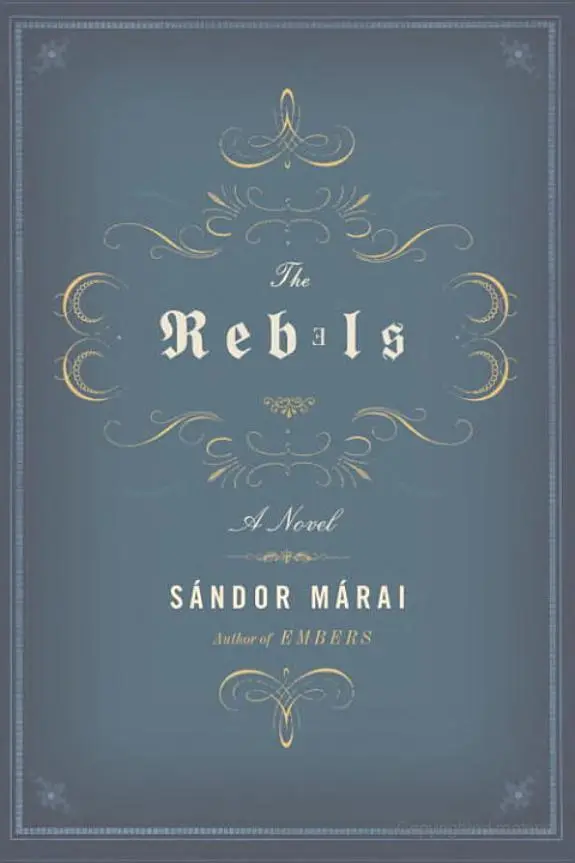
- Название:The Rebels
- Автор:
- Издательство:Knopf Doubleday Publishing Group
- Жанр:
- Год:2004
- ISBN:9780307267405
- Рейтинг книги:3 / 5. Голосов: 1
-
Избранное:Добавить в избранное
- Отзывы:
-
Ваша оценка:
The Rebels: краткое содержание, описание и аннотация
Предлагаем к чтению аннотацию, описание, краткое содержание или предисловие (зависит от того, что написал сам автор книги «The Rebels»). Если вы не нашли необходимую информацию о книге — напишите в комментариях, мы постараемся отыскать её.
is a haunting story of a group of alienated boys on the cusp of adult life—and possibly death—during World War I.
It is the summer of 1918, and four boys approaching graduation are living in a ghost town bereft of fathers, uncles, and older brothers, who are off fighting at the front. The boys know they will very soon be sent to join their elders, and in their final weeks of freedom they begin acting out their frustrations and fears in a series of subversive games and petty thefts. But when they attract the attention of a stranger in town—an actor with a traveling theater company—their games, and their lives, begin to move in a direction they could not have predicted and cannot control, and one that reveals them to be strangers to one another. Resisting and defying adulthood, they find themselves still subject to its baffling power even in their attempted rebellion.
The Rebels — читать онлайн бесплатно полную книгу (весь текст) целиком
Ниже представлен текст книги, разбитый по страницам. Система сохранения места последней прочитанной страницы, позволяет с удобством читать онлайн бесплатно книгу «The Rebels», без необходимости каждый раз заново искать на чём Вы остановились. Поставьте закладку, и сможете в любой момент перейти на страницу, на которой закончили чтение.
Интервал:
Закладка:
She would have been prepared to share him, but couldn’t bear to admit to herself that there was nothing left to share. Ábel, who had once been hers, was lost to her. The house was big and empty now. The town too seemed emptier without the men. Life no longer had a single comprehensive meaning for her. Ábel lowered his eyes whenever she spoke to him. She had noticed how often, reluctantly, possibly out of pity, he lied to her. He lied to her as if he didn’t want the truth to hurt her. And since she dared not investigate the lies she hastened to accept what the boy said.
The scent of Ábel’s childhood slowly faded from the rooms. Both of them went round trying to hang on to the lingering trail of it, searching for the life that had gone, the intimacy of the looks they had once cast on each other, the affection once implicit in their gestures. She gave in, and like all those who recognize some major mistake in their lives, found a calm indifference settling on her. The boy had, in some sense, been abducted. Some similar force had taken his father too. The meaning of her life had drifted away from her.
Ábel hovered around Tibor with a bad conscience. Ever since the actor had entered their lives the bond between them was fraught with tension and anxiety. Sometimes he was seized by such fierce jealousy that there were afternoons and nights when he had to slip out of his room, trudge over to Tibor’s house, and stand beneath the window to assure himself that Tibor was at home. Other times he would set up watch outside the actor’s house when the performances were over. He’d wait for hours for the actor to arrive, his heart in his mouth as he spied on him, feeling ashamed and yet relieved as he sneaked home again.
He endeavored to separate Tibor from the rest of the gang so that he could be alone with him. This experiment was all the more painful as he knew that Tibor found him dull company. Ábel worked with feverish enthusiasm to find amusements for Tibor. He dragged the secrets of home and hearth before him, hastened to bring him gifts, did his homework for him, got his aunt to cook him her special meals. He played the piano for him. He was more than willing to master the secrets of boxing, high jump, and gymnastics in order to amuse Tibor. He found various shy excuses to share his money with him and when, egged on by the gang, Tibor later executed the grand coup of pawning the family silver, he accompanied Tibor the entire length of the hazardous route. Perhaps if he were a direct witness to Tibor’s fall from grace he might gain some power over him. Perhaps he could be such a close accomplice in Tibor’s fall from grace that, if they had to sin and suffer, at least they might sin and suffer together.
Tibor found his company dull. He was careful to show his boredom nicely, with delicacy and good manners as Ábel noted to his despair. He talked in order to please him and got hold of books in order that Ábel might explain their contents to him.
A copy of Kuprin’s The Duel lay on Ábel’s desk.
“Incomprehensible and dull, isn’t it?” Tibor politely remarked. Ábel searched feverishly for an answer but gave up and fell silent, his head bowed.
“Incomprehensible and dull,” he said and stared ahead, stricken with guilt.
What did it matter that he had betrayed the spirits of great writers to gain Tibor’s favor? A volume of the humor magazine Fidibus lay on the shelf. Tibor reached over for it with considerable enthusiasm. Ábel observed and suffered as Tibor leafed slowly through pages of smutty jokes, carefully explaining them to him, feeling nervous in the presence of material of whose existence he had heard only by vague report. What could he give Tibor? Whenever they were separated he felt lost and hurt. He prepared himself for their meetings and tried to invent something new and surprising for each occasion. Meanwhile Tibor yawned discreetly, his hand covering his mouth.
He was distressed to feel so stupid, so inadequate to the honor of being Tibor’s companion. He examined himself in front of the mirror. His ginger hair, his myopic eyes, his freckled face, his scrawny body and bad posture made a painful spectacle compared to Tibor, who was fresh-faced, tall, refined yet certain in movement, held his head well, his eyes full of mild haughtiness and self-confidence, his expression conveying a raw yet delicate childishness.
He is my friend, thought Ábel, a hot sweet flush of gratitude running through him. He looks wonderful, he sometimes thought as if for the first time and felt the incomprehensible, agonizing shock of it all over again. He tried to entice Tibor into his own secret world. Tibor gazed with interest at Ábel’s house, taking in the courtyard, the garden, the secrets of the hidey-hole, and all the treasures of the vanished kingdom, while Ábel tried to conjure up for him the world of fairy tales and toys he had lived with in the glazed conservatory. Tibor followed him around, courteous and mildly bored. They talked of girls but Ábel sensed they were both lying. They competed in telling each other ever more lewd imagined adventures, not daring to look each other in the eye. They bragged of several lovers, extraordinary, quite remarkable sweethearts with whom—secretly of course—they were still in touch.
They were talking like this in the garden one day when Ábel suddenly fell silent in the middle of a story.
“It’s a lie,” he said and stood up.
Tibor also stood up, his face pale.
“What do you mean?”
“Every word I have ever spoken about girls was a lie. Not a word of it is true, not one. And you’re lying too. Admit it, you’re lying. Come on. Own up. Tibor, you are lying, aren’t you?”
They were both trembling. Ábel seized Tibor’s hand.
“Yes,” Tibor reluctantly confessed. “I’m lying.”
He freed his hand.
Ábel wanted to share his memories of his father with Tibor. For his father was only a memory now, a confusing figure shrouded in mist, adrift between the concepts of godhead and death. This was the one area where Tibor appeared to follow him with pleasure and enthusiasm. They exchanged memories of their fathers, of their first fears and of every little incident that continued to linger in their minds, glimmering there forever like distant shining myths. Tibor recounted his shock on discovering a fish-bladder condom in his father’s bedside-table drawer and described in some confusion—and with evident pain—his despair the first time his father failed to keep a promise and told a lie. He had run away with Lajos that day to hide in the stable at the barracks and felt so desperate he wanted to die.
They had no difficulty talking about their fathers. Their fathers were at the root of every difficulty: they were insincere, they refused to give straight answers, they wouldn’t say what they were suffering. The skies around their heavenly thrones had darkened to a gray shower of disappointments. The only way they could make proper peace with their fathers, suggested Ábel, would be eventually to form a pact with them.
I don’t think that’s possible, shuddered Tibor. Mine might just shoot me. He is in the mood for it. And he’d be perfectly entitled to, I think. If he came home tomorrow and failed to find the silverware or the saddle…What do you think it would be like if yours came back?
Ábel closed his eyes. His father’s return would be an extraordinary ceremonial occasion, something between a royal funeral and the emperor’s birthday. Bells would no doubt be rung as he marched in, then he’d sit down at the table, deplore the loss of his violin, and look for certain scissors and tweezers. Ábel would enter and stand before him.
“Delighted to see you, sir,” he would say and make a low bow. At that point all hell would break loose. Perhaps his father would raise his hand and hurl thunderbolts at him. But it might be that he would walk up to him and there would be an anxious moment while he considered the possibility of taking him in his arms, embracing him, and kissing him. So they would stare at each other, uncertain what to do.
Читать дальшеИнтервал:
Закладка:
Похожие книги на «The Rebels»
Представляем Вашему вниманию похожие книги на «The Rebels» списком для выбора. Мы отобрали схожую по названию и смыслу литературу в надежде предоставить читателям больше вариантов отыскать новые, интересные, ещё непрочитанные произведения.










Обсуждение, отзывы о книге «The Rebels» и просто собственные мнения читателей. Оставьте ваши комментарии, напишите, что Вы думаете о произведении, его смысле или главных героях. Укажите что конкретно понравилось, а что нет, и почему Вы так считаете.