Max Blecher - Adventures In Immediate Irreality
Здесь есть возможность читать онлайн «Max Blecher - Adventures In Immediate Irreality» весь текст электронной книги совершенно бесплатно (целиком полную версию без сокращений). В некоторых случаях можно слушать аудио, скачать через торрент в формате fb2 и присутствует краткое содержание. Год выпуска: 2015, Издательство: New Directions Publishing Corporation, Жанр: Классическая проза, на английском языке. Описание произведения, (предисловие) а так же отзывы посетителей доступны на портале библиотеки ЛибКат.
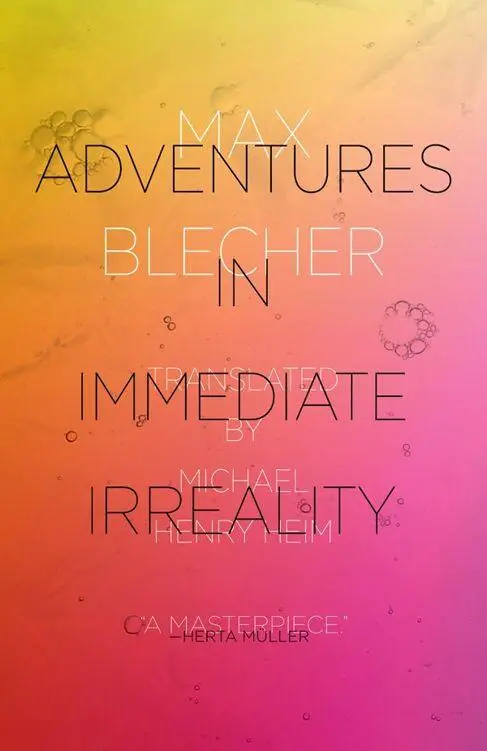
- Название:Adventures In Immediate Irreality
- Автор:
- Издательство:New Directions Publishing Corporation
- Жанр:
- Год:2015
- ISBN:нет данных
- Рейтинг книги:4 / 5. Голосов: 1
-
Избранное:Добавить в избранное
- Отзывы:
-
Ваша оценка:
Adventures In Immediate Irreality: краткое содержание, описание и аннотация
Предлагаем к чтению аннотацию, описание, краткое содержание или предисловие (зависит от того, что написал сам автор книги «Adventures In Immediate Irreality»). Если вы не нашли необходимую информацию о книге — напишите в комментариях, мы постараемся отыскать её.
The small, insignificant town is the scenery of incredible encounters with different characters, who populate a world far away from the natural rules of the universe. The discovery of the sexuality has in itself the power of the primitive initiations, but also the perversity of the surrealist paintings.
The laws of friendship rely on the capacity of the two parts to build around them a world without meaning or history. The nature is overwhelming, miraculous, troublesome. The houses live their own lives, being true bodies that breathe, suffer, transform.
The final, senseless death of a young, beautiful, mysterious young woman brings with it a deep understanding of life as a long series of sufferings and illuminations, administered by fear, nightmares, pain, but also by aesthetic ecstasies and intellectual crisis.
Adventures In Immediate Irreality — читать онлайн бесплатно полную книгу (весь текст) целиком
Ниже представлен текст книги, разбитый по страницам. Система сохранения места последней прочитанной страницы, позволяет с удобством читать онлайн бесплатно книгу «Adventures In Immediate Irreality», без необходимости каждый раз заново искать на чём Вы остановились. Поставьте закладку, и сможете в любой момент перейти на страницу, на которой закончили чтение.
Интервал:
Закладка:
But there was more: the objects were seized by a veritable frenzy of freedom, and the independence they declared of one another went far beyond simple isolation to exultation, ecstasy. Their enthusiasm for living in a new light encompassed me as well: I felt powerful bonds linking me to them, invisible networks making me every bit as much of an object, a part of the room, as they were, the way an organ grafted onto a living organism goes through subtle physical metamorphoses until it becomes one with the body once foreign to it.
Once during a crisis the sun sent a small cascade of rays onto the wall like a golden artificial lake dappled with glittering waves. I also saw the corner of a bookcase of large, leather-bound volumes behind glass. And in the end these true-to-life details, perceived from the distance of my swoon, stupefied and stunned me like a last gulp of chloroform. It was what was most humdrum and familiar in the objects that disturbed me most. The habit of being seen so many times must have worn out their thin skins, and they sometimes looked flayed and bloody to me — and alive, ineffably alive.
The climax of the crisis would occur when I began floating above the world, a condition at once pleasant and painful. At the first sound of footsteps the room reverted to its original state: things fell back into place, and I noted an ever so slight, all but imperceptible reduction in its exaltation, which gave me to believe that the certitudes I lived by were separated from the world of incertitudes by only the flimsiest of membranes.
I would awake in my old familiar room, bathed in sweat, exhausted, and fully aware of the futility of the things surrounding me but observing new details in them, as we sometimes discover a novel feature in something we have used every day for years. The room retained a vague memory of the catastrophe, like the smell of sulfur after an explosion. Gazing at the bound books behind the bookshelf glass, I somehow took their immobility for a perfidious sign of furtiveness and complicity: the objects around me never gave up the secretive attitude fiercely guarded by their impassivity.
Ordinary words lose their validity at certain depths of the soul. Here I am, trying to give an exact description of my crises, and all I can come up with are images. The magic word that might convey their essence would have to borrow from the essences of other aspects of life, distill a new scent from a judicious combination of them. It would have to contain something of the stupefaction I feel watching a person in reality and then following his gestures in a mirror, of the instability accompanying the falls I have in my dreams and the subsequent unforgettable moment of fear whistling through my spinal chord, or of the transparent mist inhabited by the bizarre decors of crystal balls I have known.
I envied the people around me who are hermetically sealed inside their secrets and isolated from the tyranny of objects. They may live out their lives as prisoners of their overcoats, but nothing external can terrorize or overcome them, nothing can penetrate their marvelous prisons. I had nothing to separate me from the world: everything around me invaded from head to toe; my skin might as well have been a sieve. The attention I paid to my surroundings, nebulous though it was, was not simply an act of will: the world, as is its nature, sank its tentacles into me; I was penetrated by the hydra’s myriad arms. Exasperating as it was, I was forced to admit that I lived in the world I saw around me; there was nothing for it.
The crises belonged as much to the places where they occurred as to me. True, some places had their own “personal” evil, but even those that did not were in a trance long before I appeared. In some rooms, for example, I felt the crises to be the crystallization of the melancholy caused by their immobility and boundless solitude.
However, the conviction that objects could be inoffensive — which arose as a kind of truce between me and the world (a truce that plunged me even more hopelessly into the uniformity of brute matter) — came to pass off a terror equal to the terror the objects themselves at times imposed upon me: their inoffensiveness came from a universal lack of strength. I had the vague feeling that nothing in the world can come to fruition, that it is impossible to accomplish anything. Even the ferocity of objects runs its course. It was thus that the idea of the imperfection of all phenomena in the world, natural or supernatural, took shape in me.
In an internal dialogue that I believe never ceased I would defy the evil powers around me one day and flatter them basely the next. I would indulge in certain odd rites, though not without motivation.
Whenever I went out and took different streets, I would retrace my steps on the way home. I did so to avoid making a circle in which trees and houses would be inscribed. In this respect, my walks were like a thread which, once unwound, I needed to rewind along the same route, and had I not done so the objects caught in the loop would have forever been closely attached to me.
Whenever it rained, I would be careful not to touch the stones in the path of the streams of water. I did so to add nothing to the water’s activity and to enable it to exercise its elemental powers unimpeded.
Fire purifies all. I always had a box of matches in my pocket, and when I felt particularly sad I would light a match and pass my hands through the flame, first one, then the other.
All this bespoke a melancholy of existence, a kind of normally organized torture in the course of my life as a child. In time the crises disappeared by themselves, though not without leaving behind a powerful memory. And although they were gone by the time I reached adolescence, the crepuscular state preceding them and the deep sense of the futility of the world coming after became, so to speak, my natural state.
Futility filled the hollows of the world like a liquid spreading in all directions, and the sky above me — eternally correct, absurd, and obscure — turned its own color of despair. Surrounded by that futility and beneath that sky, I wander eternally cursed to this day.
Chapter Two
The doctor I consulted about my crises pronounced a strange word: “paludism.” I was amazed that my secret and intimate afflictions could have a name, and a name so bizarre to boot. The doctor prescribed quinine — another cause for amazement. I could not comprehend how an illness, it , could be cured with quinine taken by a person, me . But what disturbed me most was the doctor himself. Long after he examined me, he continued to exist and bustle about my memory with those minute, automatic gestures I could not stop him from making.
He was a short man with an egg-shaped head, the pointed end of the egg lengthening into a black beard continually in motion. His small velvet eyes, fitful gestures, and thrust-forward mouth made him look like a mouse. The impression was so immediate and so strong that I thought it perfectly natural that he should give his r ’s a long and sonorous roll as if he were munching something in secret as he spoke. The quinine he gave me only increased my conviction there was something mouse-like about him, and the confirmation of said conviction proved so strange and touched on facts so central to my childhood that I believe the incident worthy of recounting.
Not far from our house there was a shop that sold sewing machines. I spent hours there every day. The owner was a young man by the name of Eugen who had just completed his military service and hoped to earn a living from the shop. He had a sister, Clara, who was a year younger than he. They lived together on the outskirts of town and spent all day in the shop, having neither friends nor relatives.
Читать дальшеИнтервал:
Закладка:
Похожие книги на «Adventures In Immediate Irreality»
Представляем Вашему вниманию похожие книги на «Adventures In Immediate Irreality» списком для выбора. Мы отобрали схожую по названию и смыслу литературу в надежде предоставить читателям больше вариантов отыскать новые, интересные, ещё непрочитанные произведения.












Обсуждение, отзывы о книге «Adventures In Immediate Irreality» и просто собственные мнения читателей. Оставьте ваши комментарии, напишите, что Вы думаете о произведении, его смысле или главных героях. Укажите что конкретно понравилось, а что нет, и почему Вы так считаете.