Pearl Buck - Kinfolk
Здесь есть возможность читать онлайн «Pearl Buck - Kinfolk» весь текст электронной книги совершенно бесплатно (целиком полную версию без сокращений). В некоторых случаях можно слушать аудио, скачать через торрент в формате fb2 и присутствует краткое содержание. Год выпуска: 2012, Издательство: Open Road Media, Жанр: Классическая проза, на английском языке. Описание произведения, (предисловие) а так же отзывы посетителей доступны на портале библиотеки ЛибКат.
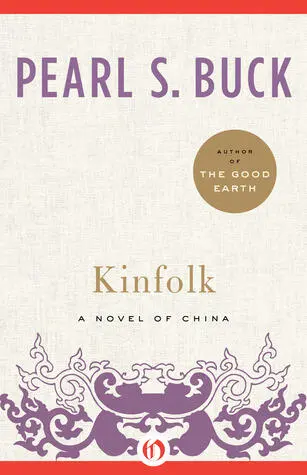
- Название:Kinfolk
- Автор:
- Издательство:Open Road Media
- Жанр:
- Год:2012
- ISBN:нет данных
- Рейтинг книги:4 / 5. Голосов: 1
-
Избранное:Добавить в избранное
- Отзывы:
-
Ваша оценка:
Kinfolk: краткое содержание, описание и аннотация
Предлагаем к чтению аннотацию, описание, краткое содержание или предисловие (зависит от того, что написал сам автор книги «Kinfolk»). Если вы не нашли необходимую информацию о книге — напишите в комментариях, мы постараемся отыскать её.
, a sharp dissection of the expatriate experience, Pearl S. Buck unfurls the story of a Chinese family living in New York. Dr. Liang is a comfortably well-off professor of Confucian philosophy, who spreads the notion of a pure and unchanging homeland. Under his influence, his four grown children decide to move to China, despite having spent their whole lives in America. As the siblings try in various ways to adjust to a new place and culture, they learn that the definition of home is far different from what they expected.
Kinfolk — читать онлайн бесплатно полную книгу (весь текст) целиком
Ниже представлен текст книги, разбитый по страницам. Система сохранения места последней прочитанной страницы, позволяет с удобством читать онлайн бесплатно книгу «Kinfolk», без необходимости каждый раз заново искать на чём Вы остановились. Поставьте закладку, и сможете в любой момент перейти на страницу, на которой закончили чтение.
Интервал:
Закладка:
James laughed. “You don’t want to go to school?” he asked.
Wang shook his head. “In old times learning was good business,” he said affably. “Now on ships is a better way for riches.”
Out in the corridor a dinner gong sounded loudly and Young Wang leaped to his feet. “The chief steward will let out his rage at me,” he exclaimed and darted to the door. There he paused for a moment. “Meat and rice are very good today,” he cried and disappeared.
James laughed and got out of the bunk. He was suddenly hungry. Meat and rice were very good.
He was proud of the skyline of Shanghai. This astonished him. In spite of the photographs and stories from friends he had not believed that there were such tall buildings in China. The long flat approach to the city had not been reassuring. For hours the ship had steamed slowly between mudbanks in a river of mud that fanned wide into the green ocean.
“No bath this morning, please,” Young Wang had said cheerfully soon after dawn. “Only river water.”
So as soon as he was dressed he had gone on deck. No shore was in sight and the ocean had changed to a muddy brown. It was his first glimpse of the soil of China, washed by the river from a thousand miles of land. Later the land itself had stolen almost imperceptibly to the horizon in the long barren mudbanks. These gave way to flat green fields and a few squat farmhouses, some low-built warehouses, a mill, a village, a town. He went below and ate his breakfast quickly and came back to stand again at the rail. There was nothing beautiful in the landscape except the brilliant blue sky, which today was cloudless. Had it been gray, the dun of land and water and sky would have frightened him.
Then suddenly at midmorning against this bright sky a new skyline had broken. He saw high buildings massed together and he perceived with a pleasurable shock that it was Shanghai and that it was as modern, from this distance, as he had been told it was by patriotic countrymen. “China is not all ignorant peasants and thatch-roofed villages,” they had said impatiently. “We have our modern cities, too. One city is more important than a thousand villages.”
He felt relief. The homecoming was not to be too strange. He did not step from his father’s comfortable apartment into a mud-walled hut.
Someone was at his elbow and he turned. It was Young Wang, his face sparkling and his eyes shining. “Very nice day,” he remarked.
“You are going ashore?” James asked.
“By and by,” Young Wang replied. “You go to hotel?”
“Yes,” James replied.
Young Wang stayed until the last possible moment and then rushed downstairs to his duties. Meanwhile the Bund loomed toward the ship. It was really quite beautiful. The street was wide and paved, and a park was green at one end.
As the ship edged to the pier, James looked down into a crowd of his own people. Their brown faces were upturned, curious, gay, patient. Here and there a white face was lifted startlingly clear against the universal brown. It was a reversal of New York where the crowd was white, and the brown face startling. He had grown up immunizing himself to the stares of white people as he walked along the streets, but here it would be comforting to belong to the crowd. In a few minutes he would be lost in it, and no one would look at him twice. Here was where he belonged.
He felt an exhilaration which was very nearly happiness. His country would not be strange to him. Why had Lili and her family ever left it and why did they not want to come back? Perhaps they had left too soon after the war. At the thought of Lili, constant in his mind, he went below to finish his packing. The sooner he reached his hotel the sooner he might find a letter from her, sent airmail, to be waiting for him.
But when he reached his hotel, an hour later, there was no letter. An indolent clerk in a dirty white gown ruffled some envelopes.
“Let me see, please,” James said.
The clerk pushed the envelopes toward him and flung out a clatter of words in Shanghai dialect to his assistant who laughed. James could not understand and he pretended not to hear. He looked at each envelope slowly. There was no letter from Lili but there was a square envelope of heavy pink paper and upon it was scrawled in large vinelike letters his name. On the back in the same loose combination of tendrils he saw the name Thelma Barnabas, Rue du Consulat. He tore open the envelope and took out a single pink sheet and the black letters flung themselves at him.
Dear Dr. Liang:
With what enthusiasm do the intellectuals of Shanghai await the arrival of the son of the great Liang Wen Hua! Dare I hope you will gather with us at my house? I have had the temerity to invite our small, but, I think, distinguished circle. We dine at seven tonight. A car will call for you half an hour before.
Yours in expectation, Thelma Barnabas
This strange epistle James turned over once or twice and then thrust into his pocket. There was no elevator in the hotel and he mounted a flight of dirty marble stairs, a bellboy with his bags leading the way. They reached the door at the end of a winding carpetless hallway. The boy struggled with a door, flung it open, and went in. James went into a large shabby room whose tall windows were hung with Chinese silk curtains of a faded rose. A soiled Peking carpet was on the floor and upon the double brass bed was a cover of dingy embroidery. Once the room had been handsome, but negligence had given it a look of decay. Upon one wall, however, was a framed water color of misty hills, which he liked at once.
He tipped the boy and closed the door. The telephone jangled and when he lifted the receiver he heard a woman’s voice, dominating, ardent, gushing, “Dr. James Liang?”
“Yes.”
“Oh, Dr. Liang — how wonderful! Welcome to poor old war-torn Shanghai! What an honor to have the distinguished — have you got my letter?”
“I have,” James replied, disliking the voice very much.
“You will come?” The voice was persuading, coaxing, compelling.
James hesitated. “I’ve only just—”
The voice broke in. “Oh, but you must! You don’t know us but we know you — you’re Liang Wen Hua’s son! We’ll have to introduce ourselves — a little group of pure intellectuals — it’s so important these days, don’t you think, when everything is so materialistic! Surely you’ve heard of the Dialectic Society? That’s our group — of course I’m only honorary, not being Chinese, but the poor things do need a place to meet and my house is theirs. I tell Charles — he’s my husband — that it’s the least we can do — the intellectuals are really starving — and they’re so important. But you know — your wonderful father is international honorary president—”
He did know but he had forgotten. Liang Wen Hua was the honorary president of many intellectual groups. The Dialectic Society of China was, as Mrs. Barnabas said, a small group of men and women, educated abroad or in modern schools here. They wrote articles and essays and edited a thin weekly in English, where they published their writings and criticized what they wrote. His father had once been one of them.
“I will come,” James said.
“Oh, wonderful,” Mrs. Barnabas sang. “I’ll send the car for you at six-thirty.”
It was a diversion, at least, James told himself. The air of Shanghai seemed flat to him even though he recognized its cause. It was absurd that a bit of paper bearing Lili’s words to him would have changed the entire city, but so it was. He went to the window and gazed into a street which might have belonged to any modern city except that the people were polyglot. Watching that restless moving throng he caught its restlessness. He must get out in it and move with it. Where were these thousands of persons going? Each, of necessity, must be on his own errand, and yet they were flowing in two concentrated opposing currents. Well, he had his private errand, too. He would go and see Lili’s home, the house which might have been his, had he been willing to obey Mr. Li. He knew where it was, and he locked his door and went downstairs.
Читать дальшеИнтервал:
Закладка:
Похожие книги на «Kinfolk»
Представляем Вашему вниманию похожие книги на «Kinfolk» списком для выбора. Мы отобрали схожую по названию и смыслу литературу в надежде предоставить читателям больше вариантов отыскать новые, интересные, ещё непрочитанные произведения.


Обсуждение, отзывы о книге «Kinfolk» и просто собственные мнения читателей. Оставьте ваши комментарии, напишите, что Вы думаете о произведении, его смысле или главных героях. Укажите что конкретно понравилось, а что нет, и почему Вы так считаете.