Pearl Buck - Sons
Здесь есть возможность читать онлайн «Pearl Buck - Sons» весь текст электронной книги совершенно бесплатно (целиком полную версию без сокращений). В некоторых случаях можно слушать аудио, скачать через торрент в формате fb2 и присутствует краткое содержание. Год выпуска: 2012, Издательство: Open Road Media, Жанр: Классическая проза, на английском языке. Описание произведения, (предисловие) а так же отзывы посетителей доступны на портале библиотеки ЛибКат.
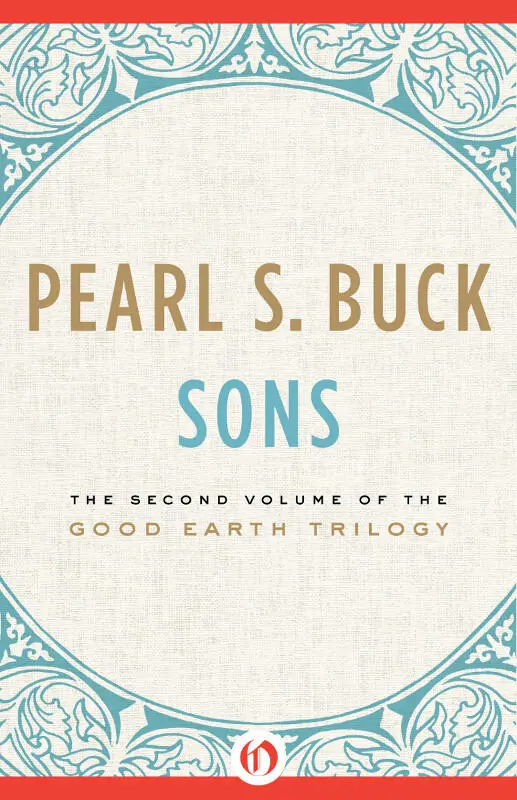
- Название:Sons
- Автор:
- Издательство:Open Road Media
- Жанр:
- Год:2012
- ISBN:нет данных
- Рейтинг книги:5 / 5. Голосов: 1
-
Избранное:Добавить в избранное
- Отзывы:
-
Ваша оценка:
Sons: краткое содержание, описание и аннотация
Предлагаем к чтению аннотацию, описание, краткое содержание или предисловие (зависит от того, что написал сам автор книги «Sons»). Если вы не нашли необходимую информацию о книге — напишите в комментариях, мы постараемся отыскать её.
Sons — читать онлайн бесплатно полную книгу (весь текст) целиком
Ниже представлен текст книги, разбитый по страницам. Система сохранения места последней прочитанной страницы, позволяет с удобством читать онлайн бесплатно книгу «Sons», без необходимости каждый раз заново искать на чём Вы остановились. Поставьте закладку, и сможете в любой момент перейти на страницу, на которой закончили чтение.
Интервал:
Закладка:
Wang the Eldest took it up and he cleared his throat and coughed loudly and he read it muttering the letters to himself as he read. When the scanty words of common greeting were written, Wang the Tiger wrote on, and his letters looked like him because they were straight and black and he brushed them boldly upon the paper,
“Send me every ounce of silver you can, for I need all. If you will lend me silver, I will repay it at a high interest on the day when I achieve what I set out to do. If you have sons over seventeen send them to me also. I will raise them up and raise them higher than you dream, for I need men of my own blood about me that I can trust in my great venture. Send me the silver and send me your sons, since I have no son of my own.”
Wang the Eldest read these words and he looked at his brother and his brother looked at him. Then Wang the Eldest said, wondering,
“Did he ever tell you at all what he did beyond that he was in an army with some southern general? It is strange he does not tell us what he will do with our sons. Men do not have sons to cast out like that into something they do not know.”
They sat for a while in silence and drank their tea, and each thought with doubt that it was a wild thing to send sons out not knowing where and yet each thought jealously of the words, “I will raise your sons high,” and each thought to himself that since he had a son or two old enough he might after all spare a son on the chance. Then Wang the Second said cautiously,
“You have sons who are more than seventeen.”
And Wang the Eldest answered, “Yes, I have two over seventeen, and I could send the second son, and I have not thought what I would do with any of them, they grow up so easily in a house like mine. The eldest must not go out, since he is next to me in the family, but I could send the second one.”
Then Wang the Second said, “My eldest is a girl, and the one after her is a son, and that one could go, I suppose, since your eldest son is at home to carry on the name.”
Each man sat and mused over his children then and thought what he had and what worth their lives could be to him. Wang the Eldest had six children by his lady, but of these two were dead in childhood, and he had one by his concubine, but his concubine was ripe to give birth again in a month or two, and of these children he had every one was sound except the third son whom a slave had dropped when he was but a few months old, so that his back grew twisted in a knot on his shoulders, and his head was too large for him and it set into this knot like a turtle’s head into its shell. Wang the Eldest had called a doctor or two to see it and he had even promised a robe to a certain goddess in the temple if she would cure the child, although in usual times he did not believe in such things. But it was all useless, for the child would carry his burden until he died, and the only pleasure his father had out of it was that he made the goddess go without her robe, since she would not do anything for him.
As for Wang the Second, he had five children in all, and three were sons, the eldest and youngest being girls. But his wife was in her prime yet and the line of his children was not ended either, doubtless, for she was so robust a woman she would bear on into her middle age.
So it was true that out of all these children a son or two could be spared out of so many, and thus each man thought when he had meditated awhile. At last Wang the Second looked up and he said,
“How shall I answer our brother?”
The elder brother hesitated then, for he was not a man to decide anything quickly for himself, having leaned for many years upon the decisions of his lady and said what she told him to say, and this Wang the Second knew and he said cunningly,
“Shall I say we will send a son apiece and I will send as much silver as I am able?”
And Wang the Eldest was glad to have it said thus and he answered, “Yes, do so, my brother, and let us decide it. I will send a son gladly, after all, because my house seems so full sometimes with brats squalling and the big ones bickering that I do swear I have not a moment’s peace. I will send my second one and you your eldest, and then if anything untoward comes, there is my eldest son left to carry our name on.”
So it was decided and the two drank tea for a while. Then when they were rested they began to talk of the lands, and of what they would sell. Now to both of these men as they sat and whispered together came a strong memory and it was of a certain day when they had first spoken of selling the land, and their father Wang Lung was in his age and they did not know he had strength enough to come creeping out after them to hear what they said as they stood in a certain field near the earthen house. But he did come and when he heard them say “sell the land” he had cried out in mighty anger,
“Now, evil, idle sons — sell the land?”
And he had been so angry he would have fallen if they had not held him up on either side, and he kept muttering over and over, “No — no — we will never sell the land—” and to soothe him, for he was too aged to be so angry, they had promised him they would never sell it. Yet even as they promised they smiled at each other over his nodding old head, foreseeing this very day when they would come together for this very purpose.
Eager as they were, therefore, upon this day, to heap up money now, the memory was still strong in them of the old man in the land so that they could not speak as easily of selling the land as they had thought they could, and each was held back in his own heart by some caution that perhaps the old man was right after all, and each resolved to himself that he would not at once sell all; no, hard times must come and if business grew bad they would still have enough land to feed themselves. For in such times as these none could be sure what day a war might come near or a robber chief seize the countryside for a time or some curse or other fall upon the people, and it was better to have something that they could not lose. Yet they were both greedy after high interest from the silver that land will bring when it is sold, and so they were torn between their desires. Therefore when Wang the Second said,
“What lands of yours will you sell?” Wang the Eldest replied with a caution that sat strangely upon him,
“After all, I have not a business as you have, and there is nothing I can do except to be a landlord, and so I must not sell more than enough to bring me in ready cash to use, and I must not sell all.”
Then Wang the Second said, “Let us go out to our lands and see all we have and where it is and how it lies, the distant and scattered pieces also. For our old father was so greedy for land that in his middle years he would buy it anywhere when it was cheap in a famine year, and we have lands all over the countryside, and some fields but a few paces in size. If you are to be landlord, it will be easier for you to have yours near together and so easy to control.”
This seemed good and reasonable to them both, and so they rose, after Wang the Eldest had paid out his money for the food they had eaten and the wines, and something over and above for the serving man. They went out then, Wang the Eldest first, and as they went men rose here and there in the room to bow and let it be known to all that they were acquainted with these two great men of the town. As for the two brothers, the eldest nodded freely and easily to all and smiled, for he loved this homage; but the younger one went with his eyes downcast and he nodded a little and very swiftly and he looked at no one, as though he feared if he were too friendly one might stop him and draw him aside and ask to borrow money of him.
So the two brothers went out to their land, and the younger one set his steps slow to match the pace of his elder brother, who was fat and heavy and unused to walking. At the city gate he was weary already and so they hailed two men who stood there with donkeys saddled and for hire, and the brothers bestrode these beasts and went out the gate.
Читать дальшеИнтервал:
Закладка:
Похожие книги на «Sons»
Представляем Вашему вниманию похожие книги на «Sons» списком для выбора. Мы отобрали схожую по названию и смыслу литературу в надежде предоставить читателям больше вариантов отыскать новые, интересные, ещё непрочитанные произведения.






Обсуждение, отзывы о книге «Sons» и просто собственные мнения читателей. Оставьте ваши комментарии, напишите, что Вы думаете о произведении, его смысле или главных героях. Укажите что конкретно понравилось, а что нет, и почему Вы так считаете.