Ivy Compton-Burnett - Dolores
Здесь есть возможность читать онлайн «Ivy Compton-Burnett - Dolores» весь текст электронной книги совершенно бесплатно (целиком полную версию без сокращений). В некоторых случаях можно слушать аудио, скачать через торрент в формате fb2 и присутствует краткое содержание. Год выпуска: 2013, Издательство: Bloomsbury Publishing, Жанр: Классическая проза, на английском языке. Описание произведения, (предисловие) а так же отзывы посетителей доступны на портале библиотеки ЛибКат.
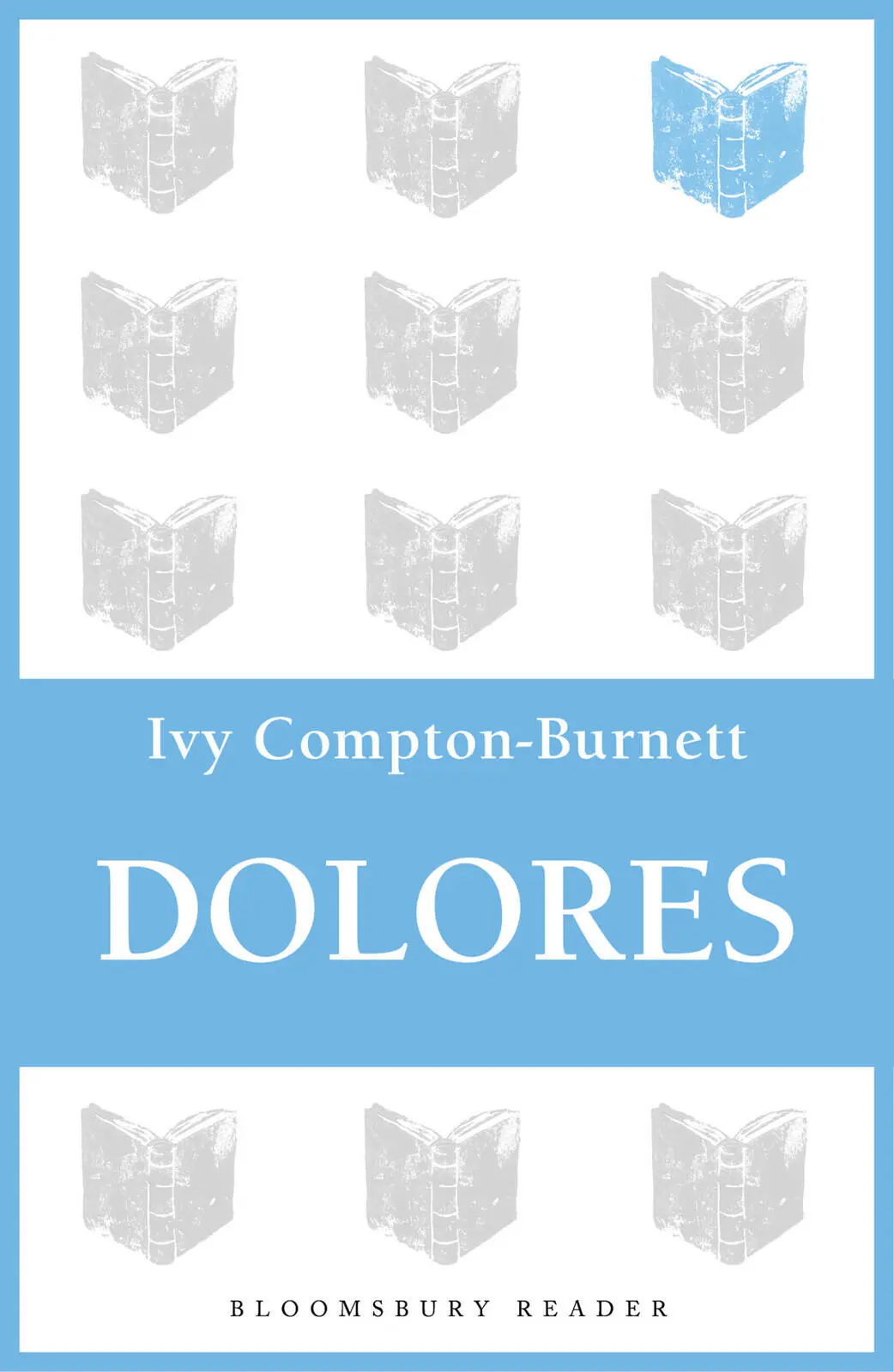
- Название:Dolores
- Автор:
- Издательство:Bloomsbury Publishing
- Жанр:
- Год:2013
- ISBN:нет данных
- Рейтинг книги:3 / 5. Голосов: 1
-
Избранное:Добавить в избранное
- Отзывы:
-
Ваша оценка:
Dolores: краткое содержание, описание и аннотация
Предлагаем к чтению аннотацию, описание, краткое содержание или предисловие (зависит от того, что написал сам автор книги «Dolores»). Если вы не нашли необходимую информацию о книге — напишите в комментариях, мы постараемся отыскать её.
was published in 1911. It sold well, and was promptly forgotten. Now that her career of sixty years is ended, and her long achievement more and more acclaimed,
, standing at that remote beginning, is curiously reborn.
Dolores — читать онлайн бесплатно полную книгу (весь текст) целиком
Ниже представлен текст книги, разбитый по страницам. Система сохранения места последней прочитанной страницы, позволяет с удобством читать онлайн бесплатно книгу «Dolores», без необходимости каждый раз заново искать на чём Вы остановились. Поставьте закладку, и сможете в любой момент перейти на страницу, на которой закончили чтение.
Интервал:
Закладка:
“I always thought souls were private,” said Felicia with a sigh, as they mingled in the stream that poured to the hall for the midday meal. “It was all a waste of time, preparing that ideal synopsis. There is no good in precautions with people who can read souls.”
The meal in the common hall was what was already familiar. The students entered and left at will; easiness of action was the feature of the whole. But to Dolores, no longer silent and alone amongst many, the sameness was less than the difference. Felicia found a place at her side, and poured out prattle; and Miss Butler passed to her seat with a smile already accepted as a thing of price. The remaining hours of the day were hours as those before them. But the comprehension of their spirit of striving self-government was not all that they carried. They were filling with the human interest, which to Dolores was the greatest thing the hours could give. As other days followed, bringing other such hours, she found herself with a place and purposes in a passionless, ardent little world — a world of women’s friendships; where there lived in a strange harmony the spirits of the mediaeval convent and modern growth.
Walking one day in the cloisters of the college, she came upon a figure standing in the shadow of a pillar, which arrested her scrutiny. It was the figure of a man — a visiting professor, as she knew from his gown, and the trencher lying at his feet, — in seeming buried in pondering; for he stood unmoving, with his eyes gazing before him, and his hands folded in his garments. His aspect was grotesque at a glance; for his massive body and arms were at variance with stunted lower limbs, and his shoulders were twisted. His face was dark and rugged of feature; his eyes piercing, but unevenly set, and so small and buried in rising flesh beneath them as hardly to be seen; his clothes and hair unkempt. An uncomely figure Dolores confessed him, as she left him to his musings. On reaching the doorway, and turning for a further glance, she was startled by the sight. He was standing with his feet set apart, his body swaying and his head and limbs working to contortion. She stood and watched him; and was startled anew when he ceased his gestures, picked up his cap with a lightning-like movement, and went his way. That evening, seated at table next to Miss Cliff, she spoke of the experience.
“Oh,” said Miss Cliff, “that was Mr Claverhouse. Have you been startled? You will soon get used to seeing him about.”
“Claverhouse?” said Dolores, with a sudden awakening of thoughts. “Any relation of Claverhouse, the dramatist?”
“The dramatist himself,” said Miss Cliff. “It is pleasant to hear his name so ready. He comes here to lecture.”
“Comes here to lecture?” said Dolores. “Why, what does he lecture on? His own plays?”
“Oh, no,” said Miss Cliff. “He lectures in classics — usually on the Greek drama. He is a classical scholar apart from his writing. You will be numbered in his pupils yourself in your last year. His plays would hardly be suited to academic purposes.”
“Would they not?” said Dolores, smiling. “I should have thought they would bear elucidation.”
“You have read them?” said Miss Cliff, with surprise. “Yes; they are obscure, as you say.
“And very profound, are they not?” said Dolores.
“Yes, yes, very profound. Read as they should be read, they take one very deep.”
“I wonder if they will ever be produced,” said Dolores.
“They would hardly bear production, would they?” said Miss Cliff. “There is so much that would not carry across the footlights. It is his ambition that they shall be read.”
“He talks about them then?” said Dolores, with an instinctive feeling of surprise.
“No, no,” said Miss Cliff, half smiling; “indeed he does not. He never comes out of himself. His only friend is a cousin of mine; or he would be a mystery to me as much as to you. He lives in Oxford with his mother; and supports her by private coaching, and by giving lectures here. His story is the old one of struggle with poverty and publishers, made bearable by the sense that he is giving his art his best.”
“I suppose what I saw was the visible part of the process,” said Dolores, covering with lightness a sense of being more deeply moved than was natural. “I must have seen him in the clutch of the creative spirit.”
“No doubt of it,” said Miss Cliff. “His habits would become a genius.”
“I suppose a few would say, they do become one,” said Dolores.
“Yes,” said Miss Cliff; “and there will be many more.”
“He must be a very fine man,” said a student who was sitting next to Dolores.
“I hardly think the words ‘fine man’ give him,” said Miss Cliff. “His personality is too strange, to be fitted by such a current description. He wants something that goes deeper, and is not so wholly complimentary.”
“But the eccentricities of the great do not take from them, do they? I have known a good many remarkable people, and I have always loved their quaintnesses,” said the student with smile-begetting naïveté.
“No, no, I daresay not,” said Miss Cliff. “I only meant, they should be suggested in a full description.”
“I really think that genius is enhanced by superficial eccentricities,” went on the student, with a short, quick utterance which seemed intended to suggest, that her words covered more than appeared. “Would Socrates’ personality mean so much to us, if he had not been like a Silenus?”
“What do you think, Miss Hutton?” said Miss Cliff.
“I should think it would,” said Dolores, with a strange sensation in the remembrance, that she had heard the last words before from the same lips. “We should just associate the other attributes with him, instead of those of a Silenus. There is not much in external attributes themselves, is there?”
“Is there not? I don’t know,” said the other, slightly shaking her head.
“Well, I will leave you to convince Miss Hutton, Miss Kingsford,” said Miss Cliff, turning with a smile at Dolores to her neighbour on the other side. “I feel quite inspirited by having met some one, who reads Mr Claverhouse’s plays so young.”
“Why, his plays must be read by any one at any age, might they not? I should think so myself from what I know of them,” said the student, addressing Dolores, but failing to disguise that her words were spoken for Miss Cliff.
Dolores looked at the speaker — a student of her own standing with whom she was barely familiar; and felt her sense of being jarred yielding to a spirit of pardon. She knew that Perdita Kingsford knew nothing of the plays; but as she met the liquid eyes in the face that changed with the moments, the knowledge lost its estranging power. There was that in Dolores which yielded to womanhood’s spells. She hardly judged of women as a woman amongst them; but as something sterner and stronger, that owed them gentleness in judgment. From the first hour to the last of their years of friendship, she read Perdita as an open page; and loved her with a love that grew, though its nurture was not in what she read.
“It is very inspiring to be brought into contact with a great, neglected life,” said Perdita, as they left the hall. “So many great lives have been unrecognised; and in a way they grow greater from the very neglect. One feels one would give or do anything for a chance of smoothing one of them; and that if one were brought into touch with it, one’s own interests would not count.”
These words were heard and forgotten, as other words, as they fell. But a time was to come when Dolores recalled them. This day which brought Perdita and Claverhouse into her life, was to gather significance in its twofold bringing of change. The change grew daily, widening and deepening along its threads. But at the first it widened and deepened slowly; and at the close of the term, we may watch her with the two who had come through her into friendship, without meeting any token that her life was not as theirs.
Читать дальшеИнтервал:
Закладка:
Похожие книги на «Dolores»
Представляем Вашему вниманию похожие книги на «Dolores» списком для выбора. Мы отобрали схожую по названию и смыслу литературу в надежде предоставить читателям больше вариантов отыскать новые, интересные, ещё непрочитанные произведения.







Обсуждение, отзывы о книге «Dolores» и просто собственные мнения читателей. Оставьте ваши комментарии, напишите, что Вы думаете о произведении, его смысле или главных героях. Укажите что конкретно понравилось, а что нет, и почему Вы так считаете.