Raja Rao - Collected Stories
Здесь есть возможность читать онлайн «Raja Rao - Collected Stories» весь текст электронной книги совершенно бесплатно (целиком полную версию без сокращений). В некоторых случаях можно слушать аудио, скачать через торрент в формате fb2 и присутствует краткое содержание. Год выпуска: 2014, Издательство: Penguin, Жанр: Классическая проза, на английском языке. Описание произведения, (предисловие) а так же отзывы посетителей доступны на портале библиотеки ЛибКат.
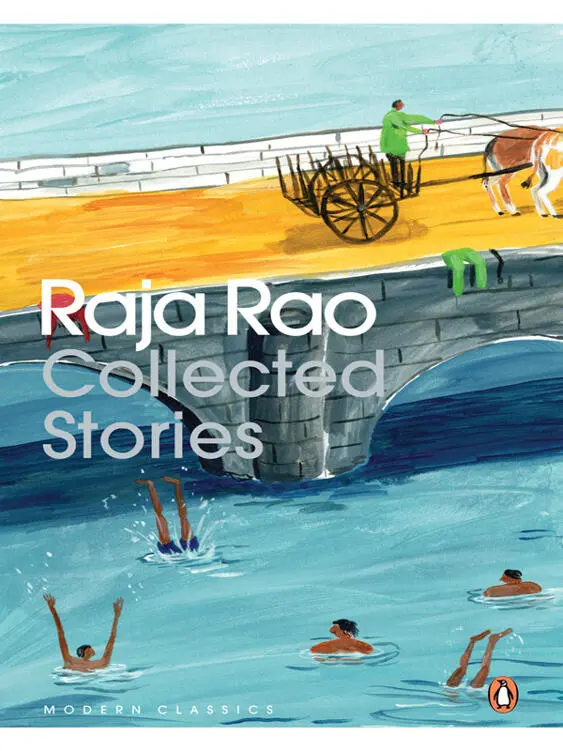
- Название:Collected Stories
- Автор:
- Издательство:Penguin
- Жанр:
- Год:2014
- ISBN:нет данных
- Рейтинг книги:5 / 5. Голосов: 1
-
Избранное:Добавить в избранное
- Отзывы:
-
Ваша оценка:
Collected Stories: краткое содержание, описание и аннотация
Предлагаем к чтению аннотацию, описание, краткое содержание или предисловие (зависит от того, что написал сам автор книги «Collected Stories»). Если вы не нашли необходимую информацию о книге — напишите в комментариях, мы постараемся отыскать её.
Collected Stories — читать онлайн бесплатно полную книгу (весь текст) целиком
Ниже представлен текст книги, разбитый по страницам. Система сохранения места последней прочитанной страницы, позволяет с удобством читать онлайн бесплатно книгу «Collected Stories», без необходимости каждый раз заново искать на чём Вы остановились. Поставьте закладку, и сможете в любой момент перейти на страницу, на которой закончили чтение.
Интервал:
Закладка:
Bhola had one passion, however. He used to love songs— not filmy songs, no, but kirtans, songs of God. He remembered his Tulsi Das in Flanders, and Pandit Viswanath who was the company cook, big tummy, sacred thread, great temper and all; though a Brahmin, he cooked everything yet was he not a safe vegetarian? He also possessed an ancient and much-worn copy of Tulsi Ramayan. So day after day after starting campfire on those cold autumnal nights, Bholanath and Vishwanath read out the holy story to the assembled soldiers, and people wept on the Flanders plains, thinking on the suffering of Sita in exile, and under Ravana’s power. You remember the text, don’t you? where Hanuman, the monkey-god, from up the Asoka tree, sees Mother Sita, and she so seated in grief and thinking on the lotus feet, the Padmapada, of her husband, Sri Rama, while Ravana arrives there promising that Mandodari and all his queens, would be her handmaids, if only Sita would look on him but once, and how, posing a blade of grass, as partition, between this ten-headed monster and her withdrawn self, she mocks at that absurd and vain scoundrel, replying in answer, could a lotus ever blossom because of a firefly’s glow? And here all the soldiers laughed and laughed. But Ravana rushes towards her, in a paroxysm, his sword lifted bright, shouting, ‘I will cut off your head, you understand.’ But Sita Devi, when she addresses the sword prayerfully, saying, ‘You sharp and cool and kind blade, please dispel my grave weight of dukha , sorrow caused by this desperate separation from my Lord, the Lord of the Raghus,’ and hearing which how all the soldiers began to sniffle and sob into their blankets, while the fire shot up in pure celestial worship. ‘He who touches Devi Sita’s footsteps even in thought is freed from a thousand births,’ wrote Tulsi Das, and Ravana, the wretch, knew it. Yet such is human existence: you vomit on what you worship. Who can protect you ever from your primal destiny, unless it be Sri Rama himself. Ravana had to be killed to attain liberation, so Ravana had to abduct Sita. Thus alone could Ravana’s head be on Sri Rama’s feet. And this was all the play of Sri Rama himself, he, Sri Rama, the very fount of compassion, explains Pandit Vishwanathji, that gave greenness to the trees, and the long waist for the mother-monkey to carry her young, he also gave Ravana such love that Ravana feared and hated his Lord. Has not Tulsi Das said, when Mandodari asks him, he, Ravana who could take any shape he wished, such his magic powers, why, she asked, did he not impersonate Sri Rama himself to seduce Sita, and tell me, did not Ravana the monster reply, ‘The moment I think of Him, Sri Rama, I become his devotee and lie at his perfumed feet.’ For hate is only love standing upside down — get it back on its feet, like a single-footed lead doll that you can buy at any village fair, which returns on itself, explains Pandit Vishwanathji, do what you will do with it, such too is love, it returns always on itself. And the soldiers always wept for Mother Sita, and prayed that evil Ravana be forgiven. Thus they prayed for Hitler too across the enemy lines. They had heard Hitler was a vegetarian and a celibate: tell me, what more could one need to be called a devotee of the Lord?
And when the bhajan was over Pandit Vishwanath kept Bhola near him and talked to him of Bhakti and Brahman, and though all this flew beyond his head, especially as he was often called out in the middle of the discourses to repair a tank-wheel or a truck-axle, and even sometimes the trigger of a machine gun. Bholanath, however, pursued his readings. On the plains of Flanders he learnt the Shiva stotra by heart, and the Chandi hymns (the Pandit had also bought a copy of the Brihat Stotra Ratnakara with him) and so hammering his wheels or patching his tyre you would hear Bhola chant.
gangatarangamaniya jatakalapam
gauriniranatravibhushitavamabhagam.
narayanapriyamanagamadapaharam
varanasipurapathih bhaja vishwanathan.
Worship Vishwanath, the Lord of Benares,
Whose locks seem delightful with wavelets of the Ganga,
He who is ever adorned on his left with Mother Gauri,
(He again) beloved of Narayana,
And the conqueror of the Bodiless God (Kama).
And when finally they came to the epilogue of Tulsi Ramayan, how they all wept, while they remembered Shiva himself had requested Garur, the Eagle-Lord, to go to Kakabhusundi, the Jewel among the Crows, and hear the sweet story of Sri Rama, as the Crow told the story day after day to the assembled birds, and how Garur explains, already at the sight of the Nilagiris, the Blue mountains, Maya fell off from all his five perceptions, and then taking his bath at the nearby river, and going up to the great banyan tree, sees Bhusundi, surrounded by all the varied birds and Bhusundi, asks: ‘Oh, King of the Feathered World,’ in great humility and gestures of etiquette, ‘with what intent, and how is it you have betaken yourself our way,’ to which, Garur makes the reply: ‘Lord Shiva himself sent me that I hear the Holy Tale of the Acts of Sri Rama from you. Yet just looking at you was enough, my doubts and misjudgements have all vanished.’ On hearing which such holy joy filled the heart of Bhusundi, that he related to the King of Birds, the geneaology of Sri Rama’s family, from Raghu downwards — the arrival of the sage Vishwamitra to arrange the marriage of the Lord to Sita Devi, daughter of one King of Videha, the abduction of Mother Sita by Ravana the monster, and of the monkeys that helped Sri Rama build the bridge across the ocean and conquer the vast island of Lanka, then the killing of Ravana and of the flight back of Rama and Sita to Ayodhya in an aerial chariot of flowers, ending with the blissful coronation of Sri Rama. ‘O King of Birds,’ concluded Bhusundi, ‘even Maya, you know, dances on the brow of Sri Rama. Such is Sri Rama, who is Knowledge, Bliss and Truth.’ And then, with the image of Sri Rama in his heart, and bowing low to Bhusundi, how Garur flew up to the Vaikuntha Heaven, to lie forever and ever at Sri Vishnu’s Feet, Sri Rama being none else than Sri Vishnu who took the human form for our redemption from Maya.
Then Pandit Vishwanath always ended his readings with: ‘He who hears this story and tells this story of Sri Rama to another, were it a man, bird or animal, will be, blessed by Sri Rama. So, now let us chant,
Raghupathi Raghava Raja Ram,
Pathitha Pavana Sita Ram.’
The Lord of the Raghus, Raghava, King Rama,
Redeemer of the fallen, Sita’s Rama.
and this chant filled the cold wet air of Flanders, day after day, with an utter sweetness. And they returned to their tents in deep peace, even as the war went on, above and before them, and they sometimes wondered, which war was which, here or there. For everything on earth, the good and the bad, come to the one single end — touching the holy feet of Sri Rama.
The war will soon be over and Bhola would return home and be with Rati, again. What was he going to do returning to Rajgarh village, he wondered. The old father was dead (he had died of the new war fevers that killed so many many), and a few days later, so the letters from Rati said, the third son Digambar had died, and one or two days later, Pitambar of the same epidemic. The mother was left with only eight sons and their children — some drove bullock-carts to carry merchandise, others worked for Rai Krishnadas with his new puff-puff textile mills, and yet others had run away to Delhi and Bombay to find war work, for, you must know, the German war brought work and work paid. Once in a while Urmili (the mother) got her money order from one or the other of her sons, was it from Bombay or Kanpur or Calcutta, but these began to come less and less. When you go far you forget where you came from. To love you must stay where you were first suckled. What is love if you cannot know how many calves, Rani, the big white cow of your Mother’s yard has had, or of the big floods of the Ganga, years ago when over a thousand people had died, or remember the small-pox years when your little niece Madhuri had been carried down to the ghats. Of course there was his Rati — she came originally from Vidwanpur in the Beli Tehsil, and she was the only daughter of a rich peasant who had a mistress and had played with her, had even took her to Sonapur fair — in fact it’s there Bholanath’s father and he had met and that’s how Bhola and Rati were duly married — well, Rati was not beautiful like her name but she knew how to cook and stitch, plaster cow-dung over the walls, draw water from the deep, dark well in the backyard — but was ever, ever silent. She never said one lone word to anyone in pain or in happiness. She never complained. She never even said she would like to go home to her mother, for the autumnal festivities. After all she could have gone, for her husband was far away at the war, but she would not do this to his family. She sat in prayer often that her Lord come back, then they will duly have a child. How the womb calls for its child. All her sisters-in-law had more children than they wanted but she had not during her two years of marriage, given birth to, were it, a little baby monkey. Even a scorpion is worth bearing for a woman than one be childless, that’s how the saying goes. A childless woman brings ill luck. Women will not invite you to their houses. They will not even look at you, lest your inauspicious gaze fall on them, and make them thus forever barren. Lord what has one done that this should be so? But Bhola will come back soon and she will have a male child.
Читать дальшеИнтервал:
Закладка:
Похожие книги на «Collected Stories»
Представляем Вашему вниманию похожие книги на «Collected Stories» списком для выбора. Мы отобрали схожую по названию и смыслу литературу в надежде предоставить читателям больше вариантов отыскать новые, интересные, ещё непрочитанные произведения.









Обсуждение, отзывы о книге «Collected Stories» и просто собственные мнения читателей. Оставьте ваши комментарии, напишите, что Вы думаете о произведении, его смысле или главных героях. Укажите что конкретно понравилось, а что нет, и почему Вы так считаете.