Raja Rao - Collected Stories
Здесь есть возможность читать онлайн «Raja Rao - Collected Stories» весь текст электронной книги совершенно бесплатно (целиком полную версию без сокращений). В некоторых случаях можно слушать аудио, скачать через торрент в формате fb2 и присутствует краткое содержание. Год выпуска: 2014, Издательство: Penguin, Жанр: Классическая проза, на английском языке. Описание произведения, (предисловие) а так же отзывы посетителей доступны на портале библиотеки ЛибКат.
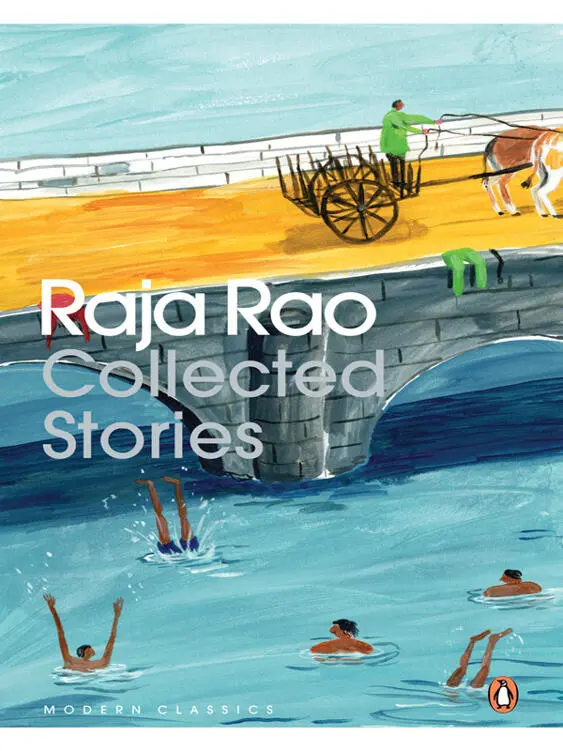
- Название:Collected Stories
- Автор:
- Издательство:Penguin
- Жанр:
- Год:2014
- ISBN:нет данных
- Рейтинг книги:5 / 5. Голосов: 1
-
Избранное:Добавить в избранное
- Отзывы:
-
Ваша оценка:
Collected Stories: краткое содержание, описание и аннотация
Предлагаем к чтению аннотацию, описание, краткое содержание или предисловие (зависит от того, что написал сам автор книги «Collected Stories»). Если вы не нашли необходимую информацию о книге — напишите в комментариях, мы постараемся отыскать её.
Collected Stories — читать онлайн бесплатно полную книгу (весь текст) целиком
Ниже представлен текст книги, разбитый по страницам. Система сохранения места последней прочитанной страницы, позволяет с удобством читать онлайн бесплатно книгу «Collected Stories», без необходимости каждый раз заново искать на чём Вы остановились. Поставьте закладку, и сможете в любой момент перейти на страницу, на которой закончили чтение.
Интервал:
Закладка:
‘Ramu, Ramu.’ Somebody was calling him. Lifting up his head he saw Jayalakshmi, his neighbour in the chemistry class, coming towards him with her usual smile of friendliness and forced mockery.
‘Ramu, you’re coming with me in my Victoria.’
‘Sorry.’
‘I suppose women not being equal to men, you cannot sit by me.’
‘No. I’m in a hurry.’ The devil throw the girl into the fire. But somewhere, something graceful and mysterious swept up, drawing him into forbidden secrets, sweetly tender. But the Brahmin in him woke up. The caste mark was not on his face but on his soul. The sweetness sank into ashes. Away. .
‘Goodbye, Jayalakshmi.’
‘Bye-bye.’
He grit his teeth, and thrusting away all thoughts of Jayalakshmi, he walked on trying to think of the approaching examinations. As he passed by the pipal tree near the gate, he saw a queer old man standing on the road, and smiling to every student that came along, exaltedly, expectantly. He wore a gold-laced turban and a loose longcoat in the old fashion. He was bare-footed, and his dhoti, also gold-laced, was creamy white; and by contrast his wrinkled dust-covered feet seemed bluish-green like cow-dung. Coldly returning his smile Ramu walked away feeling somehow that things were not well with him. Perhaps it was just tiredness. Or only loneliness; or, who could say, maybe the cat he had seen at the window on waking up forbode something terribly evil. No, no, he assured himself, the gods would not desert him after all these years. They would help him and bless him. ‘O Kenchamma, O Goddess, my salutations to Thee!’
He hardly got to the Mysore Bank Square when he heard somebody calling him from behind. The voice was unfamiliar but affectionate. And turning round whom should he see but the same old man, more smiling than ever, and his eyes beaming with intense, surging love. Ramu shivered.
‘Ramu,’ cried the old man, running up to him, breathless, ‘Ramu, are you not our Ramu of Hariharapura?’
‘Yes,’ he murmured confusedly. His lips trembled and he perspired all over oppressed by some unaccountable fear. He would have preferred to meet the will o’ the wisp than this haunting old man.
‘That’s it,’ he exclaimed, putting his hands on Ramu’s shoulders. ‘There you are, my boy. When I saw you by the gate I was sure as the dog knows its food that you were our Ramu. . But I wanted to make certain. And when I asked somebody who came behind you he said I was right. Well done, my old man, I said to myself, no mistaking it. And I ran and ran. But how like a fawn you fly! Now let me see. So you’re our Krishnappa’s son and Shama’s brother? What, Ramu, how is Hariharapura? Is it always the same old Hariharapura?’ Who the devil could this be, thought Ramu to himself, as they moved on. He knows my father, he asks about Hariharapura — and the wretch that I am, I never remember people. How he speaks too with such familiarity! He must be somebody I know! Surely. .
‘Everything goes on as usual,’ he muttered mechanically.
‘And how is our old friend Bhatta? When I saw him last, he was already losing his eyesight and he had been rather ill. Is he better now?’
‘I believe he had died some years before I was born,’ answered Ramu, still confused. ‘But his son is living and I know him pretty well.’
‘Oh, I’m sorry for the old chap. Anyway when you see young Bhatta will you give him my blessings, and ask him if he still remembers me. Will you, my son? And now tell me: how are the Corner-house people? How many children has Venkanna’s son, Srikantha? I had been to his marriage. That was the last time I saw Hariharapura. Oh, that I should have left my byre and my manger. But in those days, who would have refused a job in the Bangalore Secretariat? I was young, I was brilliant, and one day I would be an amaldar or a sub-division officer, I thought. And I went. . And I have never been able to go back and visit my relations and find out whether they were dead or alive. Government service, my son, is like prostitution. Once you take that profession you cut away all bonds. But why all that now? I have had enough of that slavery. Thanks be to God, I am out of it. Well, I retired from my service, and have had to stay on here for the education of my children. Each summer I said to myself, let the vacations come and we will go to Hariharapura, and drink the sweet waters of the Hemavathy. But children never have enough! They always cry for more. If only they were like other children, obedient, loyal, hard-working. Oh, what shall I say of my children? But. . let me see. My Srinivasan is in your class. Surely, in yours. . You know Srinivasan? S.T. Srinivasan? Now, tell me, Ramu, and I shall swear to you on anything I shall never let it out, tell me if it is true that he is very full of pranks in the class, that he has joined a group of vagabonds who smoke cigarettes and go to the houses of prostitutes. Tell me, Ramu, tell me!’
What could he answer? The question came all of a sudden and Ramu was still thinking, trying to remember all the people he knew, and all the relatives one talked of at home, and yet he could remember no one resembling this queer old man, who spoke with such familiarity and affection. Brother Shama, his brother, who knew his relatives to the tenth generation, had never said a word about him. Surely he would have, and no doubt have sent Ramu along directly to this old man when Ramu first came to Bangalore. And again, this Srinivasan? He had no class-fellow with that name.
‘I’m sorry,’ he stuttered, embarrassed to put a straight question. ‘I’m sorry. Excuse me. . I don’t remember where I could have seen you.’
‘Good God! Ramu, how scandalous that you should ask who I am! Good God! If you should forget your relatives so soon then I know how little you will care for us all, when you will have gone through the Civil Service examinations and become District Judge or Assistant Commissioner! Really, really! I cannot believe my ears. No, I cannot. But. . I must accept it. It is not your fault, my son; it is the immoral influence of this ignoble education called “modern”.’ He gave an accentuated sigh, and pathetically holding on to Ramu’s arms, he continued, ‘Well, my son, anyway don’t ignore your relations. No, please don’t. But, as you have forgotten who I am, I’ll tell you. I am Hosakere Nanjundayya. . Ho-sa-ke-re Nan-jun-dayya.’ He stood straight in front of Ramu, peering at his eyes. Ramu felt somehow abashed, repentant, revolted. Hosakere Nanjundayya, . Ho-sa-ke-re Nan-jun-dayya. . No, he could remember no such name. He felt unhappy. The cat at the window reappeared. Ill-luck. Wretched. . Wretched. .
Looking at the old man he suddenly felt relieved. The shame turned into pity, and then into courage.
‘Please pardon me,’ he burst out almost without a thought, ‘I think I still cannot recall where I could have seen you. I really am ashamed of myself. . But, you see, my memory. . ’
Nanjundayya now wriggled with amused laughter.
‘Why,’ he cried, still laughing, ‘why, I knew your family before you were born!’ How often I dined in your house. Oh, how often! Your father, dear Ramu, simply adored me. He could not, he used to swear, live without me. You see, he was my sister’s brother-in-law’s wife’s maternal uncle. And when I went to see my sister in Kantur, he always sent for me and would not let me go till the vacations were over. . And my sister naturally complained that I never stayed in her house. Poor thing! now she is dead, and so is your revered father. Oh, that I should survive them.’ He seemed almost in tears. But he soon gave a forced smile, and continued. ‘Now, tell me, Ramu, my son, are you still in the Verandah-House? Or have you moved to the new one your father was building by the mango grove? I told him it would simply be a waste of money. But he would not listen. “I want my children to be happy,” he would declare. “I will build a house that will house all of them with their wives and children and children’s children.’’’
Читать дальшеИнтервал:
Закладка:
Похожие книги на «Collected Stories»
Представляем Вашему вниманию похожие книги на «Collected Stories» списком для выбора. Мы отобрали схожую по названию и смыслу литературу в надежде предоставить читателям больше вариантов отыскать новые, интересные, ещё непрочитанные произведения.








Обсуждение, отзывы о книге «Collected Stories» и просто собственные мнения читателей. Оставьте ваши комментарии, напишите, что Вы думаете о произведении, его смысле или главных героях. Укажите что конкретно понравилось, а что нет, и почему Вы так считаете.