Upton Sinclair - Dragons’s teeth
Здесь есть возможность читать онлайн «Upton Sinclair - Dragons’s teeth» весь текст электронной книги совершенно бесплатно (целиком полную версию без сокращений). В некоторых случаях можно слушать аудио, скачать через торрент в формате fb2 и присутствует краткое содержание. Жанр: Историческая проза, на английском языке. Описание произведения, (предисловие) а так же отзывы посетителей доступны на портале библиотеки ЛибКат.
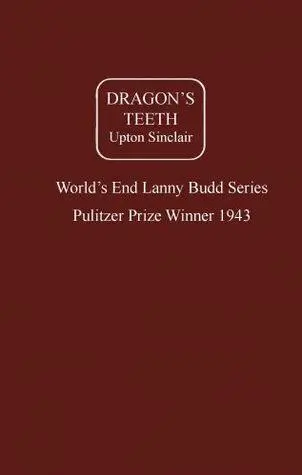
- Название:Dragons’s teeth
- Автор:
- Жанр:
- Год:неизвестен
- ISBN:нет данных
- Рейтинг книги:3 / 5. Голосов: 1
-
Избранное:Добавить в избранное
- Отзывы:
-
Ваша оценка:
Dragons’s teeth: краткое содержание, описание и аннотация
Предлагаем к чтению аннотацию, описание, краткое содержание или предисловие (зависит от того, что написал сам автор книги «Dragons’s teeth»). Если вы не нашли необходимую информацию о книге — напишите в комментариях, мы постараемся отыскать её.
Dragons’s teeth — читать онлайн бесплатно полную книгу (весь текст) целиком
Ниже представлен текст книги, разбитый по страницам. Система сохранения места последней прочитанной страницы, позволяет с удобством читать онлайн бесплатно книгу «Dragons’s teeth», без необходимости каждый раз заново искать на чём Вы остановились. Поставьте закладку, и сможете в любой момент перейти на страницу, на которой закончили чтение.
Интервал:
Закладка:
As to the conditions of her existence she was vague, as the spirits generally are. They explain that it is difficult for mortal minds to comprehend their mode of being; and that is a possibility, but also it may be an evasion. The duquesa had given evidence of her reality, but now she seemed to wish that he should take it as settled; that made her happier—and of course he sought to make her happy.
But afterward he tormented himself with doubts. Should he torment her with them?
She greeted Lanny and talked to him. She had come to him first, with messages to her husband, and now she thanked him for delivering them. It was exactly as if they had been together in the garden of the Paris mansion. She reminded him of it, and of the snow-white poodles shaved to resemble lions. She had escorted him into the library, and he, a courteous youth, had understood that she might have no more time for him, and had volunteered to make himself happy with a magazine. Did he remember what it was? She said: La Vie Parisienne, and he remembered. He darted a glance at Zaharoff, and thought he saw the old white imperial trembling. "Tell him that that is correct," insisted the Spanish duquesa with a Polish accent. "He worries so much, pauvre cheri."
The spirit talked about the unusually wet weather, and about the depression; she said that both would end soon. Such troubles did not affect her, except as they affected those she loved. She knew everything that was happening to them; apparently she knew whatever she wanted to know. Lanny asked her politely, could she bring them some fact about the affairs of her ancient family which her husband had never known, but which he might verify by research; something that was in an old document, or hidden in a secret vault in a castle; preferably something she hadn’t known during her own lifetime, so that it couldn’t have been in the subconscious mind of either of them?
"Oh, that subconscious mind!" laughed the Spanish lady. "It is a name that you make yourself unhappy with. What is mind when it isn’t conscious? Have you ever known such a thing?"
"No," said Lanny, "because then it would be conscious. But what is it that acts like a subconscious mind?"
"Perhaps it is God," was the reply; and Lanny wondered: had he brought with him some fragment of the subconscious mind of Parsifal Dingle, and injected it into the subconscious mind which called itself Maria del Pilar Antonia Angela Patrocino Simon de Muguiro у Berute, Duquesa de Marqueni у Villafranca de los Caballeros?
VIII
When the seance was over, the maid invited Madame into another room to have tea; and Sir Basil had tea and a long talk with Lanny. He wanted to know what the younger man had learned and what he now believed. Lanny, watching the aging and anxious face, knew exactly what was wanted. Zaharoff wasn’t an eager scientist, loving truth for truth’s sake; he was a man tottering on the edge of the grave, wanting to believe that when he departed this earth he was going to join the woman who had meant so much to him. And what was Lanny, a scientist or a friend?
He could say, quite honestly, that he didn’t know; that he wavered, sometimes one way, sometimes the other. Then he could go on to waver in the right direction. Certainly it had seemed to be the duquesa speaking: not the voice, but the mind, the personality, something which one never touches, never sees, but which one comes to infer, which manifests itself by various modes of communication. The duquesa speaking over a telephone, for example, and the line in rather bad condition!
Zaharoff was pleased. He said he had been reading the books. "Telepathy?"' he said. "It seems to me just a word they have invented to save having to think. What is this telepathy? How would it work? It cannot be material vibrations, because distance makes no difference to it. You have to suppose that one mind can dip into another mind at will and get anything it wants. And is that easier to credit than survival of the personality?"
Said Lanny: "It is reasonable to think that there might be a core of the consciousness which survives for a time, just as the skeleton survives the body." But he saw that this wasn’t a pleasing image to the old gentleman, and hastened to add: "Maybe time isn’t a fundamental reality; maybe everything which has ever existed still exists in some form beyond our reach or understanding. We have no idea what reality may be, or our own relationship to it. Maybe we make immortality for ourselves by desiring it. Bernard Shaw says that birds grew wings because they desired and needed to fly."
The Knight Commander and Grand Officer had never heard of Back to Methuselah, and Lanny told him about that metabiological panorama. They talked about abstruse subjects until they were like Milton’s fallen angels, in wand’ring mazes lost; also until Lanny remembered that he had to take his wife to a dinner-party. He left the old gentleman in a much happier frame of mind, but he felt a little guilty, thinking: "I hope Robbie doesn’t have any more stocks to sell him!"
IX
Lanny found his wife dressing, and while he was doing the same she told him some news. "Uncle Jesse was here."
"Indeed?" replied Lanny. "Who saw him?"
"Beauty was in town. I had quite a talk with him."
"What’s he doing?"
"He’s absorbed in his election campaign."
"How could he spare the time to come here?"
"He came on business. He wants you to sell some of his paint-ings."
"Oh, my God, Irma! I can’t sell those things, and he knows it."
"Aren’t they good enough?"
"They’re all right in a way; but they’re quite undistinguished-there must be a thousand painters in Paris doing as well."
"Don’t they manage to sell their work?"
"Sometimes they do; but I can’t recommend art unless I know it has special merit."
"They seemed to me quite charming, and I should think a lot of other people would like them."
"You mean he brought some with him?"
"A whole taxicab-load. We had quite a show, all afternoon; that, and the Comintern, and that-what is it?—diagrammatical?—"
"Dialectical materialism?"
"He says he could make a Communist out of me if it wasn’t for my money. So he tried to get some of it away from me."
"He asked you for money?"
"He may be a bad painter, dear, but he’s a very good salesman."
"You mean you bought some of those things?"
"Two."
"For the love of Mike! What did you pay?"
"Ten thousand francs apiece."
"But, Irma, that’s preposterous! He never got half that for a painting in all his life."
"Well, it made him happy. He’s your mother’s brother, and I like to keep peace in the family."
"Really, darling, you don’t have to do things like that. Beauty won’t like it a bit."
"It’s much easier to say yes than no," replied Irma, watching in the mirror of her dressing-table while her maid put the last touches to her coiffure. "Uncle Jesse’s not a bad sort, you know."
"Where are the paintings?" asked the husband.
"I put them in the closet for the present. Don’t delay now, or we’ll be late."
"Let me have just a glance."
"I didn’t buy them for art," insisted the other; "but I do like them, and maybe I’ll hang them in this room if they won’t hurt your feelings."
Lanny got out the canvases and set them up against two chairs. They were the regular product which Jesse Blackless turned out at the rate of one every fortnight whenever he chose. One was a little gamin, and the other an old peddler of charcoal; both sentimental, because Uncle Jesse really loved these рооr people and imagined things about them which fitted in with his theories. Irma didn’t have such feelings, but Lanny had taught her that she ought to, and doubtless she was trying. "Are they really so bad?" she asked.
Читать дальшеИнтервал:
Закладка:
Похожие книги на «Dragons’s teeth»
Представляем Вашему вниманию похожие книги на «Dragons’s teeth» списком для выбора. Мы отобрали схожую по названию и смыслу литературу в надежде предоставить читателям больше вариантов отыскать новые, интересные, ещё непрочитанные произведения.








Обсуждение, отзывы о книге «Dragons’s teeth» и просто собственные мнения читателей. Оставьте ваши комментарии, напишите, что Вы думаете о произведении, его смысле или главных героях. Укажите что конкретно понравилось, а что нет, и почему Вы так считаете.