Upton Sinclair - Dragons’s teeth
Здесь есть возможность читать онлайн «Upton Sinclair - Dragons’s teeth» весь текст электронной книги совершенно бесплатно (целиком полную версию без сокращений). В некоторых случаях можно слушать аудио, скачать через торрент в формате fb2 и присутствует краткое содержание. Жанр: Историческая проза, на английском языке. Описание произведения, (предисловие) а так же отзывы посетителей доступны на портале библиотеки ЛибКат.
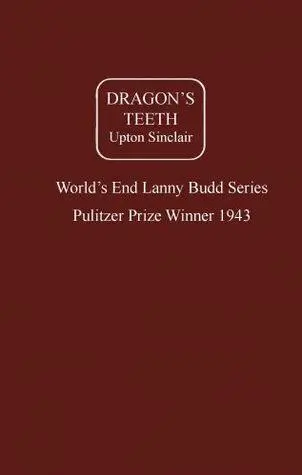
- Название:Dragons’s teeth
- Автор:
- Жанр:
- Год:неизвестен
- ISBN:нет данных
- Рейтинг книги:3 / 5. Голосов: 1
-
Избранное:Добавить в избранное
- Отзывы:
-
Ваша оценка:
Dragons’s teeth: краткое содержание, описание и аннотация
Предлагаем к чтению аннотацию, описание, краткое содержание или предисловие (зависит от того, что написал сам автор книги «Dragons’s teeth»). Если вы не нашли необходимую информацию о книге — напишите в комментариях, мы постараемся отыскать её.
Dragons’s teeth — читать онлайн бесплатно полную книгу (весь текст) целиком
Ниже представлен текст книги, разбитый по страницам. Система сохранения места последней прочитанной страницы, позволяет с удобством читать онлайн бесплатно книгу «Dragons’s teeth», без необходимости каждый раз заново искать на чём Вы остановились. Поставьте закладку, и сможете в любой момент перейти на страницу, на которой закончили чтение.
Интервал:
Закладка:
Heinrich had invited to meet his guest a sports director of one of the youth groups in Berlin. Hugo Behr was his name, and he was another exemplar of the Nordic ideal—which oddly enough a great many of the party leaders were not. There was a joke going the rounds among Berlin’s smart intellectuals that the ideal "Aryan" was required to be as blond as Hitler, as tall as Goebbels, as slender as Goring, and so on, as far as your malicious memory would carry you. But Hugo had smooth rosy cheeks and wavy golden hair, and doubtless when in a gym costume presented a figure like that of a young Hermes. He had until recently been an ardent Social-Democrat, a worker in the youth movement in that party; not only could he tell all its scandals, but he knew how to present National Socialism as the only true and real Socialism, by which the German workers were to win freedom for themselves and later for the workers of the world.
The human mind is a strange thing. Both this pair had read Mein Kampf as their holy book, and had picked out what they wanted from it. They knew that Lanny had also read the book, and assumed that he would have picked out the same things. But Lanny had noted other passages, in which the Führer had made it clear that he hadn’t the slightest interest in giving freedom to the workers of other nations or races, but on the contrary was determined to put them all to work for the benefit of the master race. "Aryan" was merely a fancy word for German—and for other persons of education and social position who were willing to join with the Nazis and help them to seize power.
However, Lanny wasn’t there to convert two Nazi officials. He permitted Hugo Behr to speak to him as one comrade to another, and now and then he made notes of something which might be of interest to the reading public of Britain. Hugo was newer in the movement than Heinrich, and more naive; he had swallowed the original Nazi program, hook, line, and sinker; that was the creed, and when you had quoted it, you had settled the point at issue. Lanny Budd, cynical worldling, product of several decadent cultures, wanted to say: "How can Hitler be getting funds from von Papen and the other Junkers if he really means to break up the great landed estates of Prussia? How can he be getting funds from Fritz Thyssen and the other steel kings if he means to socialize big industry?" But what good would it do? Hugo doubtless thought that all the party funds came from the pfennigs of the workers; that banners and brassards, brown shirts and shiny boots, automatic pistols and Budd machine guns were purchased with the profits of literature sales! Heinrich, perhaps, knew better, but wouldn’t admit it, and Lanny wasn’t free to name the sources of his own information. Better simply to listen, and make careful notes, and let Rick write an article entitled: "England, Awake!"
II
Right after the elections came a trial in Berlin of three officers charged with having made Nazi propaganda in the army. It attracted a great deal of public attention, and Adolf Hitler appeared as a witness and delivered one of his characteristic tirades, declaring that when his party took power the "November criminals," meaning the men who had established the Republic, would be judged by a people’s tribunal. "Heads will roll in the sand," he said. Such language shocked the civilized German people, and Johannes Robin took it as a proof of what he had been saying to Lanny, that all you had to do was to give this fellow rope enough and he would hang himself. There was a demand from many quarters that Hitler be tried for treason; but probably the government was of the same opinion as Johannes. Why hang a man who was so ready to hang himself? The three officers were dismissed from the army, and Adi went on making his propaganda—in the army as everywhere else.
Lanny invited Hauptmann Emil Meissner to lunch with him, and they talked about these problems. Kurt’s eldest brother, a World War veteran, had the younger’s pale blue eyes and close-cropped straw-colored hair, but not his ardent temperament; he agreed with Lanny that Kurt had been led astray, and that the Führer was a dangerous fanatic. Emil was loyal to the existing government; he said that would always be the attitude of the army, and was the obligation of every officer, no matter how much he might disapprove the policies of the politicians in control.
"Would you obey the Nazis if they should take power?" inquired the American.
Emil shut his eyes for a moment, as if to hide the painful reaction which such a question caused in him. "I don’t think it is necessary to contemplate that," he said.
Lanny replied: "The present election has made me do it." But he didn’t press the point.
Emil placed his faith in Germany’s symbol of loyalty, Feldmarschall and now Prasident Paul Ludwig Hans Anton von Beneckendorff und von Hindenburg. The old commander had won the battle of Tannenberg, the one complete victory the Germans had gained, with the result that the people had idolized him all through the rest of the war. In every town they had set up huge wooden statues of him, and it had been the supreme act of patriotism to buy nails and drive them into this statue, the money going to the German Red Cross. The Hindenburg line had been another name for national security, and now the Hindenburg presidency was the same. But the stern old titan was now eighty-three years old, and his wits were growing dim; it was hard for him to concentrate upon complex matters. The politicians swarmed about him, they pulled him this way and that, and it was painful to him and tragic to those who saw it.
Emil Meissner had been on the old field marshal’s staff during part of the war, and knew his present plight; but Emil was reserved in the presence of a foreigner, especially one who consorted with Jews and had a sister and a brother-in-law love to Adolf Hitler, and reported that the President refused to recognize this upstart even as an Austrian, but persisted in referring to him as "the Bohemian corporal," and using the name of his father, which was Schicklgruber, a plebeian and humiliating name. Der alte Herr had steadily refused to meet Corporal Schicklgruber, because he talked too much, and in the army it was customary for a non-commissioned officer to wait for his superior to speak first.
Emil expressed his ideas concerning the disorders which prevailed in the cities of the Republic, amounting to a civil war between the two sets of extremists. The Reds had begun it, without doubt, and the Brownshirts were the answer they had got; but Emil called it an atrocious thing that anybody should be permitted to organize a private army as Hitler had done. Hardly a night passed that the rival groups didn’t clash in the streets, and Emil longed for a courageous Chancellor who would order the Reichswehr to disarm both sides. The Nazi Führer pretended to deplore what his followers did, but of course that was nonsense; every speech he made was an incitement to more violence—like that insane talk about heads rolling in the sand.
So far two cultivated and modern men could agree over their coffee-cups. But Emil went on to reveal that he was a German like the others. He said that fundamentally the situation was due to the Allies and their monstrous treaty of Versailles; Germany had been stripped of everything by the reparations demands, deprived of her ships, colonies, and trade—and no people ever would starve gladly. Lanny had done his share of protesting against Versailles, and had argued for helping Germany to get on her feet again; but somehow, when he listened to Germans, he found himself shifting to the other side and wishing to remind them that they had lost the war. After all, it hadn’t been a game of ping-pong, and somebody had to pay for it. Also, Germany had had her program of what she meant to do if she had won; she had revealed it clearly in the terms she had forced upon Russia at Brest-Litovsk. Also, there had been a Franco-Prussian War, and Germany had taken Alsace-Lorraine; there had been Frederick the Great and the partition of Poland; there had been a whole string of Prussian conquests—but whose redness was notorious. On the other hand, an officer of the Reichswehr owed no you had better not mention them if you wanted to have friends in the Fatherland!
Читать дальшеИнтервал:
Закладка:
Похожие книги на «Dragons’s teeth»
Представляем Вашему вниманию похожие книги на «Dragons’s teeth» списком для выбора. Мы отобрали схожую по названию и смыслу литературу в надежде предоставить читателям больше вариантов отыскать новые, интересные, ещё непрочитанные произведения.





Обсуждение, отзывы о книге «Dragons’s teeth» и просто собственные мнения читателей. Оставьте ваши комментарии, напишите, что Вы думаете о произведении, его смысле или главных героях. Укажите что конкретно понравилось, а что нет, и почему Вы так считаете.