Саймон Моуэр - Prague Spring
Здесь есть возможность читать онлайн «Саймон Моуэр - Prague Spring» весь текст электронной книги совершенно бесплатно (целиком полную версию без сокращений). В некоторых случаях можно слушать аудио, скачать через торрент в формате fb2 и присутствует краткое содержание. Город: London, Год выпуска: 2018, ISBN: 2018, Издательство: Little, Brown Book Group, Жанр: Историческая проза, на английском языке. Описание произведения, (предисловие) а так же отзывы посетителей доступны на портале библиотеки ЛибКат.
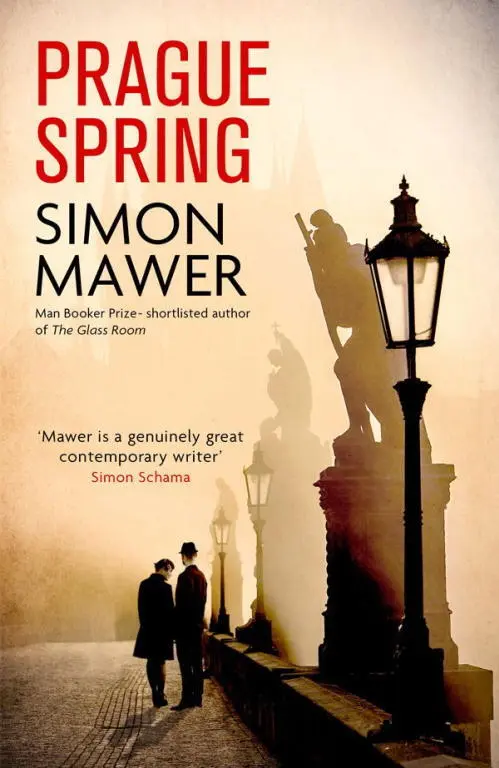
- Название:Prague Spring
- Автор:
- Издательство:Little, Brown Book Group
- Жанр:
- Год:2018
- Город:London
- ISBN:978-1-4087-1113-2
- Рейтинг книги:3 / 5. Голосов: 1
-
Избранное:Добавить в избранное
- Отзывы:
-
Ваша оценка:
Prague Spring: краткое содержание, описание и аннотация
Предлагаем к чтению аннотацию, описание, краткое содержание или предисловие (зависит от того, что написал сам автор книги «Prague Spring»). Если вы не нашли необходимую информацию о книге — напишите в комментариях, мы постараемся отыскать её.
In the summer of 1968, the year of Prague Spring with a Cold War winter, Oxford students James Borthwick and Eleanor Pike set out to hitchhike across Europe, complicating a budding friendship that could be something more. Having reached southern Germany, they decide on a whim to visit Czechoslovakia, where Alexander Dubček’s “socialism with a human face” is smiling on the world.
Meanwhile, Sam Wareham, First Secretary at the British embassy in Prague, observes developments in the country with a diplomat’s cynicism and a young man’s passion. In the company of Czech student Lenka Konečková, he finds a way into the world of Czechoslovak youth, with all its hopes and new ideas; now, nothing seems off-limits behind the Iron Curtain. But the great wheels of politics are grinding in the background; Soviet leader Leonid Brezhnev is making demands of Dubček, and the Red Army is massing on the borders.
This shrewd, engrossing, and sensual novel once again proves Simon Mawer is one of today’s most talented writers of historical spy fiction.
Prague Spring — читать онлайн бесплатно полную книгу (весь текст) целиком
Ниже представлен текст книги, разбитый по страницам. Система сохранения места последней прочитанной страницы, позволяет с удобством читать онлайн бесплатно книгу «Prague Spring», без необходимости каждый раз заново искать на чём Вы остановились. Поставьте закладку, и сможете в любой момент перейти на страницу, на которой закончили чтение.
Интервал:
Закладка:
Once out of the built-up area Harold turns to speak. They can let the hidden passenger out for a breather. It’s an awkward manoeuvre in the confined space, all four of them having to crowd forward so that the rear seat can be raised and the coffin opened. Gennady Egorkin rises, like Lazarus, from the dead. Middle-aged, balding, pallid, slick with sweat, he has the look of the hunted about him. For a few minutes he sits there in his coffin beneath the gaze of his fellow passengers while the girl leans over to minister to him, offering him water and words, presumably of comfort. The sight ought to be incongruous, perhaps even comic, but instead there’s something disturbing about it, as though one is watching a nurse administer a slow and uncomfortable medical procedure.
‘I need to piss,’ Lazarus says. They’re the first words he has spoken in English and they betray a surprisingly colloquial command of the language. Harold passes an empty plastic bottle back. While the passengers look discreetly away, the renowned orchestral conductor unbuttons his trousers and pisses into the bottle. You might evade the sight but there’s no avoiding the sound or the warm smell of urine that pervades the enclosed space and wrinkles the Edinburgh woman’s nose.
When the deed is done it is the young violinist who disposes of the urine, sliding the side door open a fraction and pouring the piss out onto the tarmac. Later, as they approach a built-up area, the man is closed back in his coffin, normal seating is resumed and the journey continues.
At Pilsen the column grinds to a halt. They wait, not knowing. The vehicle in front is a Karmann Ghia with West German number plates. In front of that an Opel, and then the British Embassy Humber. They can’t see any further. After a while the Wareham guy walks back down the road and leans in at the driver’s window.
‘Some kind of roadblock. Don’t know what the hell’s happening but there are soldiers all over the place.’
Soldiers cannot be good. Wareham glances at his watch, then at the radio at Harold’s feet. ‘Can’t you turn that bloody thing off?’
There’s a sudden silence in the van. The wait goes on. It’s stiflingly hot beneath the midday sun and people are getting out of their vehicles and wandering in the road, straining to see. When James pulls the side door open he’s told to stay inside by Harold, but it doesn’t take much to ignore him. He steps out into the sunshine and what little breeze there might be. Ellie climbs out after him, and then the embassy secretary and the violinist after her. It seems only a single move is needed to undermine the voice of authority. A haze of exhaust fumes rises above the snake of vehicles. The tarmac is hot, painted with a mirage of water.
Soldiers come nearer, going to each vehicle, checking documents, opening car boots.
Wareham asks of nobody in particular, ‘What the fuck are they looking for?’
The embassy woman seems shocked by such language, especially from a diplomat. They don’t behave like that in Morningside. James thinks of war films, of Nazi guards walking down a train, peering into compartments. What will happen? Will someone break and run? Will there be a sudden shout, the raising of a rifle, the crack of a bullet fired like the one that flew past him only the day before and smacked into the wall mere inches from his head? The singing in his ear still hasn’t stopped.
As the soldiers get nearer Nadezhda scuttles back into the van. Ellie goes with her. Wareham is on the tarmac, saying something to the soldiers, offering a cigarette, even laughing with them. ‘Passport,’ he calls to his charges. ‘They want to see your passports.’
Ellie and the violinist are ordered out of the van. They stand by the open door while the soldiers lean inside, pushing a rucksack off a seat, peering beneath the front bench, grunting when they find nothing. The violinist is shaking. Ellie holds her hand as the soldier examines her passport, flicking through the pages to find the entry visa before handing it back without a word. Then the same thing for the others.
Wareham glances at his watch and says something to the soldiers. They move on to the car behind, a Morris Minor Traveller with British plates. Everyone climbs back in the van. Wareham leans in through the window and says something to the violinist in Russian, then to the others in English: ‘Well done.’
Ahead of them cars are starting their engines. With painful slowness the serpent begins to move forward, stretching its neck into the industrial smog of Pilsen and on to that empty border area which James and Ellie crossed only ten days ago. By the middle of the afternoon they come to a halt once more, but this time at the checkpoint where Czechoslovak border guards show scant interest in their documents. Foreigners getting out while the going’s good? Who gives a damn?
Soviet troops watch with the indifference of conquerors.
The road goes on, cutting through the forest and slanting down into the wooded valley of the watercourse that the Germans call Rehlingbach, Fawnbrook, but the Czechs know simply as Hraniční potok, Border Stream. The black eagle of the Federal Republic of Germany flies on the other side of the bridge while a crowd waits beyond the checkpoint – American military, anonymous black limousines, television crews with cameras levelled at the refugees like weapons. There’s a festive air, the sense of release and relief.
‘What were you doing in Czechoslovakia?’ a voice asks Ellie as they climb down from the van. A microphone is pushed into her face. A camera aims at her. ‘Tell our viewers what it was like.’
James follows her out into the afternoon sunshine. Behind them the van moves away towards a couple of black Mercedes where men in suits gather round. He catches a glimpse of the girl being hurried into one of the cars, and then the other passenger, the man in the coffin, being helped into the other.
‘It was frightening,’ Ellie is saying. ‘Tanks, soldiers, shooting. The people were so courageous.’
‘What do you have to say to the Russians?’
‘They should go home. They’re not needed and they’re not wanted.’
As the cameras move on to other prey, unexpectedly the Wareham guy appears. ‘Where are you kids off to?’
James looks uncertain. ‘Haven’t decided really.’
‘How you doing for cash?’
‘Got to get some, I suppose. We’ve still got koruna.’
‘That won’t be worth anything here. Look’ – he takes out his wallet – ‘here are some Deutschmarks to tide you over.’ It’s like handing out charity. One hundred D-marks in a mixture of notes. About ten quid.
‘We can’t,’ Ellie says, but James has already folded the money away.
Wareham smiles that annoying, patronising smirk. He knows the one who has money plainly enough; by nothing more than their accents he can recognise the contrasts and conflicts between the two of them. ‘Take it as a present from Her Majesty, to say thank you. You did very well. I just want to remind you that we’d rather you kept quiet about the details of this whole business. You’ll read about it in the press, I expect – famous conductor flees the Russians, you know what I mean. But no one needs to know the details of how it happened. It does, as a matter of fact, come under the Official Secrets Act.’
‘We haven’t signed it,’ James points out.
Wareham smiles pityingly. ‘The Act is law, old chap. You don’t have to sign it any more than you have to have signed the Homicide Act before you can be convicted of murder.’ He glances round. The black Mercedes are driving away from the border. The VW van has already gone back to the East and the embassy Humber is waiting for him with its engine ticking over. ‘I’m afraid I’ve got to get back.’
Читать дальшеИнтервал:
Закладка:
Похожие книги на «Prague Spring»
Представляем Вашему вниманию похожие книги на «Prague Spring» списком для выбора. Мы отобрали схожую по названию и смыслу литературу в надежде предоставить читателям больше вариантов отыскать новые, интересные, ещё непрочитанные произведения.






Обсуждение, отзывы о книге «Prague Spring» и просто собственные мнения читателей. Оставьте ваши комментарии, напишите, что Вы думаете о произведении, его смысле или главных героях. Укажите что конкретно понравилось, а что нет, и почему Вы так считаете.