Саймон Моуэр - Prague Spring
Здесь есть возможность читать онлайн «Саймон Моуэр - Prague Spring» весь текст электронной книги совершенно бесплатно (целиком полную версию без сокращений). В некоторых случаях можно слушать аудио, скачать через торрент в формате fb2 и присутствует краткое содержание. Город: London, Год выпуска: 2018, ISBN: 2018, Издательство: Little, Brown Book Group, Жанр: Историческая проза, на английском языке. Описание произведения, (предисловие) а так же отзывы посетителей доступны на портале библиотеки ЛибКат.
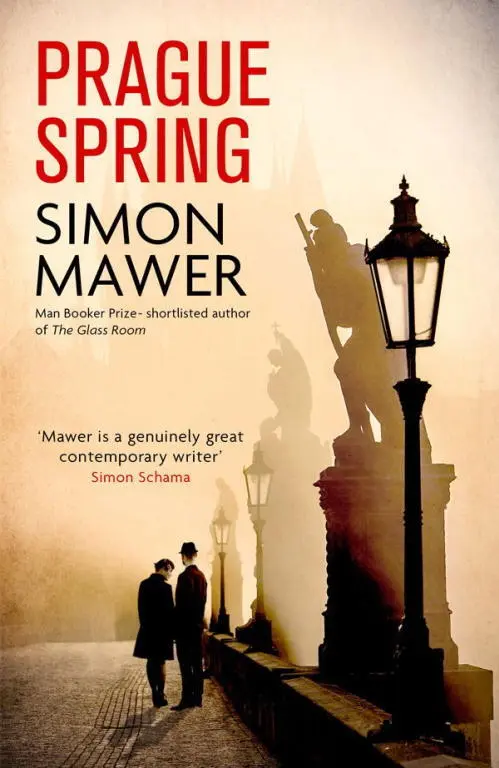
- Название:Prague Spring
- Автор:
- Издательство:Little, Brown Book Group
- Жанр:
- Год:2018
- Город:London
- ISBN:978-1-4087-1113-2
- Рейтинг книги:3 / 5. Голосов: 1
-
Избранное:Добавить в избранное
- Отзывы:
-
Ваша оценка:
Prague Spring: краткое содержание, описание и аннотация
Предлагаем к чтению аннотацию, описание, краткое содержание или предисловие (зависит от того, что написал сам автор книги «Prague Spring»). Если вы не нашли необходимую информацию о книге — напишите в комментариях, мы постараемся отыскать её.
In the summer of 1968, the year of Prague Spring with a Cold War winter, Oxford students James Borthwick and Eleanor Pike set out to hitchhike across Europe, complicating a budding friendship that could be something more. Having reached southern Germany, they decide on a whim to visit Czechoslovakia, where Alexander Dubček’s “socialism with a human face” is smiling on the world.
Meanwhile, Sam Wareham, First Secretary at the British embassy in Prague, observes developments in the country with a diplomat’s cynicism and a young man’s passion. In the company of Czech student Lenka Konečková, he finds a way into the world of Czechoslovak youth, with all its hopes and new ideas; now, nothing seems off-limits behind the Iron Curtain. But the great wheels of politics are grinding in the background; Soviet leader Leonid Brezhnev is making demands of Dubček, and the Red Army is massing on the borders.
This shrewd, engrossing, and sensual novel once again proves Simon Mawer is one of today’s most talented writers of historical spy fiction.
Prague Spring — читать онлайн бесплатно полную книгу (весь текст) целиком
Ниже представлен текст книги, разбитый по страницам. Система сохранения места последней прочитанной страницы, позволяет с удобством читать онлайн бесплатно книгу «Prague Spring», без необходимости каждый раз заново искать на чём Вы остановились. Поставьте закладку, и сможете в любой момент перейти на страницу, на которой закончили чтение.
Интервал:
Закладка:
‘Of a kind.’
‘So, a kind of socialist. A bourgeois, Western socialist. I got someone to smuggle the letter out of the country because you couldn’t just put something like that in the post.’
‘And what happened?’
She gave a wry smile, as though disappointment was only to be expected. ‘Nothing happened. I never heard from him.’
Sam felt a moment of shame. ‘Wilson should have replied. Something. Anything.’
‘But he didn’t. And now he is your prime minister.’ She got up and went over to the cooker to check the food in the oven, talking all the time. Perhaps it was a sign of the liberalisation in the country that she felt she could tell the story. ‘They were Jews, you know that? Most of them were Jews.’ The Czech word židi rang round the room. ‘My husband’s parents were Jews but he was an atheist, a communist, a good communist. But they treated him like a traitor and a Jew.’
‘Mother, please,’ said Lenka. ‘This was meant to be a happy occasion. Sunday lunch. A family thing.’
‘We have no family,’ her mother snapped. ‘Two people isn’t a family, it’s just survivors clinging to the wreckage.’ The oven door slammed shut. Sam tried to step around the obstacle that lay in the path of further discourse. ‘Weren’t they all’ – he struggled for the correct word – ‘made good in 1963?’ That was all he could manage: exonerated, absolved, acquitted, exculpated. All words beyond Sam’s vocabulary in Czech.
Kateřina laughed. It was the kind of laugh you heard often enough in Prague, the laughter of contempt and resignation. ‘What good was that to me? By then he was ten years dead.’
Lenka was still holding the snapshot of the couple sitting on a rock. Perhaps to her the world of that snapshot seemed too far away, another time in another country of which she knew nothing. Perhaps that faintly smiling figure who had been her father was a creature of myth. Yet for an adult, for her mother, it was a mere sixteen years.
‘He doesn’t even have a grave, do you know that? I don’t know what they did with his body. They just told me of his death by letter. It took me a year even to get an official death certificate. And now—’
‘Now?’
‘A few months ago they sent me a medal, his medal. The Order of the Republic.’ She made a sound that was halfway between a laugh and a cry. ‘And now they say they want to give me compensation. But I don’t want their medals or their money. I want my husband back.’
That was the moment when Sam feared she might weep. But she didn’t. There was something hard and dry about her face, as though the tears had long since drained away like water through the limestone of the Moravian karst.
‘I not only lost him, I even had to lose his name. He was Vadinský, Lukáš Vadinský. I was Kateřina Vadinská. But someone, a friend, advised me to go back to my unmarried name, so that was what I did. Konečková.’ She smiled bitterly. ‘Another betrayal.’
‘It’s the past, Maminka,’ Lenka said. ‘Things have already changed. And they are changing still.’
Her mother ignored her words. She began to lay the table with ill-matched plates, cutlery that you might find in a cheap café, a cruet set of Bohemian cut glass, two stemmed wine glasses and a tumbler. She shook her head. ‘The past,’ she said, ‘is all we have. It just repeats itself.’
‘She liked you,’ Lenka said.
They were outside, walking between the paneláky . There was a Sunday sense of lassitude about the place. Kids were kicking a football around on a worn scrap of grass, but that was the only real activity. A bench of four old men argued about something. No doubt their wives were at home washing dishes.
‘I thought she was cleverer than that,’ Sam said.
His car was parked round the corner, next to a Trabant and a row of chained bicycles. Someone had written Umyj mne , wash me, in the dust of the rear window. One of the kids, no doubt. They drove away, avoiding the footballers.
‘Your mother is quite a force,’ he said, but Lenka felt the need to apologise on her behalf. ‘She shouldn’t have talked like that, she said. ‘She should keep private matters private.’
‘She needed to talk,’ Sam said. ‘She’s a brave woman.’
The girl was silent. He knew she was looking at him. Those eyes that were the most intense cerulean blue. He wondered what she was thinking, whether she was measuring him up for something. If so, what?
17
He took an afternoon off and they went swimming. They decided on a place out of the city, on the river where Sam had been with Steffie once or twice. He hadn’t told Lenka that bit. A place he knew, that was all he told her. She’d like it.
So they packed picnic things in his Mercedes and set off, and it wasn’t long before he spotted the car following. In the last few months this sort of thing had grown rarer, as though even the security services had been tainted by the infection of liberalisation, but there it was, plain enough, an anonymous Škoda on his tail, like a faithful dog tagging after them, turning where they turned, slowing when they slowed, remaining all the time about one hundred metres behind. They made their way south of the city and after a while took a rough road that led amongst wooded hills close to the river’s edge where you could park the car easily enough. The Škoda didn’t appear. Perhaps it was waiting somewhere out of sight, knowing that there was no other way out.
He turned the engine off. Silence rushed into the enclosed world of the Mercedes. ‘How’s this?’
Lenka’s expansive smile, a gleam of naked gum. ‘It’s lovely.’ He felt that torrent of desire and affection, a dangerous complex of emotion over which he had no control. He leant towards her and kissed her, tasting the cigarette she had been smoking and the coffee she had drunk earlier, as though kissing her was to snatch a small part of her quotidian life and make it his as well.
They got out of the car and took their things from the boot. Not far away was a settlement of those small wooden cabins that Czechs use as country retreats – chaty . They were like beach huts on the English coast: the same clapboard constructions in vivid primary colours, the same defiant sense of pride. But these didn’t have uniformity. They might be put together out of anything: offcuts from a timber yard, corrugated iron, tarpaper, panels from an ancient car, barrels from a brewery. An old man watched from his garden as they carried their picnic things down through the trees to the water’s edge. The air was hot and still. The water flowed over stones and around spits of gravel with Smetana’s scurrying rhythms. Things moved in the woods that bordered the space. Birds sang. An egret, sinuous and chalk white, stood in the water on the far side, keeping one cautious eye on the intruders.
Sam took up his camera and snapped some photos: Lenka tossing her hair, Lenka holding up a hand to keep the camera off her face, Lenka smiling, Lenka frowning. ‘I will swim,’ she declared in that matter-of-fact tone she adopted when speaking English, as though everything were a statement of fact and the subjunctive never existed. ‘And no photos.’ She shook loose her hair, pulled her dress over her head and dropped it at her feet. When he’d been here before, Stephanie had struggled beneath her towel and finally emerged in a modest one-piece bathing costume. Lenka was made of sterner stuff. As unconcerned as if she were in the bathroom at home, she tossed her brassiere aside, stepped out of her underpants and stood for a moment contemplating the river. There was something hieratic about her narrow, pale body, like a figure from Slavic myth, a rusalka . He’d seen the opera with Steffie the previous autumn at the National Theatre with Milada Šubrtová playing the title role of the water nymph who falls in love with a human. It’s the age-old problem of a demigod getting tied up with a mortal, and you know it’s never going to work, however eloquently Rusalka may appeal to the moon.
Читать дальшеИнтервал:
Закладка:
Похожие книги на «Prague Spring»
Представляем Вашему вниманию похожие книги на «Prague Spring» списком для выбора. Мы отобрали схожую по названию и смыслу литературу в надежде предоставить читателям больше вариантов отыскать новые, интересные, ещё непрочитанные произведения.





Обсуждение, отзывы о книге «Prague Spring» и просто собственные мнения читателей. Оставьте ваши комментарии, напишите, что Вы думаете о произведении, его смысле или главных героях. Укажите что конкретно понравилось, а что нет, и почему Вы так считаете.