Саймон Моуэр - Prague Spring
Здесь есть возможность читать онлайн «Саймон Моуэр - Prague Spring» весь текст электронной книги совершенно бесплатно (целиком полную версию без сокращений). В некоторых случаях можно слушать аудио, скачать через торрент в формате fb2 и присутствует краткое содержание. Город: London, Год выпуска: 2018, ISBN: 2018, Издательство: Little, Brown Book Group, Жанр: Историческая проза, на английском языке. Описание произведения, (предисловие) а так же отзывы посетителей доступны на портале библиотеки ЛибКат.
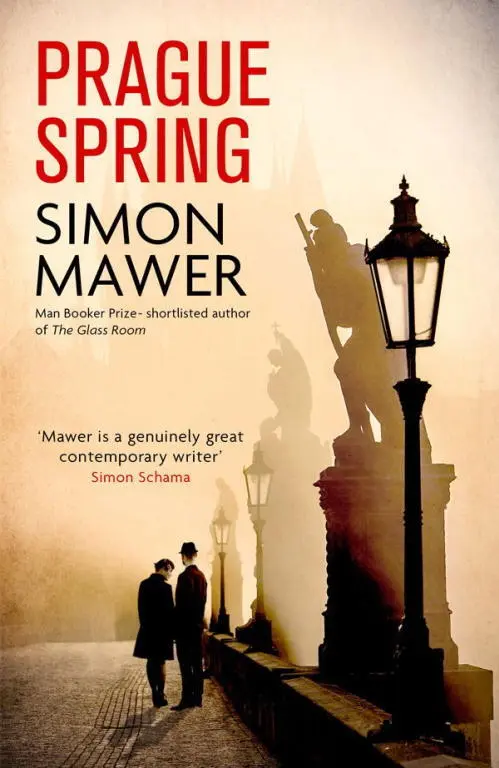
- Название:Prague Spring
- Автор:
- Издательство:Little, Brown Book Group
- Жанр:
- Год:2018
- Город:London
- ISBN:978-1-4087-1113-2
- Рейтинг книги:3 / 5. Голосов: 1
-
Избранное:Добавить в избранное
- Отзывы:
-
Ваша оценка:
Prague Spring: краткое содержание, описание и аннотация
Предлагаем к чтению аннотацию, описание, краткое содержание или предисловие (зависит от того, что написал сам автор книги «Prague Spring»). Если вы не нашли необходимую информацию о книге — напишите в комментариях, мы постараемся отыскать её.
In the summer of 1968, the year of Prague Spring with a Cold War winter, Oxford students James Borthwick and Eleanor Pike set out to hitchhike across Europe, complicating a budding friendship that could be something more. Having reached southern Germany, they decide on a whim to visit Czechoslovakia, where Alexander Dubček’s “socialism with a human face” is smiling on the world.
Meanwhile, Sam Wareham, First Secretary at the British embassy in Prague, observes developments in the country with a diplomat’s cynicism and a young man’s passion. In the company of Czech student Lenka Konečková, he finds a way into the world of Czechoslovak youth, with all its hopes and new ideas; now, nothing seems off-limits behind the Iron Curtain. But the great wheels of politics are grinding in the background; Soviet leader Leonid Brezhnev is making demands of Dubček, and the Red Army is massing on the borders.
This shrewd, engrossing, and sensual novel once again proves Simon Mawer is one of today’s most talented writers of historical spy fiction.
Prague Spring — читать онлайн бесплатно полную книгу (весь текст) целиком
Ниже представлен текст книги, разбитый по страницам. Система сохранения места последней прочитанной страницы, позволяет с удобством читать онлайн бесплатно книгу «Prague Spring», без необходимости каждый раз заново искать на чём Вы остановились. Поставьте закладку, и сможете в любой момент перейти на страницу, на которой закончили чтение.
Интервал:
Закладка:
‘What history are you talking about?’
‘My family’s.’ She attempted a smile, that ironic, Iron Curtain smile that Sam had long ago come to recognise. ‘Let’s talk about other things. Maybe I’ll introduce you to my mother sometime and then you can find out. But not now.’
So they talked about other things, and it was easy enough – the new freedoms, the freedom to write what you liked, report whatever concerned you. Food came and went. They had a bottle of Moravian wine which was not as dreadful as usual, and she wanted to know about London, swinging London, Carnaby Street, the Rolling Stones, the Beatles. Hippies. Hash. And then himself. Why exactly was he taking her out to lunch? He’d never said, the first time she asked.
‘Because I find you attractive. That’s not a sin, is it?’
‘It all depends. You say you have no wife.’
‘No.’
‘And is there no girlfriend?’
He hesitated with the tense. ‘There was. She’s called Steffie. She works for the Service, although she’s not a diplomat.’ He tried to pretend it was of no importance, but there was the snake-like slither of guilt running up his spine. He’d had a letter from her that morning, a brief but heartfelt missive enclosing a postcard of Cologne cathedral. Having a lovely time, wish you were here , was scrawled on the card. The letter said the same thing, but without the irony: Perhaps I shouldn’t have been so hasty , she had written . It’s being apart that makes me understand how good we are together .
‘She was posted back to England.’
‘And your heart is broken?’
‘We didn’t break up exactly. It’s just…’ Momentarily, he felt himself floundering beneath her steady, interrogator’s gaze. Blue eyes, narrowed against the light. ‘It’s always been a difficult relationship. When you are on post, when you meet such a limited range of people, things are always difficult. Artificial, I suppose.’
‘And now?’ It was a challenge, and he deflected it.
‘Now you must tell me about yourself. That’s only fair.’
‘What do you want to know?’
‘No boyfriend?’
‘There has been. Not recently. Not serious, anyway.’
‘What’s serious?’
‘If they matter to me. One did. He played in a group. You know? Guitars, pretending to be The Beatles? We were together a couple of years. Since then…’ She let her voice trail away into silence.
For dessert they had the inevitable palačinky , pancakes, with a sharp cherry filling and too much whipped cream. Sam glanced at his watch. ‘Look, I’m sorry but I’ve got to get back to the office. People to see, minutes to write.’
‘Of course.’
‘Perhaps I can see you again?’
‘Why not? There is – I do not know if you are interested – there is a concert coming up. My flatmate is in the orchestra so I get tickets. You met her – Jitka.’
‘Of course.’ He thought for a moment, riffling mentally through his social diary and deciding that no one would notice if he didn’t turn up to the reception at the Swiss embassy to celebrate what? Their national day, presumably. Madeleine would notice but she could go hang. ‘Yes, that’s fine. Where? What time? Maybe we can get something to eat afterwards.’
Again that shrug. ‘The House of Artists. At six. On the steps. There will be others there. Friends.’
6
The concert. A scrum of people going up the steps into the auditorium, and Lenka grabbing Sam’s hand to lead him through a side entrance and up stairs to one of the balconies. ‘You’re with the poor students now, Mr Diplomat,’ she said. They shuffled sideways into narrow seats. He was introduced to some of her friends, faces that were familiar from the political meeting – the Barboras and Terezas, the Mareks and Pavels. There was a buzz of excited conversation as they peered down on the audience in the body of the auditorium. ‘There’s Smrkovský,’ someone said, and everyone craned to look at the tough-looking man taking his seat in the stalls.
‘Do you know who he is?’ asked Lenka. It was hot up there just beneath the ceiling. Her forehead and upper lip were beaded with sweat.
‘I’m political, remember? Of course I know him. I’ve even met him.’
‘You’ve met him?’
‘Talked with him. For about three minutes.’
‘So what do you think of him?’
Sam considered for a moment. Far below people were pushing and shoving to get a moment’s contact with the man. He smiled round, shaking hands. A pugnacious, genial face, a short brush of grey hair. A member of the Central Committee of the Party, he was one of Dubček’s closest associates. ‘I think you’re looking at a man riding a tiger. You know about riding a tiger?’
‘Hard to get off?’
‘Exactly.’
People applauded. The applause began close to Smrkovský and spread out like a wave in a pond until everyone in the auditorium was clapping, from the stalls to the gods, until the man was settled into his seat. More applause greeted the orchestra as it filed on stage. Lenka pointed. ‘There’s Jitka. Second violins, next to the bald-headed man. I rent a room in her flat.’
Down amongst the penguins Jitka seemed transformed from the febrile woman of the political meetings into an elegant lady in a black evening gown. There was the sense of her beauty, even at this distance. But then, you so often had a sense of beauty with Czech women, at whatever distance you might choose. After a few minutes the conductor appeared, bobbing and weaving like a footballer through the ranks of players. He bowed to the audience and turned to the orchestra, holding out his hands to calm the storm of clapping. Then, when a perfect silence had been achieved, he raised his baton and unleashed the first crashing, portentous notes of Blaník , the sixth and final of Smetana’s cycle of tone poems, Má Vlast . It wasn’t on the programme, that was the point. The programme, on a roneoed sheet handed round amongst Lenka’s friends, had Dvořák’s Slavonic Dances and Martinů’s Sixth Symphony, not pieces of music that would have stirred Sam’s interest very much. But here, without warning, were the familiar tones of Blaník sending a pulse of excitement through the hall.
Má Vlast , My Homeland. Patriotism without kitsch, an almost impossible trick to pull off. Blaník tells of the legend that Václav, Good King Wenceslas of the Christmas carol, a kind of Bohemian King Arthur, waits beneath the Blaník mountain with a company of knights, ready to emerge and save the Czech people at their moment of greatest need, when they are threatened – legend has it – by four hostile armies. We may savour the bitter irony of that now, but then, on that hot summer evening in Prague, the music seemed a clarion call to the nation. The Russians, the East Germans, the Poles, the Hungarians would all be defied. Holding hands, the Czechs and the Slovaks would move forward into the sunlit uplands of freedom and prosperity. Socialism would show its human face to all mankind.
The audience listened transfixed throughout and, at the crashing end, stood as one to applaud. Lenka’s eyes were bright with tears. There was sweat certainly, sweat and tears mingling on her cheeks. Sam dared to put up his hand to brush them away and was blessed with a wry smile.
After the concert they all went – Jitka the violinist and half a dozen others – to a place on the river where a quartet was playing cool jazz. There were tables outside under the trees and food was served till late. Laughter, argument, beer in the warm night, the kind of thing one dreamed of even in socialist Czechoslovakia, especially in socialist Czechoslovakia now that it was finding this thrilling, novel freedom. They were joined after a while by the Strelnikov character himself, Jitka’s husband Zdeněk. He greeted Sam with enthusiasm. ‘My Englishman. I like my Englishman,’ he said. The talk was a blend of practical politics and speculative philosophy. Names were bandied around – Lukács, Marcuse – and concepts that bore names like reification and alienation . Sam felt old, an emissary from another generation. ‘What do you think?’ they kept asking him, hoping for an optimistic answer. He did a great deal of shrugging, verbally and literally. He had exhausted this kind of talk when he was at university, and working for the Foreign Office had killed any residual idealism there might have been. Where do our best interests lie? was the watchword of the diplomatic corps: pragmatism elevated to a political philosophy.
Читать дальшеИнтервал:
Закладка:
Похожие книги на «Prague Spring»
Представляем Вашему вниманию похожие книги на «Prague Spring» списком для выбора. Мы отобрали схожую по названию и смыслу литературу в надежде предоставить читателям больше вариантов отыскать новые, интересные, ещё непрочитанные произведения.



Обсуждение, отзывы о книге «Prague Spring» и просто собственные мнения читателей. Оставьте ваши комментарии, напишите, что Вы думаете о произведении, его смысле или главных героях. Укажите что конкретно понравилось, а что нет, и почему Вы так считаете.