Stephan Collishaw - Amber
Здесь есть возможность читать онлайн «Stephan Collishaw - Amber» весь текст электронной книги совершенно бесплатно (целиком полную версию без сокращений). В некоторых случаях можно слушать аудио, скачать через торрент в формате fb2 и присутствует краткое содержание. Город: London, Год выпуска: 2015, ISBN: 2015, Издательство: Dean Street Press, Жанр: Историческая проза, Современная проза, prose_military, на английском языке. Описание произведения, (предисловие) а так же отзывы посетителей доступны на портале библиотеки ЛибКат.
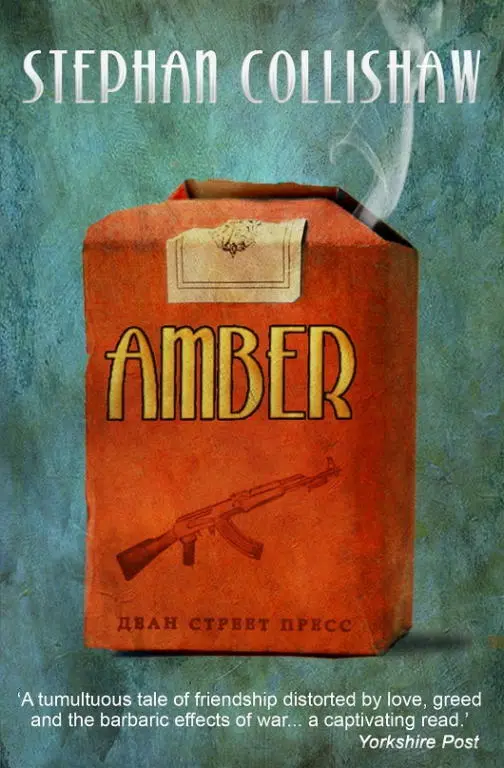
- Название:Amber
- Автор:
- Издательство:Dean Street Press
- Жанр:
- Год:2015
- Город:London
- ISBN:978-1-910570-01-2
- Рейтинг книги:5 / 5. Голосов: 1
-
Избранное:Добавить в избранное
- Отзывы:
-
Ваша оценка:
Amber: краткое содержание, описание и аннотация
Предлагаем к чтению аннотацию, описание, краткое содержание или предисловие (зависит от того, что написал сам автор книги «Amber»). Если вы не нашли необходимую информацию о книге — напишите в комментариях, мы постараемся отыскать её.
But Vassily has a guilty secret◦– eight years later, on his deathbed, he cannot make a full confession, but charges Antanas with retrieving the priceless amber bracelet he smuggled out of Afghanistan during the war. After Antanas reluctantly agrees, he discovers not only that a dangerous rival is also searching for it, but also the terrible price Vassily paid for it. Only then can he truly make peace with the past and with his estranged wife. About the Author
Amber — читать онлайн бесплатно полную книгу (весь текст) целиком
Ниже представлен текст книги, разбитый по страницам. Система сохранения места последней прочитанной страницы, позволяет с удобством читать онлайн бесплатно книгу «Amber», без необходимости каждый раз заново искать на чём Вы остановились. Поставьте закладку, и сможете в любой момент перейти на страницу, на которой закончили чтение.
Интервал:
Закладка:
Scrambling back up the bank, madly, I thought it was Zena crying from her pyre. Crawling forwards on hands and knees, struggling for breath beneath the thick clouds of smoke, I worked my way into the centre of the village once more. The cries came from the hut in which the old man had been standing. I crawled over his inert body and stumbled around the back of his crumbling home. Smoke poured from a ventilation window high in the wall. I clambered up to it. From inside I could hear a hoarse low cough, the sound of a child struggling to breathe. I called through the opening. I clawed at the mud, pulling away dry handfuls, enlarging the hole.
I pushed myself through into the darkness. Landing heavily, I immediately felt the movement beside me. Squeezed tight into the corner was a child, eyes pressed tightly shut, face dark, lips blue, throat gasping, groping for oxygen, tearing painfully, choking on the smoke. I scooped the girl into my arms and staggered out through the flames.
Chapter 29
A sharp breeze rustled the branches of the trees in Vingis Park. The sudden noise startled Kolya and he turned quickly on his heel, his hand reaching beneath his jacket. The moon had disappeared, covered by another thick layer of cloud blowing in from the coast. The only light came from the lamps on the bridge, just visible through the trees.
I pushed up the sleeve of my jacket and unbuttoned my shirt. My fingers trembled so that it took a while. It was so dark that it was hard to make out the crinkled pink skin. The scars. I felt the skin’s odd hairlessness, its wrinkles. Tentatively Kolya reached out and placed his fingers on my arm. They were cold and trembling too.
I felt again the weight of the fragile child’s body in my arms, recalling how I had stumbled down the hill, the branches of the trees lashing my face, my arms numb with pain. How I fell, headlong, tossing the child aside. Crawled through the undergrowth, picked her up and staggered on. And fell and gathered her and stumbled on.
‘We’re pulling out,’ a voice shouted close to my ear.
Vassily was perspiring, his face black with dirt, glistening with large beads of sweat. He loomed over me, blocking out the light. His hand reached down and brushed my cheek. I tried to turn my head, but it would not move.
His hands gripped the front of my flak jacket. He pulled the child from my arms. I struggled to hold on to the small body, pulling it close to my chest. Crushing it against me. Another set of hands pulled at my arms. The pain seared through my body, vibrating in my head. It was as if somebody were pushing hot iron against my flesh, tearing the skin away from my bone.
‘He’s badly burnt,’ somebody said.
‘Come on, let’s move,’ Vassily said, his voice tight with fear. ‘They may come back and we’re totally fucked. Zhuralev has taken a bullet, and the radio operator is dead.’
I tried to struggle to my feet, but Vassily pushed me back down.
‘Just roll over,’ he said. ‘Let’s get you on to the stretcher.’
Hands reached out and tugged at me. Pulled and pushed. Lifted and dropped. Sick with exhaustion, I lay still as they hoisted me up. They ran, jolting me so my teeth rattled. I heard the splash of water as they forded the stream and their heavy breathing and curses as they stumbled down the line. My head throbbed and my arms burnt.
‘Zena,’ I murmured, my voice hoarse, barely audible above the noise of the engines of the armoured vehicles.
There was a strong wind blowing. The sand was whipped up from the track and swirled in dark, choking clouds around the stationary vehicles. The wind was accompanied by a heavy throb, a clattering pulse. My stretcher was lifted and slid along the floor of a helicopter.
A medic looked down at me, gently pushing my head to one side, digging strong fingers into the side of my neck, eliciting a pain so sharp it brought tears to my eyes and a cry to my lips. A look of wearied annoyance crossed the medic’s face and he pushed my head roughly back into place. He turned and extracted a syringe from his bag, took a small glass vial and snapped off its nipple. Inserting the needle, he sucked the morphine up into the syringe. The tip was white from where it had been boiled. Its rubber looked dark and perished. He injected me and turned immediately to deal with another casualty.
Sitting above me, on one of the metal seats along the side of the chopper, was the medic with the spectacles.
‘Zena,’ I said.
He glanced down at me. His spectacles were cracked and a yellowing bandage had been wound tightly around his head. Blood had begun to seep through it, a dark stain.
A rush of warmth flooded my senses, entirely at odds with the desperate darkness of my thoughts. I fought it. My eyelids flickered. When they slid closed, I opened them again, lifting the skin with deliberate effort. The metal beneath me lurched suddenly and somebody cursed. Somebody else was crying. My eyelids fell heavily and I could not lift them, though I tried.
‘Zena.’ The helicopter dipped as it turned so that my stretcher slid across the metal floor, coming to rest against the legs of the seats. Darkness enfolded me.
‘Let’s go now,’ Kolya said softly.
I nodded and pulled down the sleeves of my shirt and jacket. We turned in the direction of the bridge and trudged along the dark path in silence, feet crunching on the gravel. On the back of my neck I felt a drop of rain. Glancing up, I saw the dark shape of an owl swoop down across the sky and settle at the top of a tree. From the far side of the bridge it was possible to hear the dog barking still, disturbed by some other nocturnal soul. On the bank of the river, by the end of the bridge, work was being done to create a new path through the centre of the woods to the auditorium. The earth-working equipment cast weird shapes in the darkness. Kolya shivered and hurried on towards the light of the lamp on the footbridge.
Chapter 30
I did not wake as the Mi-8 skimmed low through the pass, ruffling the sky-blue lakes, tossing the branches of the trees. Nor did I wake in Jalalabad when they hauled me off and lined me up on the tarmac in the darkness, with boys with missing limbs, shattered skulls, boys already zipped into bags. I did not wake on the plane that transported us across the narrow fissures, the broken-backed mountains, the jagged teeth of Afghanistan, to Kabul.
It was dark when I came to. I could not breathe. I was tied and bound and choking. I struggled and tossed around. I have been captured, was my first thought. My grenade. One for the muj, one for yourself◦– our first lesson in Afghanistan. I could not move my arms. When I threw back my head to clear my windpipe a searing pain scalded me and detonated a series of mini-explosions behind my eyes. I cried out.
I heard the clatter of footsteps. The slap of rubber on tiles. The slop of slippers. Hands were pulling at me, lifting me.
Leave me◦– no◦– oh fuck, oh fuck.
‘Sedate him,’ somebody muttered.
Lying on my back I could breathe more easily. My head continued to thump and I could not feel my limbs. Figures swam in front of my eyes.
Zena.
A hand reached out and clamped itself tightly over my lips.
‘Get it in quick, before he wakes the whole fucking ward with his screams.’
Light. My eyelids slid open. The brightness hurt, forcing me to squint. The walls were hospital green. A low rumble sounded softly in my ears. Carefully I peered from side to side. I could not turn too far without setting off the pain. The room was lined with metal-framed beds. Two nurses lounged against a wall, one gazing out of the window. As my mind cleared a little, I realised that the low rumbling, which I had taken to be traffic on the road outside, or the murmur of an old fan, was in fact the quiet moans of a hundred men. The moans rose and fell, a continuous stream of pain ebbing and flowing around the hospital ward. It took me a few moments more to realise that I too was a part of this current, my moan joining theirs, escaping my throat involuntarily, rising to float beneath the high ceiling, with the fat flies and spiders that nestled darkly in corners.
Читать дальшеИнтервал:
Закладка:
Похожие книги на «Amber»
Представляем Вашему вниманию похожие книги на «Amber» списком для выбора. Мы отобрали схожую по названию и смыслу литературу в надежде предоставить читателям больше вариантов отыскать новые, интересные, ещё непрочитанные произведения.










Обсуждение, отзывы о книге «Amber» и просто собственные мнения читателей. Оставьте ваши комментарии, напишите, что Вы думаете о произведении, его смысле или главных героях. Укажите что конкретно понравилось, а что нет, и почему Вы так считаете.