Александр Дюма - The Conspirators
Здесь есть возможность читать онлайн «Александр Дюма - The Conspirators» весь текст электронной книги совершенно бесплатно (целиком полную версию без сокращений). В некоторых случаях можно слушать аудио, скачать через торрент в формате fb2 и присутствует краткое содержание. Год выпуска: 2014, Издательство: epubBooks Classics, Жанр: Историческая проза, на английском языке. Описание произведения, (предисловие) а так же отзывы посетителей доступны на портале библиотеки ЛибКат.
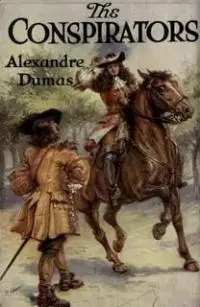
- Название:The Conspirators
- Автор:
- Издательство:epubBooks Classics
- Жанр:
- Год:2014
- ISBN:нет данных
- Рейтинг книги:3 / 5. Голосов: 1
-
Избранное:Добавить в избранное
- Отзывы:
-
Ваша оценка:
The Conspirators: краткое содержание, описание и аннотация
Предлагаем к чтению аннотацию, описание, краткое содержание или предисловие (зависит от того, что написал сам автор книги «The Conspirators»). Если вы не нашли необходимую информацию о книге — напишите в комментариях, мы постараемся отыскать её.
The Conspirators — читать онлайн бесплатно полную книгу (весь текст) целиком
Ниже представлен текст книги, разбитый по страницам. Система сохранения места последней прочитанной страницы, позволяет с удобством читать онлайн бесплатно книгу «The Conspirators», без необходимости каждый раз заново искать на чём Вы остановились. Поставьте закладку, и сможете в любой момент перейти на страницу, на которой закончили чтение.
Интервал:
Закладка:
At nine o'clock they thought they could distinguish sounds. D'Avranches lay down, with his ear to the ground, and distinctly heard the rolling of a carriage. At that instant they saw, at about a thousand paces from the angle of the road, a point of light like a star; the conspirators trembled with excitement, it was evidently the outrider with his torch. There was soon no doubt—they saw the carriage with its two lanterns. D'Harmental, Pompadour, Valef, and Laval, grasped one another's hands, put on their masks, and each one took the place assigned to him. The carriage advanced rapidly—it was really that of the duke. By the light of the torch which he carried they could distinguish the red dress of the outrider, some five–and–twenty paces before the horses. The road was silent and deserted, everything was favorable. D'Harmental threw a last glance on his companions. D'Avranches was in the middle of the road pretending to be drunk, Laval and Pompadour on each side of the path, and opposite him Valef, who was cocking his pistols. As to the outrider, the two jockeys and the prince, it was evident that they were all in a state of perfect security, and would fall quietly into the trap. The carriage still advanced; already the outrider had passed D'Harmental and Valef, suddenly he struck against D'Avranches, who sprang up, seized the bridle, snatched the torch from his hand, and extinguished it. At this sight the jockeys tried to turn the carriage, but it was too late; Pompadour and Laval sprang upon them pistol in hand, while D'Harmental and Valef presented themselves at the two doors, extinguished the lanterns, and intimated to the prince that if he did not make any resistance his life would be spared, but that if, on the contrary, he defended himself, or cried out, they were determined to proceed to extremities.
Contrary to the expectation of D'Harmental and Valef, who knew the courage of the regent, the prince only said:
"Well, gentlemen, do not harm me. I will go wherever you wish."
D'Harmental and Valef threw a glance at the road; they saw Pompadour and D'Avranches leading into the depth of the wood the outrider, the two jockeys, the outrider's horse, and two of the carriage horses which they had unharnessed. The chevalier sprang from his horse, mounted that of the first postilion; Laval and Valef placed themselves before the doors, the carriage set off at a gallop, and taking the first turn to the left, began to roll, without noise and without light, in the direction of Charenton. All the arrangements had been so perfect, that the seizure had not occupied more than five minutes; no resistance had been made, not a cry had been uttered. Most assuredly, this time fortune was on the side of the conspirators.
But having arrived at the end of the cross–road, D'Harmental encountered a first obstacle; the barrier—either by accident or design—was closed, and they were obliged to retrace their steps and take another road. The chevalier turned his horses, took a lateral alley, and the journey, interrupted for an instant, recommenced at an increased speed.
The new route which the chevalier had taken led him to a four–cross road; one of the roads led straight to Charenton. There was no time to lose, and in any event he must traverse this square. For an instant he thought he distinguished men in the darkness before him, but this vision disappeared like a mist, and the carriage continued its progress without interruption. On approaching the cross–roads D'Harmental fancied he heard the neighing of a horse, and a sort of ringing of iron, like sabers being drawn from their sheaths, but either taking it for the wind among the leaves, or for some other noise for which he need not stop, he continued with the same swiftness, the same silence, and in the midst of the same darkness. But, having arrived at the cross–roads, D'Harmental noticed a singular circumstance, a sort of wall seemed to close all the roads; something was happening. D'Harmental stopped the carriage, and wished to return by the road he had come down, but a similar wall had closed behind him. At that instant he heard the voices of Laval and Valef crying:
"We are surrounded, save yourself!"
And both left the doors, leaped their horses over the ditch, darted into the forest, and disappeared among the trees.
But it was impossible for D'Harmental, who was mounted on the postilion's horse, to follow his companions, and, not being able to escape the living wall, which the chevalier recognized as a regiment of musketeers, he tried to break through it, and with his head lowered, and a pistol in each hand, spurred his horse up the nearest road, without considering whether it was the right one. He had scarcely gone ten steps, however, when a musket–ball entered the head of his horse, which fell, entangling D'Harmental's leg. Instantly eight or ten cavaliers sprang upon him; he fired one pistol by hazard, and put the other to his head, to blow his brains out, but he had not time, for two musketeers seized him by the arms, and four others dragged him from beneath the horse. The pretended prince descended from the carriage, and turned out to be a valet in disguise; they placed D'Harmental with two officers inside the carriage, and harnessed another horse in the place of the one which had been shot. The carriage once more moved forward, taking a new direction, and escorted by a squadron of musketeers. A quarter of an hour afterward it rolled over a drawbridge, a heavy door grated upon its hinges, and D'Harmental passed under a somber and vaulted gateway, on the inner side of which, an officer in the uniform of a colonel was waiting for him. It was Monsieur de Launay, the governor of the Bastille.
If our readers desire to know how the plot had been discovered, they must recall the conversation between Dubois and La Fillon. The gossip of the prime minister, it will be remembered, suspected Roquefinette of being mixed up in some illicit proceeding, and had denounced him on condition of his life being spared. A few days afterward D'Harmental came to her house, and she recognized him as the young man who had held the former conference with Roquefinette. She had consequently mounted the stairs behind him, and, going into the next room, had, by aid of a hole bored in the partition, heard everything.
What she had heard was the project for carrying off the regent on his return from Chelles. Dubois had been informed the same evening, and, in order to take the conspirators in the act, had put a suit of the regent's clothes on Monsieur Bourguignon, and, having surrounded the Bois de Vincennes with a regiment of Gray Musketeers, besides light–horse and dragoons, had produced the result we have just related. The head of the plot had been taken in the fact, and as the prime minister knew the names of all the conspirators, there was little chance remaining for them of escape from the meshes of the vast net which was hourly closing around them.
Chapter XXXIX
A Prime Minister's Memory
When Bathilde reopened her eyes, she found herself in Mademoiselle Emilie's room. Mirza was lying on the end of the bed; the two sisters were one at each side of her pillow, and Buvat, overcome by grief, was sitting in a corner, his head bent, and his hands resting on his knees.
At first all her thoughts were confused, and her sensation was one of bodily pain; she raised her hand to her head; the wound was behind the temple. A doctor, who had been called in, had arranged the first dressing, and left orders that he was to be sent for if fever declared itself.
Astonished to find herself—on waking from a sleep which had appeared to her heavy and painful—in bed in a strange room, the young girl turned an inquiring glance on each person present, but Emilie and Athenais shunned her eyes, and Buvat heaved a mournful sigh. Mirza alone stretched out her little head for a caress. Unluckily for the coaxing little creature, Bathilde began to recover her memory; the veil which was drawn before the late events rose little by little, and soon she began to connect the broken threads which might guide her in the past. She recalled the return of Buvat, what he had told her of the conspiracy, the danger which would result to D'Harmental from the revelation he had made. Then she remembered her hope of being in time to save him, the rapidity with which she had crossed the street and mounted the staircase; lastly, her entry into Raoul's room returned to her memory, and once more she found herself before the corpse of Roquefinette.
Читать дальшеИнтервал:
Закладка:
Похожие книги на «The Conspirators»
Представляем Вашему вниманию похожие книги на «The Conspirators» списком для выбора. Мы отобрали схожую по названию и смыслу литературу в надежде предоставить читателям больше вариантов отыскать новые, интересные, ещё непрочитанные произведения.


Обсуждение, отзывы о книге «The Conspirators» и просто собственные мнения читателей. Оставьте ваши комментарии, напишите, что Вы думаете о произведении, его смысле или главных героях. Укажите что конкретно понравилось, а что нет, и почему Вы так считаете.