Александр Дюма - The Conspirators
Здесь есть возможность читать онлайн «Александр Дюма - The Conspirators» весь текст электронной книги совершенно бесплатно (целиком полную версию без сокращений). В некоторых случаях можно слушать аудио, скачать через торрент в формате fb2 и присутствует краткое содержание. Год выпуска: 2014, Издательство: epubBooks Classics, Жанр: Историческая проза, на английском языке. Описание произведения, (предисловие) а так же отзывы посетителей доступны на портале библиотеки ЛибКат.
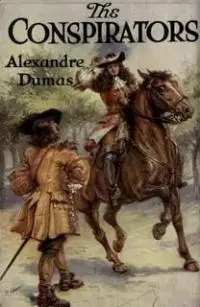
- Название:The Conspirators
- Автор:
- Издательство:epubBooks Classics
- Жанр:
- Год:2014
- ISBN:нет данных
- Рейтинг книги:3 / 5. Голосов: 1
-
Избранное:Добавить в избранное
- Отзывы:
-
Ваша оценка:
The Conspirators: краткое содержание, описание и аннотация
Предлагаем к чтению аннотацию, описание, краткое содержание или предисловие (зависит от того, что написал сам автор книги «The Conspirators»). Если вы не нашли необходимую информацию о книге — напишите в комментариях, мы постараемся отыскать её.
The Conspirators — читать онлайн бесплатно полную книгу (весь текст) целиком
Ниже представлен текст книги, разбитый по страницам. Система сохранения места последней прочитанной страницы, позволяет с удобством читать онлайн бесплатно книгу «The Conspirators», без необходимости каждый раз заново искать на чём Вы остановились. Поставьте закладку, и сможете в любой момент перейти на страницу, на которой закончили чтение.
Интервал:
Закладка:
D'Harmental complied, and Brigaud, dressed as he was, came and sat beside him.
"To the corner of the Rue du Gros Chenet and the Rue de Cléry," said the abbe.
The coachman, impatient at having waited so long, obeyed quickly. At the place indicated the carriage stopped; the chevalier got out, and soon disappeared round the corner of the Rue du Temps–Perdu. As to the carriage, it rolled on noiselessly toward the Boulevards, like a fairy car which does not touch the earth.
Chapter XV
Jean Buvat
Our readers must now make a better acquaintance with one of the principal personages in the history which we have undertaken to relate, of whom we have scarcely spoken. We would refer to the good bourgeois, whom we have seen quitting the group in the Rue de Valois, and making for the Barrière des Sergents at the moment when the street–singer began his collection, and who, it will be remembered, we have since seen at so inopportune a moment in the Rue des Bons–Enfants.
Heaven preserve us from questioning the intelligence of our readers, so as to doubt for a moment that they had recognized in the poor devil to whom the Chevalier d'Harmental had rendered such timely assistance the good man of the terrace in the Rue du Temps–Perdu. But they cannot know, unless we tell them in detail, what he was physically, morally, and socially. If the reader has not forgotten the little we have already told him, it will be remembered that he was from forty to forty–five years of age. Now as every one knows, after forty years of age the bourgeois of Paris entirely forgets the care of his person, with which he is not generally much occupied, a negligence from which his corporeal graces suffer considerably, particularly when, as in the present instance, his appearance is not to be admired.
Our bourgeois was a little man of five feet four, short and fat, disposed to become obese as he advanced in age; and with one of those placid faces where all—hair, eyebrows, eyes, and skin—seem of the same color; in fact, one of those faces of which, at ten paces, one does not distinguish a feature. The most enthusiastic physiognomist, if he had sought to read on this countenance some high and curious destiny, would have been stopped in his examination as he mounted from his great blue eyes to his depressed forehead, or descended from his half–open mouth to the fold of his double chin. There he would have understood that he had under his eyes one of those heads to which all fermentation is unknown, whose freshness is respected by the passions, good or bad, and who turn nothing in the empty corners of their brain but the burden of some old nursery song. Let us add that Providence, who does nothing by halves, had signed the original, of which we have just offered a copy to our readers, by the characteristic name of Jean Buvat.
It is true that the persons who ought to have appreciated the profound nullity of spirit, and excellent qualities of heart of this good man, suppressed his patronymic, and ordinarily called him Le Bonhomme Buvat.
From his earliest youth the little Buvat, who had a marked repugnance for all other kinds of study, manifested a particular inclination for caligraphy: thus he arrived every morning at the College des Oratoriens, where his mother sent him gratis, with his exercises and translations full of faults, but written with a neatness, a regularity, and a beauty which it was charming to see. The little Buvat was whipped every day for the idleness of his mind, and received the writing prize every year for the skill of his hand. At fifteen years of age he passed from the Epitome Sacræ, which he had recommenced five times, to the Epitome Græcæ; but the professor soon perceived that this was too much for him, and put him back for the sixth time in the Epitome Sacræ. Passive as he appeared, young Buvat was not wanting in a certain pride. He came home in the evening crying to his mother, and complaining of the injustice which had been done him, declaring, in his grief, a thing which till then he had been careful not to confess, namely, that there were in the school children of ten years old more advanced than he was.
Widow Buvat, who saw her son start every morning with his exercises perfectly neat (which led her to believe that there could be no fault to be found with them), went the next day to abuse the good fathers. They replied that her son was a good boy, incapable of an evil thought toward God, or a bad action toward his neighbor; but that, at the same time, he was so awfully stupid that they advised her to develop, by making him a writing–master, the only talent with which nature had blessed him. This counsel was a ray of light for Madame Buvat; she understood that, in this manner, the benefit she should derive from her son would be immediate. She came back to her house, and communicated to her son the new plans she had formed for him. Young Buvat saw in this only a means of escaping the castigation which he received every morning, for which the prize, bound in calf, that he received every year was not a compensation.
He received the propositions of his mother with great joy; promised her that, before six months were over, he would be the first writing–master in the capital; and the same day, after having, from his little savings, bought a knife with four blades, a packet of quills, and two copy–books, set himself to the work. The good Oratoriens were not deceived as to the true vocation of young Buvat. Caligraphy was with him an art which almost became drawing. At the end of six months, like the ape in the Arabian Nights, he wrote six kinds of writing; and imitated men's faces, trees, and animals. At the end of a year he had made such progress that he thought he might now give out his prospectus. He worked at it for three months, day and night; and almost lost his sight over it. At the end of that time he had accomplished a chef–d'oeuvre.
It was not a simple writing, but a real picture representing the creation of the world, and divided almost like the Transfiguration of Raphael. In the upper part, consecrated to Eden, was the Eternal Father drawing Eve from the side of the sleeping Adam, and surrounded by those animals which the nobility of their nature brings near to man, such as the lion, the horse, and the dog. At the bottom was the sea, in the depths of which were to be seen swimming the most fantastic fishes, and on the surface a superb three–decked vessel. On the two sides, trees full of birds put the heavens, which they touched with their topmost branches, in communication with the earth, which they grasped with their roots; and in the space left in the middle of all this, in the most perfectly horizontal line, and reproduced in six different writings, was the adverb "pitilessly." This time the artist was not deceived; the picture produced the effect which he expected. A week afterward young Buvat had five male and two female scholars. His reputation increased; and Madame Buvat, after some time passed in greater ease than she had known even in her husband's lifetime, had the satisfaction of dying perfectly secure about her son's future.
As to him, after having sufficiently mourned his mother, he pursued the course of his life, one day exactly like the other. He arrived thus at the age of twenty–six or twenty–seven, having passed the stormy part of existence in the eternal calm of his innocent and virtuous good nature. It was about this time that the good man found an opportunity of doing a sublime action, which he did instinctively and simply, as he did everything; but perhaps a man of mind might have passed it over without seeing it, or turned away from it if he had seen it. There was in the house No. 6, in the Rue des Orties, of which Buvat occupied the attic, a young couple who were the admiration of the whole quarter for the harmony in which they lived. They appeared made for each other. The husband was a man of from thirty–four to thirty–five years of age, of a southern origin, with black eyes, beard and hair, sunburned complexion, and teeth like pearls. He was called Albert du Rocher, and was the son of an ancient Cevenol chief, who had been forced to turn Catholic, with all his family, at the persecutions of Monsieur Baville; and half from opposition, half because youth seeks youth, he had entered the household of M. le Duc de Chartres, which was being reformed just at that time, having suffered much in the campaign preceding the battle of Steinkirk, where the prince had made his debut in arms. Du Rocher had obtained the place of La Neuville, who had been killed in that charge which, conducted by the Duc de Chartres, had decided the victory.
Читать дальшеИнтервал:
Закладка:
Похожие книги на «The Conspirators»
Представляем Вашему вниманию похожие книги на «The Conspirators» списком для выбора. Мы отобрали схожую по названию и смыслу литературу в надежде предоставить читателям больше вариантов отыскать новые, интересные, ещё непрочитанные произведения.
Обсуждение, отзывы о книге «The Conspirators» и просто собственные мнения читателей. Оставьте ваши комментарии, напишите, что Вы думаете о произведении, его смысле или главных героях. Укажите что конкретно понравилось, а что нет, и почему Вы так считаете.