Арнольд Цвейг - Outside Verdun
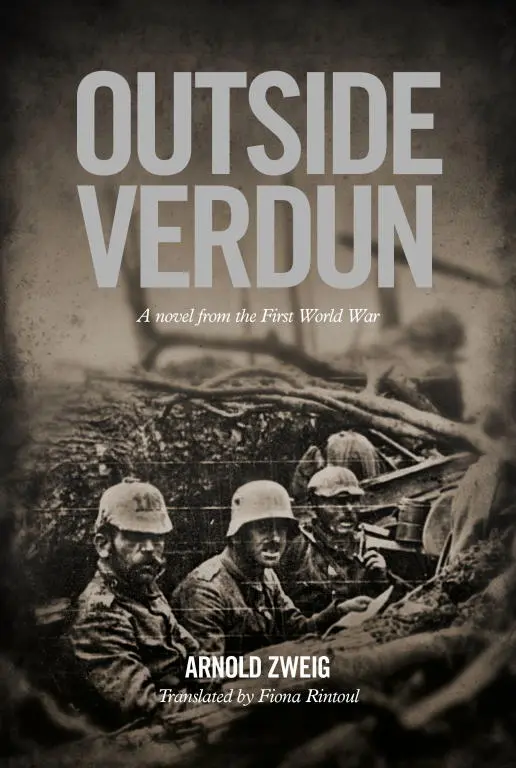
Здесь есть возможность читать онлайн «Арнольд Цвейг - Outside Verdun» весь текст электронной книги совершенно бесплатно (целиком полную версию без сокращений). В некоторых случаях можно слушать аудио, скачать через торрент в формате fb2 и присутствует краткое содержание. Город: Glasgow, Год выпуска: 2014, ISBN: 2014, Издательство: Freight Books, Жанр: Историческая проза, prose_military, на английском языке. Описание произведения, (предисловие) а так же отзывы посетителей доступны на портале библиотеки ЛибКат.
- Название:Outside Verdun
- Автор:
- Издательство:Freight Books
- Жанр:
- Год:2014
- Город:Glasgow
- ISBN:978-1-908754-52-3
- Рейтинг книги:3 / 5. Голосов: 1
-
Избранное:Добавить в избранное
- Отзывы:
-
Ваша оценка:
Outside Verdun: краткое содержание, описание и аннотация
Предлагаем к чтению аннотацию, описание, краткое содержание или предисловие (зависит от того, что написал сам автор книги «Outside Verdun»). Если вы не нашли необходимую информацию о книге — напишите в комментариях, мы постараемся отыскать её.
“The war, an operation instigated by men, still felt to him like a storm decreed by fate, an unleashing of powerful elements, unaccountable and beyond criticism.”
Arnold Zweig’s novel was first published in 1933 and is based on his own experiences in the German army during World War I. Following the unlawful killing of his younger brother by his own superiors, Lieutenant Kroysing swears revenge, using his influence to arrange for his brother’s unit, normally safely behind the lines, to be reassigned to the fortress at Douaument, in the very heart of the battle for France. Bertin, a lowly but educated Jewish sapper through whose eyes the story unfolds, is the innocent man caught in the cross-fire.
The book not only explores the heart-breaking tragedy of one individual trapped in a nightmare of industrialized warfare but also reveals the iniquities of German society in microcosm, with all its injustice, brutality, anti-Semitism, and incompetence. A brilliant translation captures all the subtleties, cadences, and detachment of Zweig’s masterful prose.
Outside Verdun — читать онлайн бесплатно полную книгу (весь текст) целиком
Ниже представлен текст книги, разбитый по страницам. Система сохранения места последней прочитанной страницы, позволяет с удобством читать онлайн бесплатно книгу «Outside Verdun», без необходимости каждый раз заново искать на чём Вы остановились. Поставьте закладку, и сможете в любой момент перейти на страницу, на которой закончили чтение.
Интервал:
Закладка:
Far beyond the burnt, half-destroyed city of Verdun, an aeroplane was at that very moment being readied for take off. Pale in the moonlight and feeling tight round the chest, the painter Jean-François Rouard, together with the mechanics, was checking the wing struts, altitude and directional controls and bomb fixings. The bombs hung head downwards under the belly of the aeroplane like giant bats: two on the right, two on the left. These old crates always look pretty rickety , he thought. No wonder. It was not yet quite eight years since Blériot had flown across the channel. And how long was it since Pégoud had horrified the world with his loops, dives and upside down flight? With his hands in his pockets, Rouard shook his head and marvelled at people, for what had once been considered disgusting was now a wartime pilot’s bread and butter. Down with war , he thought. It’s a filthy mess, but as long as the Boche wants to trample over France, we’ll have to drop the necessary on his thick, wooden skull . And then he asked about the petrol. All being well, he hoped to be back in half an hour and he knocked three times on the leafless apple tree next to the hangar, whose branches were silhouetted like veins against the sky. From the half shadow of the nearby barn Philippe appeared, his friend and pilot. He’d been answering the call of nature before being strapped in. He was the son of a Breton fisherman and approached with a rolling stride. From his hand swung a rosary of ivory beads that he always hung on a little hook to the right of his seat at the front of the plane as a talisman. Rouard nodded to him and he nodded back. There was a calm affinity between the two friends, who had already faced death together under an aeroplane’s blazing wreckage, and no more was required.
Lieutenant Kroysing stretched his long legs over the edge of his hard-won woman’s bed, got dressed, kissed both her hands, wished her good night and hobbled the couple of steps to the room across the corridor as quietly as he could. It was completely dark, Lieutenant Flachsbauer was snoring and a similar sawing could be heard from many of the men in the ward across the corridor. Kroysing felt his way along the wall to his bed, stowed his crutch and hopped into the sack with practised ease. His heart was full of joy and a contentment as deep as the voice in his chest. He had bent fate to his will. By taking possession of that woman, he felt quite sure he had given himself a head start on all other men. Now he could become whatever he wanted: air force captain, chief engineer, the driving force at the head of a global company. That woman was now rummaging about in her tiny room, getting washed, and in a moment she would open her door warily and hurry down the corridor by the light of her pocket torch to put in a word for a friend at his request with a man of whom he was not the slightest bit jealous. Because henceforth he would just be a memory to her. That woman who had hesitated so long and laughed at him, even when he took her in his arms, would propel him on and be the wind in his wings. He couldn’t imagine a higher state of bliss. He hadn’t been able to hold Douaumont because imbeciles had intervened, but he would hold on to that woman and with her the path into the future. He closed his eyes, completely at peace, and let himself sink back with a smile. He actually wanted to stay awake so he’d hear her come back. He still felt very awake; he’d just doze for a moment. The following day she’d have to clear up the squaddies’ festering bandages again. No matter, that was part of life too. He hummed a tune in his head, a song from his student days by the poet Friedrich Schiller. It began with the words: ‘Joy, beautiful sparkle of the gods…’
As Sister Kläre walked down the long corridor in barracks 3, turned the corner and made her way down the much longer ones in barracks 2 and 1, she wondered if it had been silly of her to leave the electric light on in her room. She’d opened the window. She didn’t want to sleep in the fumes from the oil lamp and had left the room to air until she came back. She wished she could find a new way of breathing that would let her to suck the happiness she felt right down into the tips of her toes along with the God-given breath of life. She hadn’t felt as alive as this for a decade. If only she were sure she’d closed the shutter. There was enough of a draught between its wooden edge and the barracks wall. And there was no point in being too careful. Sister Kläre was an old soldier and knew you sometimes had to be careless. Nonetheless, it would be cleverer and better, more sensible and more careful to go back and turn the light out. But – and she laughed internally – we don’t always do what’s careful and sensible; we usually do what’s sensible and sometimes what’s easiest. And she was very tired and she’d need be on the ball for the conversation to come and it would probably take a while to get put through, and so she’d best save those precious minutes. And what if the shutter were gaping open? And someone went past precisely in the quarter of an hour when she was away and noticed that Sister Kläre had disobeyed the regulations and left her light on and not sealed the window? Was it that nice lad Bertin who’d told a story about seeing a general when he was on guard duty driving through an ammunitions dump with his headlights on full beam? Come on , thought Sister Kläre as she went into the telephone room, leave it. I’m so happy. I’ve got such a fine specimen for a husband. Nothing can go wrong for me now .
For obvious reasons, the Dannevoux field hospital telephone exchange was located in that part of the large barracks complex closest to the approach from the village. It was operated by severely disabled soldiers with eye injuries; before this war they would have been called blind men. One of them could made out a certain amount of light and shade, the second only had the use of part of his left eye and the third could only see things on the edges of his field of vision – everything in front of him dissolved into darkness. The medical officer had selected these three almost blind men from among his patients and made them telephonists. They were happy with their work and accommodation. All three had been cavalrymen: an Uhlan from Magdeburg, a cuirassier from Schwedt and a dragoon from Allenstein. None of them wanted to go back to Germany and tap around as blind men, and they had all easily mastered the tasks associated with their new work. Their hearing had sharpened and their memories had improved. The telephone service in Dannevoux field hospital functioned smoothly. When Sister Kläre opened the door, the room reeked of smoke from the men’s tobacco. By the faint light of the lamp she saw Keller the cuirassier sitting knitting – a sense of touch was more important for that than sight. He recognised her by her voice and was surprised and pleased to have her visit at this late hour. As he’d been working at this job for while, he often made the connection Sister Kläre requested and as usual he said: ‘Sit yourself down, sister. It might take a while.’ Then he began to negotiate with people far away. He’d never seen them but was on highly confidential terms with them. Discretion is part of a telephonist’s job.
In the circle of light from the small lamp, Sister Kläre waited to hear the results of his efforts. With her arms propped on the table and her slim wrists either side of her chin, she watched him. She felt for her cigarette case, pulled out a cigarette and began to smoke. She smiled as her eye lit upon a small monogram on the hammered metal with a tiny coronet under it. That golden thing was quite appropriate here; the man who gave it to her would soon be on the other end of the line.
The crown prince of the German Reich was a particularly genial host and that evening he was in radiant mood. He’d had a Swiss military author to dinner, and they’d enjoyed a long, technical chat about the movements of the 5th Army during the last days of the Battle of the Marne – a discussion that would one day bear fruit. Also at the small, round table were a war correspondent and an artist, both from German newspapers. The crown prince’s personal adjutant completed the company. There were no women. When an orderly entered and whispered something to the adjutant, and he turned to his host and said, with a particular emphasis that remained opaque to the guests, that there was an official telephone call for him, the slim gentleman leapt up, excused himself with a few polite words and hurried into the room next door. He didn’t know exactly who might be calling him, but it couldn’t be anything unpleasant. Perhaps it was the crown princess, perhaps one of his boys, but before he’d sat down at the writing table with the telephone on it, his adjutant caught up with him, said two words to him and disappeared again. ‘But how delightful,’ were therefore the first words he spoke into the telephone.
Читать дальшеИнтервал:
Закладка:
Похожие книги на «Outside Verdun»
Представляем Вашему вниманию похожие книги на «Outside Verdun» списком для выбора. Мы отобрали схожую по названию и смыслу литературу в надежде предоставить читателям больше вариантов отыскать новые, интересные, ещё непрочитанные произведения.










Обсуждение, отзывы о книге «Outside Verdun» и просто собственные мнения читателей. Оставьте ваши комментарии, напишите, что Вы думаете о произведении, его смысле или главных героях. Укажите что конкретно понравилось, а что нет, и почему Вы так считаете.