Philippa Gregory - Virgin Earth
Здесь есть возможность читать онлайн «Philippa Gregory - Virgin Earth» — ознакомительный отрывок электронной книги совершенно бесплатно, а после прочтения отрывка купить полную версию. В некоторых случаях можно слушать аудио, скачать через торрент в формате fb2 и присутствует краткое содержание. Жанр: Историческая проза, на английском языке. Описание произведения, (предисловие) а так же отзывы посетителей доступны на портале библиотеки ЛибКат.
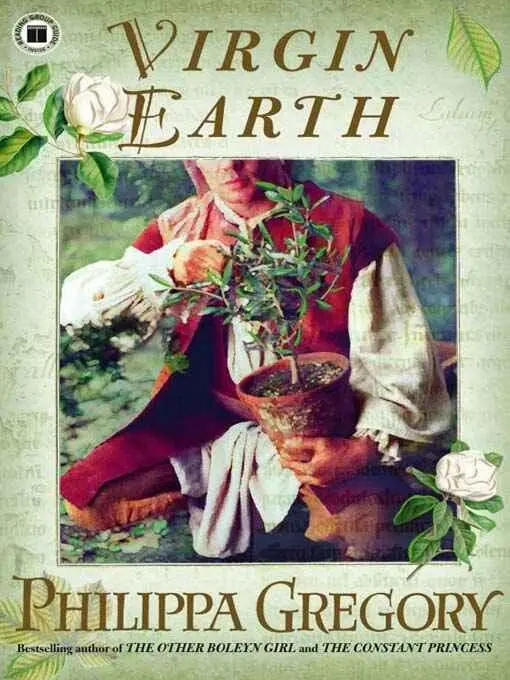
- Название:Virgin Earth
- Автор:
- Жанр:
- Год:неизвестен
- ISBN:нет данных
- Рейтинг книги:4 / 5. Голосов: 1
-
Избранное:Добавить в избранное
- Отзывы:
-
Ваша оценка:
Virgin Earth: краткое содержание, описание и аннотация
Предлагаем к чтению аннотацию, описание, краткое содержание или предисловие (зависит от того, что написал сам автор книги «Virgin Earth»). Если вы не нашли необходимую информацию о книге — напишите в комментариях, мы постараемся отыскать её.
Virgin Earth — читать онлайн ознакомительный отрывок
Ниже представлен текст книги, разбитый по страницам. Система сохранения места последней прочитанной страницы, позволяет с удобством читать онлайн бесплатно книгу «Virgin Earth», без необходимости каждый раз заново искать на чём Вы остановились. Поставьте закладку, и сможете в любой момент перейти на страницу, на которой закончили чтение.
Интервал:
Закладка:
John dropped his head in his hands. He thought that he must have been mad to leave his wife and his children and his home, madly selfish to leave them in the middle of a war, mad with folly to think that he could make a life for himself in a wilderness and mad with vanity to think that he could love and marry a young woman and make his life all over again, to his own mad pattern.
John stretched out on his mattress and heard a low groan of pain, his own sick heart.
He lay very still for some time. Down below Francis the Negro came in with a load of wood and dumped it by the hearth. “You in here, Mr. Tradescant?”
“Here,” John said. He dragged himself to the ladder and came down, his knees weak, the very grip of his fingers on the rungs seemed powerless.
Francis looked more closely at John and his face slightly softened. “Was it your letter? Bad news from your home?”
John shook his head and passed his hand over his face. “No. They’re managing without me. It just made me think I should be there.”
The Negro shrugged, as if the weight of exile was unbearably heavy on his own shoulders. “Sometimes a man cannot be where he should be.”
“Yes, but I chose to come here,” John said.
A slow smile lightened the man’s face, as if John’s folly was deliciously funny. “You chose this?”
John nodded. “I have a beautiful home in Lambeth and a wife who was ready to love me, and two healthy children growing every day, and I took it into my head that there was no life for me there, and that the woman I loved was here, and that I could start all over again, that I should start all over again.”
Francis kneeled at the hearth and stacked wood with steady deftness.
“I’ve been in my father’s shadow all my life,” John said, more to himself than to the silent man. “When I came here for the first time it was virgin earth for me, because it was somewhere he had not been, with plants that he had not seen, a place where he had not made friends and where people would not always know me as his son, a lesser copy of the real thing.
“At home, I worked in his trade, I did what he did. And I always felt I did it less well. And when it came to loyalty to a master, or certainty about my own course-” John broke off with a little laugh. “He always knew what was the right thing to do. It seemed to me that he was a man of absolute certainty. And I have spent my life blown this way and that with my doubts.”
Francis gave him a brief glance. “I’ve seen Englishmen like that,” he observed. “It always makes me wonder if you are so uncertain, why you are so quick to make rules, to make war, to go into the lives of other people?”
“What about you?” John asked. “Why did you come?”
The man’s face shone in the flickering light from the fire. “I’ve been in the wrong place all my life,” he said thoughtfully. “Being in the wrong place and longing for home is no new thing for me.”
“Where is your home?” John asked.
“The kingdom of Dahomey,” the man replied.
“Is that in Africa?”
The man nodded.
“Were you sold into slavery?”
“I was pushed into slavery, I was dragged into slavery, I was kicking and screaming and biting and fighting from roadside to marketplace to gangplank and down into the hold. I didn’t stop fighting and screaming and breaking away until-” He suddenly broke off.
“Until when?”
“Until they brought us up on deck for washing and I saw the sea all around me and no land in sight, and I realized I didn’t know even where my home was anymore, that if I escaped it would do me no good because I didn’t know where to go. That I was lost, and that I would stay lost for the rest of my life.”
The two men fell silent. John measured the enormity of that journey across the sea which could suck the courage out of a man, a fighting man.
“Did they bring you to England?”
“Jamaica first, but the captain brought me on to England. He wanted a slave. Lost me in a game of cards to a London merchant, he sold me to Mr. Hobert who wanted to bring a horse to Virginia to do his plowing for him but was advised that he couldn’t ship a horse but a man would do the job as well. So now I am a plow horse.”
“He doesn’t treat you badly,” John said.
The man shook his head. “For a horse I’m doing well,” he said with quiet irony. “I get to live in the house and I eat what they eat. And I have a piece of land of my own.”
“You will grow your own food?”
“My own food, my own tobacco, and I will trade on my own account, and when I have earned fifteen shillings Mr. Hobert has agreed to sell me my liberty and then I will be his indentured servant, and not his slave, and when I have earned enough to keep myself I shall buy more land and then I shall be a planter, as good as you.”
“You will be freed?”
“Mr. Hobert has promised it, the magistrate has witnessed it, and the other black men tell me that it is not uncommon. In a country as big as this a man has to agree with his slaves how long they shall work for him. It’s too easy for them to just run from him to a master who will offer better terms. There are always other planters who would give them work, there is always more land for them to plant for themselves.”
“Don’t you want to go back to Africa?”
An expression of deep pain passed swiftly across the black face and was gone. “I have to believe that I will be there at the hour of my death,” he said. “When they talk of paradise and going to heaven that is where I think I will be. But I don’t expect to see it again in this life.”
“Did you leave a family behind?”
“My wife, my child, my mother and two little brothers.”
John was silent at the enormity of this loss. “You must hate us,” he said. “All of us white men for taking you away.”
The man looked directly at him. “I don’t hate you,” he said. “I have no time left for hate.” He paused. “But I don’t know how you can pray to your god and hope that he hears you.”
John turned his head away. “Oh, I can tell you that,” he said bitterly. “We do a clever little trick, us Englishmen. We start by assuming that everything in the world is ours, everything that ever was, everything that ever will be.” He thought of the king’s elegant assumption that the world was constructed for his pleasure, that every work of art should belong to him, almost by right. “In our own country anyone who is not powerful and beautiful is a lesser person, not worth thinking about. When we go overseas we find many men and women who are not like us, so we think they are lesser still. When we find people whose language we can’t understand we say they can’t speak, when they don’t have houses like our houses we say they can’t build, when they don’t make music like our music or dance like we dance we say they can only howl like dogs, that they are animals, that they are less than animals because less useful to us.”
“So Bertram Hobert takes me as his plow horse.”
“And I swagger around, thinking that I can come to this country and that the land is empty and I can take a headright, and the woman could have no better future than to love me,” John said bitterly. “And so I walked away from the land I already owned and the woman to whom I owed a duty. Because I am an Englishman. Because the whole world is to be made for my convenience.”
The door opened and Sarah Hobert stood in the doorway, mud encrusting her boots. “Pull them off,” she said abruptly to Francis. “I’ve come to make dinner.”
Francis kneeled at her feet. John stepped back into the darker corner of the room. Sarah came into the room in her stockinged feet and pulled off her cape, spread it out on the hooks to dry. “It’s raining again,” she said. “I wish it would stop.”
Читать дальшеИнтервал:
Закладка:
Похожие книги на «Virgin Earth»
Представляем Вашему вниманию похожие книги на «Virgin Earth» списком для выбора. Мы отобрали схожую по названию и смыслу литературу в надежде предоставить читателям больше вариантов отыскать новые, интересные, ещё непрочитанные произведения.
Обсуждение, отзывы о книге «Virgin Earth» и просто собственные мнения читателей. Оставьте ваши комментарии, напишите, что Вы думаете о произведении, его смысле или главных героях. Укажите что конкретно понравилось, а что нет, и почему Вы так считаете.