Ever Dundas - Goblin
Здесь есть возможность читать онлайн «Ever Dundas - Goblin» весь текст электронной книги совершенно бесплатно (целиком полную версию без сокращений). В некоторых случаях можно слушать аудио, скачать через торрент в формате fb2 и присутствует краткое содержание. Город: Glasgow, Год выпуска: 2017, ISBN: 2017, Издательство: Freight Books, Жанр: Историческая проза, на английском языке. Описание произведения, (предисловие) а так же отзывы посетителей доступны на портале библиотеки ЛибКат.
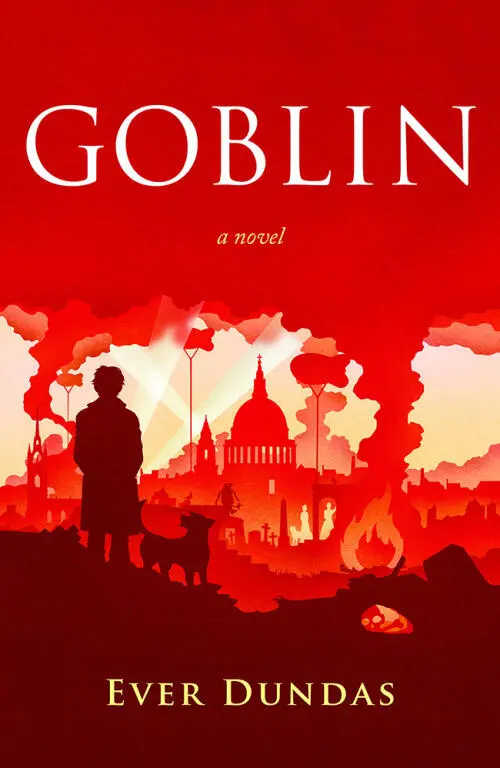
- Название:Goblin
- Автор:
- Издательство:Freight Books
- Жанр:
- Год:2017
- Город:Glasgow
- ISBN:978-1-911332-29-9
- Рейтинг книги:5 / 5. Голосов: 1
-
Избранное:Добавить в избранное
- Отзывы:
-
Ваша оценка:
Goblin: краткое содержание, описание и аннотация
Предлагаем к чтению аннотацию, описание, краткое содержание или предисловие (зависит от того, что написал сам автор книги «Goblin»). Если вы не нашли необходимую информацию о книге — напишите в комментариях, мы постараемся отыскать её.
A novel set between the past and present with magical realist elements. Goblin is an outcast girl growing up in London during World War 2. After witnessing a shocking event she increasingly takes refuge in a self-constructed but magical imaginary world. Having been rejected by her mother, she leads a feral life amidst the craters of London’s Blitz, and takes comfort in her family of animals, abandoned pets she’s rescued from London’s streets.
In 2011, a chance meeting and an unwanted phone call compels an elderly Goblin to return to London amidst the riots and face the ghosts of her past. Will she discover the truth buried deep in her fractured memory or retreat to the safety of near madness? In Goblin, debut novelist Dundas has constructed an utterly beguiling historical tale with an unforgettable female protagonist at its centre.
Goblin — читать онлайн бесплатно полную книгу (весь текст) целиком
Ниже представлен текст книги, разбитый по страницам. Система сохранения места последней прочитанной страницы, позволяет с удобством читать онлайн бесплатно книгу «Goblin», без необходимости каждый раз заново искать на чём Вы остановились. Поставьте закладку, и сможете в любой момент перейти на страницу, на которой закончили чтение.
Интервал:
Закладка:
I could see Juliana was going to defend me, but I squeezed her hand and shook my head.
‘It’s okay,’ I said. ‘Antonio’s right. I think I should let him be.’
‘Let who be?’ said Maria.
‘David,’ I said, looking at Antonio. ‘I should just let him be. Wherever he is.’
‘Yes,’ said Antonio. ‘You should let him go.’
‘I should leave him in the past with everything else,’ I said. ‘I should let it all rot.’
I raised my glass and said to Juliana, ‘To the future.’
Juliana hesitated then said, ‘To the future,’ clinking her glass gently against mine. We all toasted and Juliana leaned in and kissed me. I heard Maria make a disapproving clicking noise.
After dinner, we all staggered, talked and laughed our way through the streets. I saw posters of David, of Maria’s son. We tore them down.
‘To the future!’ we shouted.
The next morning was the first day I received a postcard.
I didn’t know who they were from. They were unsigned. He said he was living in Edinburgh. That he was well. That he hoped I was well. There was no return address. A postcard arrived once a week, sometimes more. Beautiful scenes of Edinburgh.
“Dear Goblin, I’ve lived here for many years now. You would love it here. I’m well. I hope you’re well.”
Of course, I thought it was David.
But I knew it wasn’t. I knew who it was but I pretended it was this person or that person. It could be whoever I wanted it to be. Until one day he signed it and I ripped it to pieces.
He had attacked me, abandoned me, and now he was sending me postcards telling me he was well and he hoped I was too.
London, 16 March 1930
She died the day she was born. Goblin-runt born blue, not breathing, never to breathe. They buried her in Kensal Green and they lived happily ever after.
London, 16 March 1930
She died the day she was born. Goblin-runt born blue, not breathing, never to breathe. They buried her in Kensal Green and they grieved. They wept at her grave and rent their clothes and wailed. Their son David healed them, bringing joy. Only his love could keep them from clawing their way six feet under to join their baby blue. David became a musician and they were proud. He objected to war and they were proud. He lived until he was 102 years old, when he died peacefully, his wife by his side holding his hand, holding his dear true heart until the moment it stopped.
She was comforted by the lives he had touched, by the people he brought joy to. She was glad of the chance he got to live that his baby sister did not have. She was comforted that he would live on in the lives he had touched, in the music he had made. He would live on.
His baby blue sister was erased the moment she emerged from the womb. Erased and forgotten. She touched no one. No lives were touched, except with grief, which David healed and they forgot, baby born blue, six feet deep.
London, 1939
She told everyone I’d likely died and they all said what a shame it was. Shame, shame, shame.
London, 1930s/1940s
Goblin and Devil, Mac and Stevie. We played in our street, we made up stories, we made up plays. Da died in the war. Ma died in our home, bombed out. David and I went to the sea.
London, 1930s, 40s, 50s, 60s, 70s…
The Crazy Pigeon Woman of Amen Court flew home to her family, held by the pigeons’ beaks clamped shut on her clothes. She flew and flew and flew until she was gone.
Goblin-runt moved in and became the Crazy Pigeon Girl of Amen Court. She learned taxidermy, she fed the baby pigeons and they followed her here and there and they slept in her hair. The local kids spat at her but she didn’t care because she knew they’d get eaten by the lizard people down below. The Crazy Pigeon Girl of Amen Court lived out her days happy and content.
Prison, 1967
My legs buckled and I fell. He had me by the throat. He squeezed. I looked directly into his eyes, glad that someone was finally pushing me down that rabbit hole. Soon I’d be six feet under. Soon the mistake would be erased. But not my mistakes. There was nothing I could do about that now. I couldn’t rewrite the story.
I let go, my breath gone.
The In-Between Realm
Goblin: a mischievous ugly dwarf-like creature of folklore.
Doesn’t exist. A fairy tale.
Venice, 1972
I took the boat out to the Bone Island. I had several bottles of wine. I was knocking one back, rowing, knocking it back, rowing… drinking, drinking, drinking… the sun was high in the sky and my cheeks burned with booze and heat. Chattering and laughing and greeting the dead I leapt from the boat, hoisted out my bottles of wine and clambered ignominiously over the wall, falling, scrabbling, smashing a bottle of wine, saving the others and spraining an ankle. I licked the sweet red wine that dripped from the wall, spattered like blood. I surveyed the land, disappointed to see bushes sprouting up here and there and there and here and where are the bones? I left my treasures by the wall, holding one bottle by the neck, staggering across the uneven ground, pushing at the bushes, peering between the branches and leaves. I found bones; the bleached, the forgotten, the poor, the nobodies. ‘You didn’t count,’ I said. ‘You meant nothing, you are nothing, and I join you and I toast to that!’ I took up a bone, wielding it like a weapon, knocking back the wine, dizzy with booze and sun and suicidal elation. ‘My weary bones,’ I laughed. ‘My weary bones shall rest with the dispossessed. Will you drink to that?’ I sprinkled the wine across this bleached bulbous land. ‘Drink this, my blood,’ I said, and fell back, burrowing into the bones, marking my space amongst the dead, baking in the sun. ‘Drink this, my blood,’ I mumbled. I had a blade with me, hanging around my neck on a silver chain, but I was tired, I was worn out. All I wanted was sleep and I slept, for surely I would die in this heat. Surely these bones would pull me down and down and down. My rotten flesh would feed these plants and I would be gone, disappeared, swallowed up. ‘I am well,’ I said, sinking into sleep. ‘And I hope you are too.’
I swayed, gently. I woke and I puked. Someone tried to guide me, guide me to the edge, but I was still sick on myself and in the boat, the rest spewing out into the lagoon. I leaned over the edge watching the little fish hoover up my vomit. I swayed and swayed and I was sick and sick.
Hollowed out, I fell back into the boat, lying on the bottom, laughing.
‘Feeding the fish,’ I said. ‘Feeding the fish.’
A hand gripped my face, clasped around my jaw.
‘Get up. Sit up.’
I sat up, trying to focus.
‘Drink,’ they said. ‘You’re dehydrated. Drink.’
I took the bottle of water from them and knocked it back like it was wine.
The night after the Bone Island and feeding the fishes, I went out drinking with Juliana and her friends, laughing and dancing, ignoring my throbbing ankle. I passed out in the bar and woke up in my flat. I woke to the smell of burning. I pulled myself up, blinking into the smoke. I would rather drown, but this would do. I leaned back, waiting.
‘You’re not Catholic.’
‘Who’s there?’
Was this murder? Did someone want me dead?
‘It’s me, you idiot. It’s always me, picking up the pieces.’
I looked over and saw Juliana, rummaging through papers, burning my things. She’d found my scraps, my fantasies, my what-ifs. I watched as her anger sent everything up in flames, dropping them into one of my cooking pots. Monty was whining, the cats scratched at the door.
Читать дальшеИнтервал:
Закладка:
Похожие книги на «Goblin»
Представляем Вашему вниманию похожие книги на «Goblin» списком для выбора. Мы отобрали схожую по названию и смыслу литературу в надежде предоставить читателям больше вариантов отыскать новые, интересные, ещё непрочитанные произведения.





Обсуждение, отзывы о книге «Goblin» и просто собственные мнения читателей. Оставьте ваши комментарии, напишите, что Вы думаете о произведении, его смысле или главных героях. Укажите что конкретно понравилось, а что нет, и почему Вы так считаете.