Jasper Kent - Thirteen Years Later
Здесь есть возможность читать онлайн «Jasper Kent - Thirteen Years Later» весь текст электронной книги совершенно бесплатно (целиком полную версию без сокращений). В некоторых случаях можно слушать аудио, скачать через торрент в формате fb2 и присутствует краткое содержание. Жанр: Историческая проза, Ужасы и Мистика, на английском языке. Описание произведения, (предисловие) а так же отзывы посетителей доступны на портале библиотеки ЛибКат.
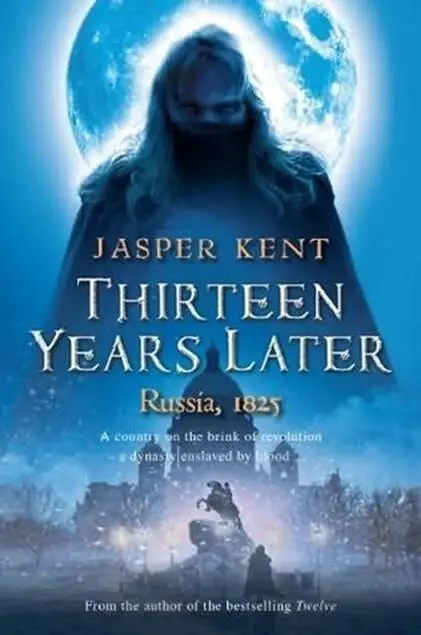
- Название:Thirteen Years Later
- Автор:
- Жанр:
- Год:неизвестен
- ISBN:нет данных
- Рейтинг книги:5 / 5. Голосов: 1
-
Избранное:Добавить в избранное
- Отзывы:
-
Ваша оценка:
Thirteen Years Later: краткое содержание, описание и аннотация
Предлагаем к чтению аннотацию, описание, краткое содержание или предисловие (зависит от того, что написал сам автор книги «Thirteen Years Later»). Если вы не нашли необходимую информацию о книге — напишите в комментариях, мы постараемся отыскать её.
Thirteen Years Later — читать онлайн бесплатно полную книгу (весь текст) целиком
Ниже представлен текст книги, разбитый по страницам. Система сохранения места последней прочитанной страницы, позволяет с удобством читать онлайн бесплатно книгу «Thirteen Years Later», без необходимости каждый раз заново искать на чём Вы остановились. Поставьте закладку, и сможете в любой момент перейти на страницу, на которой закончили чтение.
Интервал:
Закладка:
There Cain had been waiting, aged since their last encounter, in 1812, but unmistakable. The dark figure with the dragon ring had vanished, along with his influence over the tsar, but now there was a far more concrete reason to follow Cain deep into the caves; he carried a pistol. Eventually they had found themselves here, wherever here might be. Along the route Aleksandr had seen no one. His main concern had been to remember the way out – in the hope he’d get the chance to leave.
It was, to be blunt, a cave – but a well-appointed cave. There was a carpet, chairs, tables and a desk; even a clavichord, sitting in the corner, its lid open. All around were items of scientific equipment – smoked glass and polished brass – whose purpose the tsar could not fathom. Curtains and tapestries hung from the walls around, giving a slightly greater sense of it being a room, but they did not cover all the rocky surfaces and so the reminders of Cain’s troglodyte existence were never far away.
‘You’re wise to have come,’ said Cain, speaking in French. He had already put down his gun. He wafted his hand towards a chair, indicating that Aleksandr should sit. The chair was wooden, with no cushion. Its high back was intricately carved. It looked medieval. The tsar sat down.
Suddenly, the air was pierced by a howling scream, which came from a doorway to Aleksandr’s right. It was not the route they had come by. Cain gave a tight, apologetic smile. He walked over and closed the door, then drew a heavy red-velvet curtain across it. He returned to face the tsar.
‘I don’t think I really had a choice,’ said Aleksandr in response to his earlier comment.
‘The choice was offered, but your great-great-grandfather made the decision for you – for all of his heirs.’
‘I’m not sure a man can be bound by the promises of his ancestors.’
‘You admit Pyotr made a promise then?’
‘I’m told that’s what your master believes.’
Cain flashed Aleksandr the briefest look of anger, which mellowed into a smile. ‘I think the word “employer” more aptly describes our relationship.’
‘Just like an Englishman to go into service,’ said the tsar, in English. He wondered for a moment whether it might be dangerous to taunt Cain, but discovered in himself no sense of fear. Whatever plan Cain was to execute had been set in place over generations – human generations – and was unlikely to be affected by anything Aleksandr might say now.
‘I’d forgotten how excellent your English was,’ said Cain, continuing in the same tongue. He changed the subject. ‘Would you care for a drink?’ He went over to a dresser, atop which were several decanters. It should have been incongruous against the rough stone wall, but somehow the furniture and the decor, after an initial surprise, seemed quite appropriate for their surroundings.
‘No, thank you,’ said the tsar. As he spoke, he thought he heard the scream again, muffled through the heavy oak door – but he might have imagined it.
Cain turned back to him with a look of disappointment. ‘Oh, come now, Aleksandr Pavlovich. Do you think I’m going to poison you? Look!’ He pointed to a cabinet on the other side of the cave. ‘I have swords and guns. If I wanted to harm you, I wouldn’t need to be so subtle as to use poison. Claret?’ Aleksandr remained silent. Cain lifted the top from a decanter and poured two glasses. ‘You see?’ he said, raising one of them to his lips. He took a swig and sucked the wine through his teeth to aerate it. ‘It does me no harm.’ He walked over to the tsar and placed the wine on the broad arm of his chair.
‘Why doesn’t your employer come and see me himself?’ asked Aleksandr.
Cain nodded towards a grandfather clock that stood behind his desk. It was still mid-afternoon. ‘It’s not a good time of day for him. But he has made himself known to you; otherwise, why would you be here?’
Aleksandr thought of the dark figure of his dreams and visions, and again of today, when he had been tempted from the cliff top.
‘That was the same man that Pyotr met?’ Aleksandr asked, though he had no doubt of the truth of it.
‘One hundred and thirteen years ago.’
‘It’s a long time to hold a grudge.’ Aleksandr sipped from his glass without thinking, but realized he had little to fear from it. Cain’s argument made sense. Besides, it was an exceptionally good wine.
‘He has little else to amuse him,’ said Cain, slipping a strand of his blond hair behind his ear. ‘But it’s more than that. If he simply sought revenge then, as you suggest, it would hardly be fair to take it out on Pyotr’s descendants. And he would have had ample opportunity to do so before now.’
‘So what does he want?’
‘He wants what is owed to him. What your great-great-grandfather promised him.’
‘That’s still not my concern,’ said Aleksandr. He took another sip of claret.
‘It is when you have in your possession that which is not rightfully yours. That which was promised to my employer and which you have presumed to inherit.’
‘And what would that be? I’ve inherited a lot of things, from many people.’ Again, Aleksandr heard the muffled scream outside.
‘What Pyotr Alekseevich Romanov promised seemed worth less then than it does now. Yet still he chose the path of betrayal. You must make amends.’
‘Tell me then, what is it he wants?’ Aleksandr drank again. Now the wine had begun to taste sour – metallic. He feared he already knew the nature of the claim against him.
Cain explained in a single word.
‘Russia.’
Aleksei had left the voordalak whose skin had provided the binding for Cain’s notebook and carried on through the tunnels. There were no more cells or chains, though Aleksei knew he had taken but one path out of the many that penetrated the hillside. There could be a dozen others, each with its own set of miserable, filthy victims. Even from the little he had read of Cain’s book, Aleksei understood that the number of experiments being carried out would need more subjects than these few wretches.
Behind him, he no longer heard the sound of screams. With the same regularity, they had been replaced by short, self-controlled gasps, which still conveyed quite persuasively the pain the creature must have been experiencing. The water was evidently bringing some relief – or perhaps the hope Aleksei had seen in its eyes at the arrival of the three-fingered man had made it braver.
The tunnel ended abruptly in a large wooden door. Here, the passageway, though still largely a natural phenomenon, had been dug out so that the door fitted snugly. It would have suited any nobleman’s house in Moscow or Petersburg. On the stone of the cave wall above it, more writing had been chalked. The handwriting was similar to that of the word ‘Prometheus’ earlier. It was most likely Cain’s – any slight differences from the book could be explained by the difficulties of writing on rock.
Again, the alphabet was Latin, not Cyrillic, but the language this time was Italian.
Lasciate ogni speranza, voi ch’intrate.
It was an archaic form of the language, somewhat different from that spoken today. In fact, Aleksei could date it very specifically, to the first quarter of the fourteenth century, for the same reason that he did not have to struggle with the translation. It was Dante – Inferno; the words written above the gate of Hell.
Abandon every hope, you who enter.
Given the Hell that Aleksei had just walked through, he wondered what greater horrors could possibly lie ahead. He put his ear to the door. He could just hear the sounds of speech, but could discern no distinct words.
He turned the handle and pushed against the door. It moved smoothly and silently – well engineered considering its unconventional housing. Behind it, there was darkness. The voices were clearer now. They were speaking English, but even so Aleksei could recognize one of them as being that of the tsar.
Читать дальшеИнтервал:
Закладка:
Похожие книги на «Thirteen Years Later»
Представляем Вашему вниманию похожие книги на «Thirteen Years Later» списком для выбора. Мы отобрали схожую по названию и смыслу литературу в надежде предоставить читателям больше вариантов отыскать новые, интересные, ещё непрочитанные произведения.





Обсуждение, отзывы о книге «Thirteen Years Later» и просто собственные мнения читателей. Оставьте ваши комментарии, напишите, что Вы думаете о произведении, его смысле или главных героях. Укажите что конкретно понравилось, а что нет, и почему Вы так считаете.