Jasper Kent - Thirteen Years Later
Здесь есть возможность читать онлайн «Jasper Kent - Thirteen Years Later» весь текст электронной книги совершенно бесплатно (целиком полную версию без сокращений). В некоторых случаях можно слушать аудио, скачать через торрент в формате fb2 и присутствует краткое содержание. Жанр: Историческая проза, Ужасы и Мистика, на английском языке. Описание произведения, (предисловие) а так же отзывы посетителей доступны на портале библиотеки ЛибКат.
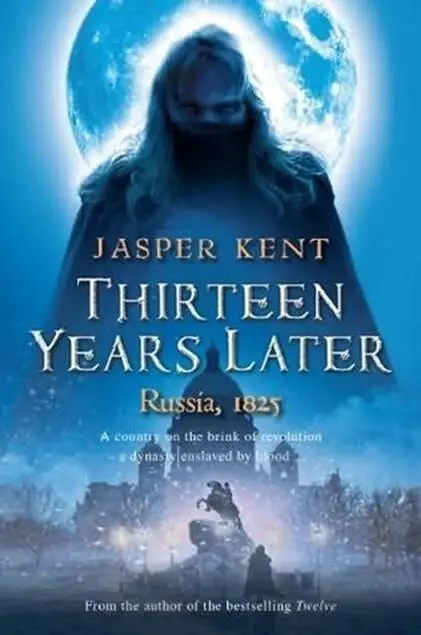
- Название:Thirteen Years Later
- Автор:
- Жанр:
- Год:неизвестен
- ISBN:нет данных
- Рейтинг книги:5 / 5. Голосов: 1
-
Избранное:Добавить в избранное
- Отзывы:
-
Ваша оценка:
Thirteen Years Later: краткое содержание, описание и аннотация
Предлагаем к чтению аннотацию, описание, краткое содержание или предисловие (зависит от того, что написал сам автор книги «Thirteen Years Later»). Если вы не нашли необходимую информацию о книге — напишите в комментариях, мы постараемся отыскать её.
Thirteen Years Later — читать онлайн бесплатно полную книгу (весь текст) целиком
Ниже представлен текст книги, разбитый по страницам. Система сохранения места последней прочитанной страницы, позволяет с удобством читать онлайн бесплатно книгу «Thirteen Years Later», без необходимости каждый раз заново искать на чём Вы остановились. Поставьте закладку, и сможете в любой момент перейти на страницу, на которой закончили чтение.
Интервал:
Закладка:
‘But if not, how can he know?’
‘His anticipation may not be correct.’ He wondered whether such words would be comforting. It was not reason that drove the woman’s grief. But she seemed to understand.
‘He believes it to be. And he accepts it.’
‘We must all accept death eventually,’ said the starets.
‘And embrace it?’
‘Are you sure you’re not seeing things in him that are not really there?’
‘How can I know?’ Her voice was despairing.
‘We must pray for you.’
‘And for him.’
‘For both of you.’ The starets placed his hands on the tsaritsa’s head and muttered a prayer in Old Slavonic that she was unlikely to understand. Then she stood.
‘May I come to you again?’ she asked.
‘Perhaps it is better if I come to you.’
She nodded meekly. ‘When?’
The starets searched for the most reassuring answer. ‘When the Lord’s work needs doing,’ he said. It seemed to satisfy her.
Aleksei had not appreciated how tiresome a royal tour could be. Much of the landscape they passed through had been of enormous beauty, and the towns and cities so different from what anyone from the north of the country was used to, that he would truly have enjoyed the journey if he had been able to travel at his own pace. But the place of a tsar, it seemed, was not with his land but with his people. Everywhere they stopped he would spend time in conversation with local dignitaries or merchants, as if his authority as tsar somehow rested on their approval. Perhaps he was more sympathetic to the democratic ideas of the Northern Society than he claimed. He had certainly held some truck with them in his youth. Aleksei could have wandered off on his own, and was tempted to, secure in the knowledge that there would be no danger until Bakhchisaray. But that was an obvious ploy; an invitation to a location could easily be a trap that would be sprung en route there. Kyesha had thought that the ultimate destination was in fact beyond Bakhchisaray, but there was no benefit to be drawn in relying on that. Aleksei was never close beside the tsar, but was never beyond his summoning.
They had stopped before they had ever really got going at Mariupol, a little way down the coast from Taganrog, and Aleksandr had talked to a group of Mennonites – Germanic, protestant pacifists; hardly representatives of the Russian outlook on life. After that they had visited Berdyansk, and the tsar was once again welcomed by the local populace.
At last they passed along the narrow isthmus at Perekop and entered the Crimean Peninsula itself. From a military perspective, it was a frightening terrain. The isthmus was perhaps only eight versts across at its narrowest, and the land beyond was flat and without cover. It felt like they were riding into a trap. But Aleksei knew the trap would not be sprung here. A narrow strip of land such as Perekop would be ideal to contain an army, but a single man, be he a peasant or a tsar, would need closer attention.
From there they went on to Simferopol, where the first signs of a magnificent landscape began to appear. Many Russians, certainly those from Moscow or Petersburg, could pass their whole life without ever seeing a mountain. To the east, the Urals were too far from civilization to attract much interest. Aleksei had heard that the Caucasus mountains were impressive, but he had never seen them. He was luckier than most of his countrymen to have travelled west on the march towards Paris and to have seen the Alps, though only looking up from their foothills, and before that the Carpathians, when fighting on the Danube. But it had all been many years ago, and Aleksei had become used to the vast, flat steppe of his homeland. Much of the Crimea was the same, but suddenly now the mountains rose out of it, and as the tsar’s party carried on further south, they rose even higher.
As the roads became steeper, Aleksandr chose to travel on horseback rather than by carriage. In view of the terrain, it was a sensible move, but it did nothing to assist his personal safety. And when the tsar travelled by horse, so must the rest of his entourage. Their guides led them through a broad pass in a range of peaks that stretched out unendingly to the east and west, and at last the Black Sea lay before them. Plunging down towards it, the mountains were at their steepest, at some places descending as cliffs directly into the water, at others leaving a narrow strip of level ground between themselves and the waves. At each such point, human habitation was in evidence.
One of these locations was their next stop, Gurzuf, not far from Yalta, where Aleksei suspected from the cleanliness of the town and the self-satisfaction of the local governor, Count Vorontsov, that the latter had recently made a supreme effort to achieve the former, or had instructed others to.
There they also met a man who had at once aroused Aleksei’s suspicion: Count Vorontsov’s personal physician – an Englishman by the name of Robert Lee. It was unfair to suspect every Englishman on the peninsula, but it would be foolish to ignore the link. Dr Lee was first introduced to the tsar by way of the demonstration of a miraculous new cure for swamp fever – which was prevalent in the area – administered to a local tatar chief. The results were effective and almost instantaneous, and Lee was invited to dine with the royal party.
Dr Lee revealed that the principal ingredient of his tonic was a substance he called ‘sulphate of quinine’, which was extracted from a South American tree known as the cinchona. Both Wylie and Tarasov were fascinated to learn more of this; it appeared that their isolation in Russia had prevented them from keeping up to speed with medical progress in the West. Aleksei was also intrigued. ‘Quinine’ had been a term that occurred more than once in Cain’s notes, though through lack of familiarity with the word, he had not been able to translate those sections. He glanced over at Wylie, but the doctor showed no reaction.
The conversation then moved on to the subject of homeopathy – not a word that Aleksei recalled seeing in Cain’s book. Much of the detail was lost on Aleksei, but it appeared that Wylie was a proponent of the concept, while Lee was not. However, it was Count Vorontsov, rather than his physician, who seemed to pursue the issue with the greater passion.
‘Like cures like,’ insisted Wylie. This apparently had been the claim of homeopathy’s inventor, a German called Hahnemann.
‘So if I were to stab you through the heart,’ asked the count, ‘bringing about your death, would a second stab wound restore you to life?’
Before Wylie could respond, Colonel Salomka had interjected. ‘There is a peasant myth in these parts concerning a creature called an oopir.’ He had chortled as he spoke, but Aleksei had instantly paid attention. He glanced again at Wylie, but still saw no response. There was no reason the Scot should be familiar with the local term. ‘As with many of these creatures,’ continued Salomka, ‘the oopir must be killed by stabbing through the heart with a stake of hawthorn. But here’s the thing’ – he sniggered again – ‘you mustn’t stab it a second time, or it will come back to life. Maybe that’s where Herr Hahnemann got his ideas from.’
Most around the table laughed. The tsar did not, perhaps out of respect for the views of Wylie. Nor did Wylie himself. That might have been out of pique at being mocked, but Aleksei noticed that this time it was Wylie’s eyes that were on him, looking for a reaction.
A moment later, Wylie resumed the defence of his pet subject. ‘That’s why Dr Hahnemann promulgates the use of only the most dilute quantities of his medicines,’ he said.
‘So more of a scratch than a stab?’ suggested Salomka.
Читать дальшеИнтервал:
Закладка:
Похожие книги на «Thirteen Years Later»
Представляем Вашему вниманию похожие книги на «Thirteen Years Later» списком для выбора. Мы отобрали схожую по названию и смыслу литературу в надежде предоставить читателям больше вариантов отыскать новые, интересные, ещё непрочитанные произведения.







Обсуждение, отзывы о книге «Thirteen Years Later» и просто собственные мнения читателей. Оставьте ваши комментарии, напишите, что Вы думаете о произведении, его смысле или главных героях. Укажите что конкретно понравилось, а что нет, и почему Вы так считаете.