Jasper Kent - Thirteen Years Later
Здесь есть возможность читать онлайн «Jasper Kent - Thirteen Years Later» весь текст электронной книги совершенно бесплатно (целиком полную версию без сокращений). В некоторых случаях можно слушать аудио, скачать через торрент в формате fb2 и присутствует краткое содержание. Жанр: Историческая проза, Ужасы и Мистика, на английском языке. Описание произведения, (предисловие) а так же отзывы посетителей доступны на портале библиотеки ЛибКат.
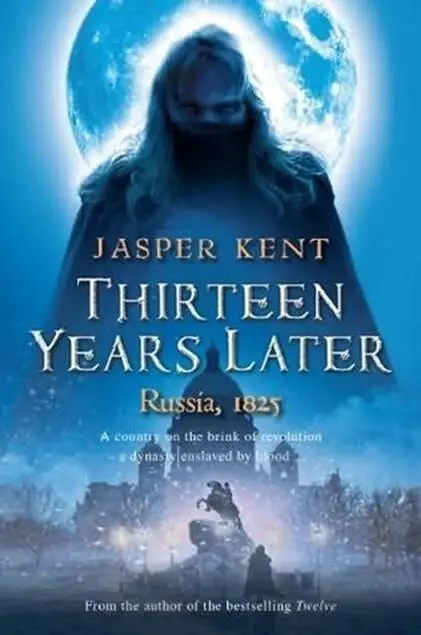
- Название:Thirteen Years Later
- Автор:
- Жанр:
- Год:неизвестен
- ISBN:нет данных
- Рейтинг книги:5 / 5. Голосов: 1
-
Избранное:Добавить в избранное
- Отзывы:
-
Ваша оценка:
Thirteen Years Later: краткое содержание, описание и аннотация
Предлагаем к чтению аннотацию, описание, краткое содержание или предисловие (зависит от того, что написал сам автор книги «Thirteen Years Later»). Если вы не нашли необходимую информацию о книге — напишите в комментариях, мы постараемся отыскать её.
Thirteen Years Later — читать онлайн бесплатно полную книгу (весь текст) целиком
Ниже представлен текст книги, разбитый по страницам. Система сохранения места последней прочитанной страницы, позволяет с удобством читать онлайн бесплатно книгу «Thirteen Years Later», без необходимости каждый раз заново искать на чём Вы остановились. Поставьте закладку, и сможете в любой момент перейти на страницу, на которой закончили чтение.
Интервал:
Закладка:
He gripped the solid wooden handle of Dmitry’s toy sword. It was well made, even though all those years ago Aleksei had had no idea what the real function of such a sword might be. He went back to the bedroom and slipped it under the mattress on his side of the bed. Then he lay down. He reached across and rested his hand on Domnikiia’s hair, listening to the sounds of breathing that came from her and from Tamara, easily distinguishing one from the other. It would have been a blissful way to spend the night, were it not for the fear that gripped him.
He knew it would have been safer to wake Domnikiia and warn her, but he refrained, not, as he at first told himself, to spare her anguish, but to spare him her reproach. It was he who had brought this on them; his inquisitiveness that had meant he couldn’t resist Kyesha’s bait. She would not have said anything directly; quite the reverse. She would have told him that they were in this together – there had been only a few months, at the beginning of their relationship, when they had not known and feared the voordalak together. More than dividing them, it was a part of what they were as a couple.
But Tamara made things different. Whatever Domnikiia might say about being unafraid for herself, she would loathe Aleksei for bringing her daughter into danger. And in those circumstances, it would be ‘her’ not ‘their’. There was only one person in the world that Domnikiia would turn her back on Aleksei for – at least, he hoped only one.
But whatever Domnikiia’s thoughts might be, it was easier to avoid the issue. He would explain Tamara’s presence by saying she had had a nightmare – even if she had no memory of it herself.
Nightmare or no nightmare, it was not Toma who lay awake that night until the first orange light of dawn glowed behind the curtains and the birds struck up their announcement of the new day. Kyesha had not come. Moscow was a big city. There were many places towards which he might have been heading, and why should he know where Aleksei was living anyway?
The dawn meant he would not be arriving here, whatever his ultimate intentions; not until nightfall at any rate. If he was a voordalak, then in some dark cellar of the city he would be settling down to rest. The knowledge brought comfort to Aleksei, and he finally allowed himself to fall into a troubled sleep.

Dawn came to the Dardanelles an hour later than it did to Moscow. It did so just as R zbunarea steered quietly out of the Aegean and into the strait. Its passenger hovered at the top of the ladder that led down to the hold. He had wanted to see them pass this place. An oddly mundane desire for a man of his stature, whose journey would change the face of Europe, but he was, nonetheless, a man with a sense of history. He gazed out at the coast of Asia Minor stretching away to the south. Somewhere there had stood Troy. Even he was not old enough to know where, but he was wise enough to know its existence was no myth.


The route that the ship was taking, at least for now, was that of Jason. Ultimately, their destinations were different, but Jason’s goal of Colchis had not been so far from where R zbunarea was headed. Jason’s quest had been to bring back the Golden Fleece. That – unlike Troy – was surely a myth, certainly as far as its magical properties went. And it had been guarded by a serpent. If that were true, the passenger of R zbunarea would surely have known about it. He glanced down at the golden beast that entwined his finger and smiled to himself. He was in danger of believing his own propaganda. But he, like Jason, would bring a great treasure back with him when he returned this way.
He gazed to the east, into the mouth of the strait, set against the backdrop of the morning twilight. He could sense to within a second of arc where the sun was. Normally, he would not have cut it so fine, but he had wanted to see the strait.
It was at the very moment the first sliver of the sun’s disc appeared on the horizon that he slipped once more below deck.
‘You must have been up and out very early.’
For the briefest of moments, the terrifying thought crossed Aleksei’s mind that Kyesha had found him, accompanied by the far more astonishing concept that if Kyesha could be out and about at this time of day, he could not be a vampire. Both ideas were quashed in an instant as Aleksei recognized the voice as one so familiar to him – that of his own son.
He turned and saw Dmitry sitting in the hallway of the hotel reading a pamphlet.
‘Well, you know me,’ said Aleksei, smiling. It wasn’t the smartest thing to say. Dmitry did know him, and knew therefore that early rising – certainly at his own volition – was not an obvious feature of his character. Perhaps Dmitry would take it as ironic. He had awoken particularly late this morning, due to not sleeping the previous night, and then spent an hour playing with Toma. After that he had come straight to the hotel to collect his mail and change his clothes. ‘How long have you been waiting?’
‘Almost four hours,’ said Dmitry.
‘You only just missed me,’ Aleksei lied, hoping the hotel’s patron had not over-elaborated his story to Dmitry. ‘You should have left a note.’
‘That’s what I did yesterday.’
Aleksei had not come to the hotel at all the previous day. ‘Yes, I’m sorry,’ he said. ‘I’ve been busy.’
‘Me too. But I had to see you. I’ve been so excited since Monday.’
‘I think we’d better walk,’ said Aleksei, glancing pointedly over to the hotel keeper, who was unconvincingly pretending not to listen to their conversation. Dmitry nodded and stood up. Aleksei led the way out on to the street. They turned south, away from the centre of the city.
‘I was as surprised as you are,’ said Aleksei.
‘You can’t have been! I mean, no one’s more loyal to the tsar than you.’
‘I’m loyal to Russia. That’s what we all have in common.’
‘Well, I see that now. I always thought you saw them as one and the same thing,’ said Dmitry.
Aleksei knew that he would have to lie to his son. He had lied before – to those he loved as well as those he despised – but this time was different. Each word he said against the tsar would be a lie that only made Dmitry admire his father more. What would become of that admiration if the truth were ever revealed?
‘Aleksandr has changed over the years,’ replied Aleksei. That was true enough, and for the worse, in Aleksei’s opinion. It was the war that had caused it all, most agreed on that. In the first decade of his rule, leading up to Bonaparte’s invasion, Aleksandr had had plans drawn up both for government reform and emancipation of the serfs. It had been his minister, Speransky, who had done the real work, but Aleksandr had been behind him. But with war, priorities had changed and Speransky had fallen from favour. And after the war, Aleksandr had suddenly begun to see himself as a peacemaker – he’d found an almost evangelical zeal for it – and seemed to forget the need for change at home. He was happier to be seen as a figure on the world stage, a wise older brother settling the disputes of his fellow kings, kaisers and emperors. And if he would not act as a force for transformation at home, others would, and the transformation would consume him. Aleksei could easily list the tsar’s faults, but he could not share the rebels’ ideas of how to address them.
‘I should have known from the way you talk about Paris – and about Uncle Maks.’ Dmitry wasn’t really listening to what Aleksei said. He was carried away by what he believed his father to be. It almost made things worse – there was nothing now that Aleksei could say to disabuse his son, short of a full confession, and he wasn’t going to risk that. ‘Does Mama know?’ asked Dmitry, coming to a sudden standstill.
Читать дальшеИнтервал:
Закладка:
Похожие книги на «Thirteen Years Later»
Представляем Вашему вниманию похожие книги на «Thirteen Years Later» списком для выбора. Мы отобрали схожую по названию и смыслу литературу в надежде предоставить читателям больше вариантов отыскать новые, интересные, ещё непрочитанные произведения.








Обсуждение, отзывы о книге «Thirteen Years Later» и просто собственные мнения читателей. Оставьте ваши комментарии, напишите, что Вы думаете о произведении, его смысле или главных героях. Укажите что конкретно понравилось, а что нет, и почему Вы так считаете.