Jasper Kent - Thirteen Years Later
Здесь есть возможность читать онлайн «Jasper Kent - Thirteen Years Later» весь текст электронной книги совершенно бесплатно (целиком полную версию без сокращений). В некоторых случаях можно слушать аудио, скачать через торрент в формате fb2 и присутствует краткое содержание. Жанр: Историческая проза, Ужасы и Мистика, на английском языке. Описание произведения, (предисловие) а так же отзывы посетителей доступны на портале библиотеки ЛибКат.
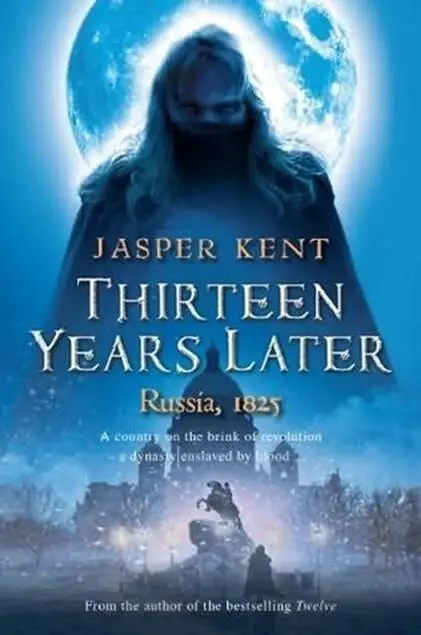
- Название:Thirteen Years Later
- Автор:
- Жанр:
- Год:неизвестен
- ISBN:нет данных
- Рейтинг книги:5 / 5. Голосов: 1
-
Избранное:Добавить в избранное
- Отзывы:
-
Ваша оценка:
Thirteen Years Later: краткое содержание, описание и аннотация
Предлагаем к чтению аннотацию, описание, краткое содержание или предисловие (зависит от того, что написал сам автор книги «Thirteen Years Later»). Если вы не нашли необходимую информацию о книге — напишите в комментариях, мы постараемся отыскать её.
Thirteen Years Later — читать онлайн бесплатно полную книгу (весь текст) целиком
Ниже представлен текст книги, разбитый по страницам. Система сохранения места последней прочитанной страницы, позволяет с удобством читать онлайн бесплатно книгу «Thirteen Years Later», без необходимости каждый раз заново искать на чём Вы остановились. Поставьте закладку, и сможете в любой момент перейти на страницу, на которой закончили чтение.
Интервал:
Закладка:
CHAPTER IV
ALEKSEI SPENT THE NIGHT IN THE HOME OF YELENA AND Valentin Lavrov, sleeping entwined in the limbs of his lover of almost fourteen years, just a few steps away from their beloved daughter. He crept away a little before dawn, having kissed Domnikiia, who awoke, on the lips and Tamara, who did not, on the forehead.
He glanced around as he arrived back at his hotel, but Dmitry had not shown up early. He slipped inside and emerged within half an hour, shaved, changed and carrying a knapsack which contained, amongst other necessities, the wooden sword his son had given him. The two horses he had ordered stood ready for him, and he had to wait but a few moments for Dmitry to arrive.
‘So, how was your first night in Moscow?’ asked Aleksei, as they trotted south out of the city.
‘Somewhat quiet,’ said Dmitry. ‘I’m not officially expected until next week, so until then they’re just giving me a bed to sleep in. There are only two others there so far.’
‘So did you all go and see the sights last night?’
‘We had a drink,’ said Dmitry cautiously. ‘How long will it take to reach Desna?’
Aleksei could easily tell that Dmitry didn’t want to go into any detail about his first night in the army, nor would he, for many years, want to go into detail over any other night. The reason was simple: he had no standards to judge his own behaviour by. Whilst Aleksei, like any military father, had not held back in telling his stories of both valour and defeat, his descriptions of army life outside of battles, both in those long intermissions known as peace, and in those snatched moments of darkness when the enemy must pause for sleep, had remained sanitized. There was no need to tell any son about the whoring and the drinking and the inescapable vomiting. At least, that was Aleksei’s thought. He knew other fathers who told their sons the whole truth, and knew too how odious those sons grew up to be. But it meant that, for Dmitry, any story he told his father of his army life would be a stab in the dark, risking, in the one extreme, shocking his sensibilities, and in the other his silent contempt.
‘A couple of hours, at most,’ he replied, ‘though I’ve done the return journey quicker.’
‘You never told me what happened,’ said Dmitry.
‘You never needed to know.’
‘I think I do now.’
Aleksei nodded. ‘It was before Bonaparte reached Moscow – around the time of Borodino. We’d all headed out west to do what we could to stop him. The twelve Oprichniki and me, Dmitry, Vadim and Maks, divided up into four groups. We got separated, but made it back to Moscow. I met up with Dmitry, who told me that Maks was a French spy – that he’d handed three of the Oprichniki straight over to the enemy.’
‘Did you believe him?’
‘I don’t know if I did at the time, but he was quite right. Maks got a message to me through… well, it doesn’t matter – through a contact. It said to meet him at the place we’re going to now. I went there, more slowly than we’re going, making sure I wasn’t followed.’ He looked around. They were out of the city now. ‘Not much has changed,’ he added.
‘And when you got there?’
‘And when I got there, I found Maks. He confessed to everything – everything he thought I knew. Told me he’d happily handed over the Oprichniki to be executed by the French; told me he’d been spying for them since Austerlitz – that was in ’05.’
‘I know that, Papa.’
‘Sorry,’ said Aleksei, momentarily brought back to the present. ‘Of course you do. The thing is, what Maks didn’t tell me was that he’d discovered the Oprichniki had their own agenda.’ They were vampires; that was the simple, straightforward way to put it. But even if he hadn’t wanted to protect his son from such dangerous knowledge, the very word, spoken out loud on this sunny autumn morning in an era when modernity had expelled all such notions from educated people, would have been greeted with laughter.
‘They weren’t on our side, then?’ asked Dmitry, forcing his father to continue the story.
‘Up to a point, but when there were no more French for them to rob’ – ‘rob’, that was a nice way to put it – ‘they turned on the Russians.’
‘I can’t imagine many Russians had anything worth taking at the time,’ said Dmitry.
‘“From him that hath not, even that he hath shall be taken away from him,”’ replied Aleksei. ‘They were very devout.’
‘But Maks told you everything?’
‘About himself, but not about them. And before he could, they arrived.’
‘They’d followed you?’
‘Your Uncle Dmitry had found out where Maks was, and told them. They got there soon after I did.’ After dark.
‘They wanted justice?’
‘They wanted revenge,’ spat Aleksei, adding more calmly, ‘but it’s a moot point. I was outnumbered – I couldn’t stop them. But I should have stayed.’
‘You wanted to see him die?’
‘I wanted to see him live, just a little longer. But I wanted to live myself, and that seemed more important at the time. Eventually I came back – to bury him.’
‘When was that?’ asked Dmitry.
‘About two months later, when your Uncle Dmitry and I travelled side by side down this very road, just as you and I are doing now.’
‘So you’d reconciled with Dmitry by then?’
Aleksei was about to answer, but found he could not. Had he ever truly accepted Dmitry’s complicity with the Oprichniki? He felt now, in 1825, that he had, but he had only reached that acceptance in the years after Dmitry’s death. ‘Just about,’ he answered, rather than be forced to explain.
‘I guess he was as much in the dark as you were as to what the Oprichniki were really up to.’
‘Oh, he knew all right.’ Aleksei paused to recollect, but realized he could not leave the issue hanging. ‘Don’t worry, Mitka, you’re nothing like your namesake.’ Aleksei spurred his horse on a little, and pulled away from his son.
‘I never thought I was,’ muttered Dmitry.
He is here. Come at once.
The letter had taken nine days to reach Ragusa. The uprising of the Greeks against the Turks made all communication hazardous, but they had chosen their couriers with care. Now there were only a few final preparations to be made, but little could be done immediately. A heavy curtain hung over the window and behind it were wooden boards, but still it was obvious that the sun had risen outside. The atmosphere was oppressive, nauseating. Sleep was the best escape. He would have slept already, but for the anticipation – for the last three mornings – that the letter would arrive.
He screwed it up and threw it into the unlit fireplace. It would burn when the next guest stayed in this room – one who needed the comfort of physical warmth. Even if it was found and read, it did not matter. He would be long gone and no one would know where to follow him.
Sleep: that was the thing for now. At sunset he would make things ready. Even then, there would be no need to rush. The journey would not begin until the small hours of the morning. That was the safest way. And for now, sleep. Patience came easily after so long an existence as his. He had waited over a hundred years and soon he would claim what he was rightfully owed.
Over a hundred years, and yet as he lay down, he felt he could still taste that noblest of blood on his lips.
They arrived at Desna before noon. Not quite at Desna – the small, abandoned wooden hut was a little north of the village.
‘We’re early,’ Dmitry said.
‘I know,’ his father replied.
Aleksei tied up his horse, using a tree some way from the hut. Dmitry did likewise, then strode across the open patch of dusty ground that stood between them and the wooden building.
Читать дальшеИнтервал:
Закладка:
Похожие книги на «Thirteen Years Later»
Представляем Вашему вниманию похожие книги на «Thirteen Years Later» списком для выбора. Мы отобрали схожую по названию и смыслу литературу в надежде предоставить читателям больше вариантов отыскать новые, интересные, ещё непрочитанные произведения.








Обсуждение, отзывы о книге «Thirteen Years Later» и просто собственные мнения читателей. Оставьте ваши комментарии, напишите, что Вы думаете о произведении, его смысле или главных героях. Укажите что конкретно понравилось, а что нет, и почему Вы так считаете.