Jasper Kent - Thirteen Years Later
Здесь есть возможность читать онлайн «Jasper Kent - Thirteen Years Later» весь текст электронной книги совершенно бесплатно (целиком полную версию без сокращений). В некоторых случаях можно слушать аудио, скачать через торрент в формате fb2 и присутствует краткое содержание. Жанр: Историческая проза, Ужасы и Мистика, на английском языке. Описание произведения, (предисловие) а так же отзывы посетителей доступны на портале библиотеки ЛибКат.
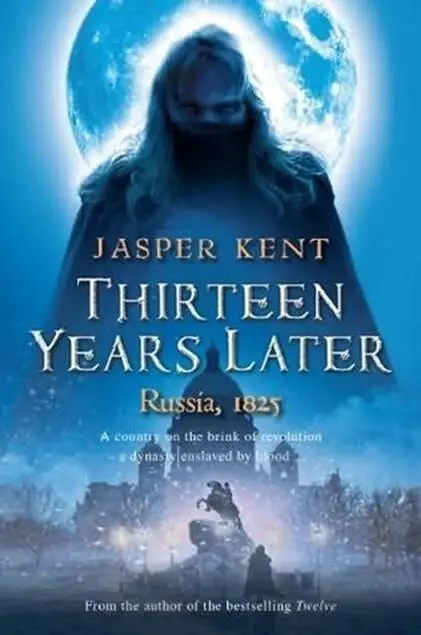
- Название:Thirteen Years Later
- Автор:
- Жанр:
- Год:неизвестен
- ISBN:нет данных
- Рейтинг книги:5 / 5. Голосов: 1
-
Избранное:Добавить в избранное
- Отзывы:
-
Ваша оценка:
Thirteen Years Later: краткое содержание, описание и аннотация
Предлагаем к чтению аннотацию, описание, краткое содержание или предисловие (зависит от того, что написал сам автор книги «Thirteen Years Later»). Если вы не нашли необходимую информацию о книге — напишите в комментариях, мы постараемся отыскать её.
Thirteen Years Later — читать онлайн бесплатно полную книгу (весь текст) целиком
Ниже представлен текст книги, разбитый по страницам. Система сохранения места последней прочитанной страницы, позволяет с удобством читать онлайн бесплатно книгу «Thirteen Years Later», без необходимости каждый раз заново искать на чём Вы остановились. Поставьте закладку, и сможете в любой момент перейти на страницу, на которой закончили чтение.
Интервал:
Закладка:
‘And after a little while, we drop the “Konstantin”,’ said the man who had just been introduced to Dmitry as Kakhovsky.
‘But what if it turns out that Nikolai isn’t trying to take over?’ asked Aleksei, ever cautious.
‘It will be too late by then,’ said Ryleev. ‘If not, no one will blame us for trying to support the rightful tsar, even if it was based on a misunderstanding. Carry on with the news from Moscow, though.’
‘All those who are friendly to our cause are ready to rise up,’ continued Dmitry, ‘but they await a signal from you – or an event that will force them to act.’
‘The latter is unlikely in Moscow, I think,’ said Ryleev. ‘And what of the ordinary people?’
‘They mourn Aleksandr and accept Konstantin.’
‘So they suspect nothing of Nikolai’s actions?’
‘Not when we left. Many have already sworn allegiance to Konstantin, so they may be on our side when they hear.’
‘Good,’ said Ryleev.
‘So, what’s the plan?’ asked Aleksei.
‘We wait.’
‘More waiting?’ Dmitry was horrified. Aleksei raised a hand, indicating that he should listen.
‘Wait until Nikolai declares himself tsar,’ continued Ryleev. ‘It will be a few days, at most.’
‘How can you be sure?’ asked Aleksei, quite prepared now to speak rather than listen.
‘Trust me, we are certain. We already have agitators in the streets and in the barracks. Once the news of Nikolai’s announcement spreads – even if we have to spread it ourselves – then the focal point will be the Winter Palace. We’ll demand the proper reinstatement of Konstantin and a formal constitution to stop such an outrage from ever happening again.’
‘But Konstantin will still be days away from Petersburg,’ said Aleksei.
‘Exactly,’ replied Ryleev, with not a little pride, ‘and that is why we will suggest the appointment of an interim dictator.’
‘You?’
‘Goodness, no. Prince Troubetzkoy has been elected to the role.’
‘Is he happy with that?’ asked Aleksei.
‘Sergei Pyetrovich is a moderate,’ said Ryleev. ‘He sees the position as a way of preventing things from getting out of hand.’
‘Does Nikolai suspect?’ asked Aleksei.
‘We must presume that he does,’ said Ryleev. ‘That may be why he has hesitated to move. But every day he waits, the confusion grows and with it we grow stronger. In the end, he may be able to command more men than we do, but they will not fire upon their fellow soldiers.’
‘What can we do?’ asked Dmitry.
Ryleev looked at Aleksei. ‘Your brigade is the Life Guard Hussars, is it not, Aleksei Ivanovich?’
Dmitry’s father nodded.
‘You are in a minority there – they have been amongst the hardest to persuade to our cause. Do what you can to bring them round, or at least, keep them away if Nikolai calls on them.’
‘My regiment’s in Moscow,’ Dmitry told them, fearful of the implication.
‘I would not send you back there at a time like this,’ replied Ryleev. ‘We’ll find a role for you.’
Dmitry was thrilled.
Nikolai Pavlovich wondered if he didn’t hate his brothers. All except Mihail. Mihail was the only one of them younger than Nikolai, and he was loyal. Konstantin was a wastrel – he didn’t deserve to be tsar, and it was a good thing he wasn’t going to be. But that he should refuse even to come to Petersburg and acknowledge his brother as rightful leader threatened to throw the whole country into chaos. It was typical of him.
It was Aleksandr who was currently the object of his brother’s greatest wrath. The emotion disgusted him, and he was certain – and prayed for that certainty to transform into reality – that in a few weeks or months he would feel different. He had loved Aleksandr all his life, almost as a replacement for the father who had been taken away from him when he was only four. He had disagreed at times with some of Aleksandr’s earlier liberal attitudes to the modernization of his country, but Aleksandr had seen the error of his ways. Above all, Nikolai could only regard his brother as a hero – a world hero – for his stand against Bonaparte.
But Aleksandr could not have picked a worse time to die. That was not fair – nor was it ultimately Nikolai’s complaint. Aleksandr could not choose the time and place of his death, but as emperor, he should have been prepared for it to happen at any moment. As it was, he had left his affairs – the nation’s affairs – in a terrible state.
For a start, there was the shocking vagueness over the succession. The decision that Nikolai should become tsar was clear and sensible, but why had that clarity not been conveyed to the very people he was intended to rule? It was not their place to decide who governed them, but it was a matter of simple practicality that they should be aware of who that person was. On top of that, Nikolai now discovered, there was the fact that Aleksandr had been aware for several years of groups within the army that were plotting against him. Had he not understood that the very idea of ‘plotting against him’ did not mean ‘plotting against Aleksandr’, but ‘plotting against the tsar’, whoever that might be? And now – de facto if not yet de jure – Nikolai was the tsar. The plots had not stopped with Aleksandr’s death; if anything, they were likely to intensify.
Nikolai had to concede that he had not been completely unaware of what was going on, but he had assumed that his brother had things under control. Now, here in front of him, sat Baron Frederiks, fresh from Taganrog, with news that should have been known in Petersburg long before.
‘I cannot but apologize for the delay, Highness. His late Majesty told me to leave with all haste, but upon his death I delayed. Then when Baron Diebich heard of the dispatches I had, he told me to depart immediately.’
‘The fault is not entirely yours, Baron,’ replied Nikolai. ‘You were but the final link in a chain of delays.’ It was as close as he could bring himself to criticizing his brother in front of another. He did nothing to correct the way Frederiks addressed him. The announcement of the fact that he was tsar would have to be handled with care.
‘What action has been taken against the Southern Society?’ he asked.
‘When I departed, nothing,’ said Frederiks, ‘but much was planned. Arrests may have been made already; if not, then in the next few days. Pestel will be detained for sure.’
‘And without him, the rebellion in the south will collapse?’
‘It will be greatly hindered.’
Nikolai nodded curtly. Frederiks was wise not to employ hyperbole, however much he might be tempted. There was one document amongst the papers of the greatest interest, made up of just five sheets of paper, with the briefest of notes attached in his brother’s hand.
Membership of the Northern Society – for NPR only
Nikolai’s attitude momentarily softened as he saw this reminder of his brother, possibly one of the last things he had written. He touched the paper with his thumb, making sure that Frederiks would not discern the action, and felt the whisper of a connection. He sat down and glanced through the list. Many names were unfamiliar to him, some he could easily have guessed, others were horrifying. Troubetzkoy was a shock; Volkonsky a greater one. He checked carefully. It was S. G. Volkonsky – Sergei Grigorovich. It would have been unthinkable to see Pyotr Mihailovich on the list.
Perhaps more shocking than the names of the élite were those of the high- and middle-ranking officers; men with whom the royal family should have been able to trust their lives. A. I. Danilov, for example. He was a colonel in the Life Guards, wasn’t he? Nikolai couldn’t picture the face, but he remembered Aleksandr specifically commenting on some action he’d carried out. It was horrible for his brother’s trust to be so brutally betrayed, but it was his own fault. He’d been too soft-hearted; too ill disciplined. Well, that wouldn’t happen in the reign of Nikolai I – and this list would make a good start for showing everyone who needed reminding that treachery was the greatest sin of all.
Читать дальшеИнтервал:
Закладка:
Похожие книги на «Thirteen Years Later»
Представляем Вашему вниманию похожие книги на «Thirteen Years Later» списком для выбора. Мы отобрали схожую по названию и смыслу литературу в надежде предоставить читателям больше вариантов отыскать новые, интересные, ещё непрочитанные произведения.




Обсуждение, отзывы о книге «Thirteen Years Later» и просто собственные мнения читателей. Оставьте ваши комментарии, напишите, что Вы думаете о произведении, его смысле или главных героях. Укажите что конкретно понравилось, а что нет, и почему Вы так считаете.