Thomas Keneally - A River Town
Здесь есть возможность читать онлайн «Thomas Keneally - A River Town» весь текст электронной книги совершенно бесплатно (целиком полную версию без сокращений). В некоторых случаях можно слушать аудио, скачать через торрент в формате fb2 и присутствует краткое содержание. Город: New York, Год выпуска: 2011, ISBN: 2011, Издательство: Nan A. Talese, Жанр: Историческая проза, на английском языке. Описание произведения, (предисловие) а так же отзывы посетителей доступны на портале библиотеки ЛибКат.
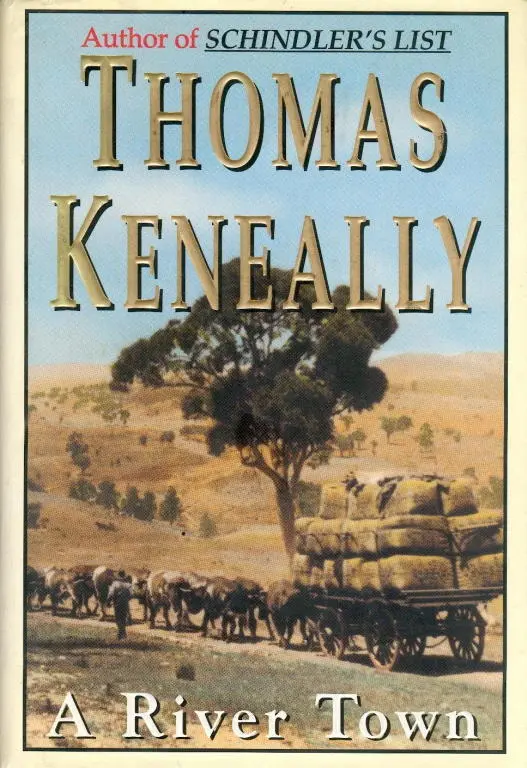
- Название:A River Town
- Автор:
- Издательство:Nan A. Talese
- Жанр:
- Год:2011
- Город:New York
- ISBN:978-0-307-80063-3
- Рейтинг книги:4 / 5. Голосов: 1
-
Избранное:Добавить в избранное
- Отзывы:
-
Ваша оценка:
A River Town: краткое содержание, описание и аннотация
Предлагаем к чтению аннотацию, описание, краткое содержание или предисловие (зависит от того, что написал сам автор книги «A River Town»). Если вы не нашли необходимую информацию о книге — напишите в комментариях, мы постараемся отыскать её.
.
A River Town — читать онлайн бесплатно полную книгу (весь текст) целиком
Ниже представлен текст книги, разбитый по страницам. Система сохранения места последней прочитанной страницы, позволяет с удобством читать онлайн бесплатно книгу «A River Town», без необходимости каждый раз заново искать на чём Вы остановились. Поставьте закладку, и сможете в любой момент перейти на страницу, на которой закончили чтение.
Интервал:
Закладка:
Since business proved slow in the afternoon, Tim wondered did people know Kitty had come down on the drogher? Did they fear she’d pass the plague to them along with the crackers and cheese?
Look in the Argus for plague-news and the hope of sighting a new letter to grace the day of Kitty’s return. And it was there! Page nine.
Dear Sir,
It appears from the casualty figures for Queenslanders and northern New South Welshmen published in your last issue and shown to be due to meningitis [1], enteric fever [5], and ambush of a column of two hundred mounted rifles by Boers [13], that the tactics of General French in the Transvaal have been nothing short of disastrous. Even the Australian bushmen move in column of march, like an outmoded British regiment.
Is General French characteristic of the men born to rule over us and long to reign over us? I simply ask the question. While we sacrifice our young in South Africa, we are asked also to sacrifice the best concepts of our coming Federation. Our colonial statesmen, led by Mr. Alfred Deakin of Victoria, are now asked to take our Bill for the Commonwealth of Australia to Britain, where the political equivalents of General French can peer over them in the offices of the Secretary of State for the Colonies in Whitehall. Not only do we then surrender our young to the incompetence of British generals, but we surrender the best ideas for our future to the supervision and amendment of far-off British Ministers of State who have never seen our shore, and can have no chief and primary interest in our welfare.
The British will be very ill-informed indeed if they decide to interfere too much with the Australian Commonwealth Act. The sweet clauses we have raised up for a Federal Commonwealth, like the sweet boys we have sent to South Africa, will be mowed down by incompetent men if we do not take care.
I am, etc. Australis Central KempseyTim laid his hand emphatically a number of times on the page. Fair enough, fair enough, Australis .
But who had written these letters? A farmer with time to think? Yet the address was Central Kempsey. Was that a mere blind? Who was this Thomas Paine of the Macleay?
He went through a list in his head. Old Burke upriver at Pee Dee had time enough and adequate disgruntlement to write these. But they were not his opinions. He was not for Federation. He was in favour purely of running Pee Dee station as he wished under a regime of free trade and low tax. So Old Burke had not written these. Borger, the farmer who had spoken up at the Patriotic Fund meeting in the Good Templars? Certainly Borger, you would think. It was pure Freeman’s Journal stuff.
Well, good for the lad, though he would suffer. He might take his cream to the butter factory and find it turned back by some fellow worried about far, far South Africa. It was the one thing wrong with the country. People were too in love with other quarters of the globe and not enough with this place itself. To an emigrant, the Macleay was sufficient kingdom. You couldn’t tell the women that, of course. Kitty loved reading the Palace news. Didn’t see any of it as political. It was purely a matter of tiaras, blood-lines, balls and regattas. If you wanted to be strict about it, as Australis obviously did, you could say that the women were abettors of the high loyalism of New South Wales. But then why shouldn’t they enjoy themselves, reading about fanciful things?
In late afternoon, more rain to soothe the burnt pastures upriver. Old Kylie from the Good Templars came around under a big black umbrella asking for donations for farmers who had lost their stock, their crops, their outbuildings. Contributions over ten shillings would be published in the list of donations to appear in both the Argus and Chronicle . Tim went into the storeroom, to the black and red cash box. He opened it with the key from his fob and took out a ten bob banknote. A green pound note beckoned to him. Ten bob contributors would be the lowest on the list. In the face of fines and threats, he would show his open-handedness. He knew the crime of vanity beckoned. People on the way to Mass calling out to him with respect and then muttering to each other that he was a good fellow and always ready to extend credit. He loved to be suspected of generosity beyond his means. Besides, poor buggers had lost their stock, their horses and cattle, and could go broke.
He took the thirty shillings, the one pound ten, out to old Kylie. Lunacy. The old man whistled and wrote him a receipt. “This is very generous of you, Mr. Shea. Not all the tradespeople are as generous as this!”
One in the eye for Ernie Malcolm.
Through the rain without an umbrella came Joe O’Neill slightly aglow and his lips a little thick. Stammery. He’d been to the Commercial to meet the natives, and now was coming to dinner carrying bottles of lager and stout cradled in his arms. If the rain kept up he would have to sleep in the cart in the shed.
“I think I’ll like this place,” he told Tim, coming into the store and shaking himself. It would have been the Offhand who pumped almost too much grog into Joe, asking him for impressions of recent events in Ireland and the British Isles. Would Ireland ever get Home Rule, or had Home Rule run aground for good on the snowy white breast of Mrs. O’Shea (a Kitty like his), mistress of the late, great Parnell? And so on. Ireland suffering mortally from Parnell’s mortal lusts, and Joe passing on the news to the Offhand on the Northern Rivers of New South Wales.
Joe had the look of an emigrant who believed he’d settled in already. A few pints with the natives had done it. With the denizens. But there was no chance that he’d make an easy voyager, the way Mamie did. When he got out to his relatives and started to live in his slab hut, the silence and otherness would get to him, and he’d be struck by a big bush melancholy.
At dinner, Joe and Mamie took the chance to tell further tales of the voyage. An extraordinary thing, a voyage of that extent. When you are on it, you think that you would be able to talk by the hour about it afterwards. But there is something you can’t convey about the sea’s repetitive sunsets and dawns, about the variations of swell, about porpoises seen off the stern, about the ferocity of sea sickness. The other mistake you made was to think that life after you landed would be as varied as that. A frustration that in giving a picture of the voyage, you made it sound as ordinary as the rest of life.
When it came to taking places at table, Mamie insisted on sitting between Kitty and Bandy Habash. Then the children down one side, and Joe O’Neill and Ellen Burke at the foot, looking a little wan together. Tim praised Ellen to Kitty, and recounted now the accidents which had marked her absence.
“Holy Mary,” said Kitty, “Pee Dee. And Angelus tower! If I’d stayed away another week, you’d all be dead!”
But tonight it seemed a comic rather than fatal possibility. Joe O’Neill flicked Johnny’s ear playfully, and even Tim found himself laughing.
A number of bottles of stout and ale had been opened with the soup, and everyone was drinking freely except for Bandy.
“Thank Christ I’m a Catholic,” said Joe, adding to the beer already in him. “Drinking’s the one thing you’re allowed. I would have made a rotten Mohammedan.”
But you could see by the way his eyes moved at the beginnings and ends of sentences and during silences that he was thinking, “Surely she can’t really like this little brown fellow?”
As for Ellen Burke, she kept dashing out to the cookhouse, just like someone covering up with kitchen work her lack of ease.
Tim said, “Now tell me, Bandy, these remedies of yours. Do they cure anything? What do you put in these things, Bandy, you sell to people?”
Читать дальшеИнтервал:
Закладка:
Похожие книги на «A River Town»
Представляем Вашему вниманию похожие книги на «A River Town» списком для выбора. Мы отобрали схожую по названию и смыслу литературу в надежде предоставить читателям больше вариантов отыскать новые, интересные, ещё непрочитанные произведения.











Обсуждение, отзывы о книге «A River Town» и просто собственные мнения читателей. Оставьте ваши комментарии, напишите, что Вы думаете о произведении, его смысле или главных героях. Укажите что конкретно понравилось, а что нет, и почему Вы так считаете.