Thomas Keneally - A River Town
Здесь есть возможность читать онлайн «Thomas Keneally - A River Town» весь текст электронной книги совершенно бесплатно (целиком полную версию без сокращений). В некоторых случаях можно слушать аудио, скачать через торрент в формате fb2 и присутствует краткое содержание. Город: New York, Год выпуска: 2011, ISBN: 2011, Издательство: Nan A. Talese, Жанр: Историческая проза, на английском языке. Описание произведения, (предисловие) а так же отзывы посетителей доступны на портале библиотеки ЛибКат.
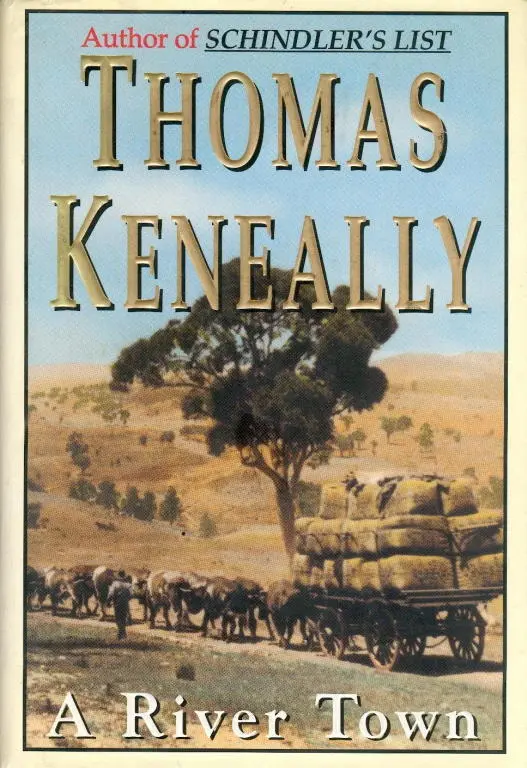
- Название:A River Town
- Автор:
- Издательство:Nan A. Talese
- Жанр:
- Год:2011
- Город:New York
- ISBN:978-0-307-80063-3
- Рейтинг книги:4 / 5. Голосов: 1
-
Избранное:Добавить в избранное
- Отзывы:
-
Ваша оценка:
A River Town: краткое содержание, описание и аннотация
Предлагаем к чтению аннотацию, описание, краткое содержание или предисловие (зависит от того, что написал сам автор книги «A River Town»). Если вы не нашли необходимую информацию о книге — напишите в комментариях, мы постараемся отыскать её.
.
A River Town — читать онлайн бесплатно полную книгу (весь текст) целиком
Ниже представлен текст книги, разбитый по страницам. Система сохранения места последней прочитанной страницы, позволяет с удобством читать онлайн бесплатно книгу «A River Town», без необходимости каждый раз заново искать на чём Вы остановились. Поставьте закладку, и сможете в любой момент перейти на страницу, на которой закончили чтение.
Интервал:
Закладка:
Mrs. Malcolm put her hand out temporarily, seeking an invisible object.
“You have three children to feed, Mr. Shea?”
“I have the third on the way, Mrs. Malcolm. April perhaps.”
“Ah, what a creation we are! Cattle for instance can’t state, do not know the terms of their pregnancies. They have to be told by the farmer.”
Tim did not know what to make of that. “I suppose that’s right, Mrs. Malcolm. What a work we are.”
But with the plain exchange of pleaded-for money done, he didn’t feel like much of a work of anything.
“We don’t have children, but as Ernie says we have the Masonic Lodge and the Good Templars, and the Macleay District Hospital Board, and the Board of the Cricket Club, and, of course, the Turf Club and the Patriotic Fund and the Royal Humane Society. And we keep accounts at as many stores as we can. Spread the wealth, eh. I suppose that in a way the storekeepers’ children are our children. By an indirect route. So we must be happy, I suppose.”
Ernie had talked like that at the cricket. It must be an article of faith of the Malcolm household.
“That’s a fair way of looking at it, Mrs. Malcolm,” said Tim. Now he wanted to escape, to take his embarrassment out to old Pee Dee, his confessor nag to whom he could mutter away as he drove.
She grabbed his wrist. Frantic suddenness. “I’d be grateful if you would look at it that way.”
“Of course,” he said. He would make any pledges if she’d let him go.
“Good,” said Mrs. Malcolm. “That’s guaranteed then.”
“Could I call Primrose for you, Mrs. Malcolm?”
She laughed at this. “I can find my way around my own house, thank you.”
“Of course.”
But she stood there, did not move further into the house, did not release him to the working day, the hard outside light.
“If you’ll excuse me, Mrs. Malcolm,” he said.
“Yes, I suppose you’ve done your business, haven’t you, Tim?”
It sounded as if he were again being cast as a storekeeper in a variety sketch. Meanness, the vice you found in everyone, and everywhere in the hard-up bush. The copper tedium of coins coloured the soul.
“Far beyond the price of any grocery bill, there’s the friendship with yourself and Mr. Malcolm.”
“Oh,” she said. “Very well. Then you might as well go.”
He thanked her in a normal voice and took his hat and left. Outside, in heat like a blow on the back of the head, he passed the sterile verandahs where the dream of elegant Winnie and devoted Ernie sitting together in childless serenity on hot evenings had soured and gone stale. He passed out the TRADESMEN’S ENTRANCE, untethered the cart and got aboard, Pee Dee waving his head from side to side in complaint. Tim spoke in the huge afternoon, into which longed-for thunderclouds had now come massing from the west. “Five pounds, you bugger! Gratefully received.”
Back to the wifeless store and hearth. Ellen Burke cooked a better bush-style breakfast than Kitty, and sandsoaped the kitchen table afterwards as a matter of course. So he would have been an ungrateful fellow indeed to complain. But the tidiness felt like the tidiness of someone else’s house, and the food like food from a stranger’s kitchen.
The store felt his, and so he minded it while Ellen exercised his permission to take the children for a walk.
An Aboriginal man, in a blue shirt and trousers tied with rope, appeared as the afternoon storms began and lightning reduced Belgrave Street to size. He looked around to be sure where he was. His feet had left on the boards the faintest trace of soft yellow dust. He had that damaged look: his eyes at odds with his face and with each other. A bad case. People sold them any old poison to drink.
“Mr. Shea,” the man said in a sharp-edged accent, half-cockney, half something left from before whites came to the Macleay. “I’d like a pint of methylated for cleaning things. And you got some of that rosehip syrup?”
They were barred from the pubs, and so they drank methylated spirits sweetened with syrup. That’s why the man had that look, as if his eyes were not part of his body but were floating, without reference to one another.
Tim said, “Not here, Jack. I don’t sell methylated for those purposes.”
Every other bugger did, so why should he be so fastidious and not a practical man?
“Mate, be a good feller to me!” the man pleaded. The thunder high above and wide out in the cow pastures seemed to jolt his head.
“No. Don’t you come in here asking for White Lady. I tell you that every time.”
The man went out muttering, and stood under the awning, looking to the left up Belgrave Street, to the right up Smith. His White Lady beckoned. His love. Visiting circuses always went out there, to the blacks’ camp. The circus midgets with their liquor to trade. The huge men with beards and breasts like women. Some townsmen too. Cheap delights. Black velvet , they were reputed to call it. God knows why. Such a luscious name for wretched townships of hessian and bark and iron sheeting. But how must it be for a fellow to see the half-castes trailing into town and see your features on the brown faces of the Greenhill children?
“White Lady, mate,” the natives said lovingly. It had brought quick ruin to blackfellers who hadn’t even seen white men until three score and ten years ago. The first of them a few convicts escaped out this way from Port Macquarie. They’d begun the long mix of blood. And the torment. And now everyone said the blacks would die out, that that was the world’s way.
The Offhand cheered one of his wifeless midmornings by coming in for Woodbines. A sparing smoker, he lit one shakingly in the shop and very politely went outside to hurl the spent match into Smith Street. Then he returned, puffing and trembling.
“A second great rescue for you, Tim. This time from the decks of Terara . The Chronicle reports many a bush cricket match, but this one will stand out in the telling. Children overboard! The two highest scoring batsmen dive in to save said children overboard! And one of the children saved is then runner-up in the wicket-hitting competition. Sublime!”
Tim began to laugh. “That’s Johnny. Born athlete. Only drawback is the little bugger seems to want to kill his father.”
“And then,” said the Offhand, “going on to a new topic. The courage of Mr. Artillery, Lancer, Mounted-Bushman, Light-Infantry, Horse-Guards Chance. It was good to have a few sane men there to say otherwise to him and his brethren.”
Tim felt a spurt of unrest. All right for the Offhand to volunteer to be sane or mocking or whatever he’d been. The mighty feared his powers of satire.
“I would have been better not to go,” said Tim. “It always comes back to loyal vows I would rather not take.”
The Offhand shook his head. “Tim, they will find it very hard to get up a loyal list or a disloyal list or whatever it is they want to get up. The civilised British value of free speech takes precedence over monarchs in my book, and I shall be saying so.”
They both watched through the glass as a white horse drawing a sulky pig-rooted while turning into Smith Street outside T. Shea—General Store. The horse did not send up much dust since the road was baked hard now, and after the intense storms it had grown quite hot again. They saw Meagher, a publican, beefy but with very fine, good-looking features, fighting with the reins, looking too heavy for his sulky.
“Ah,” said the Offhand, puffing away. “Tim, there’s a parable for you. How decency brings its own ruin!”
Meagher managed to wrench his horse and buggy around the corner, heading towards the Wharf Hotel, which he owned.
“He still walks with a limp you know,” said the Offhand.
Читать дальшеИнтервал:
Закладка:
Похожие книги на «A River Town»
Представляем Вашему вниманию похожие книги на «A River Town» списком для выбора. Мы отобрали схожую по названию и смыслу литературу в надежде предоставить читателям больше вариантов отыскать новые, интересные, ещё непрочитанные произведения.











Обсуждение, отзывы о книге «A River Town» и просто собственные мнения читателей. Оставьте ваши комментарии, напишите, что Вы думаете о произведении, его смысле или главных героях. Укажите что конкретно понравилось, а что нет, и почему Вы так считаете.