Stewart Binns - Conquest
Здесь есть возможность читать онлайн «Stewart Binns - Conquest» весь текст электронной книги совершенно бесплатно (целиком полную версию без сокращений). В некоторых случаях можно слушать аудио, скачать через торрент в формате fb2 и присутствует краткое содержание. Город: London, Год выпуска: 2011, ISBN: 2011, Издательство: Penguin Books, Жанр: Историческая проза, на английском языке. Описание произведения, (предисловие) а так же отзывы посетителей доступны на портале библиотеки ЛибКат.
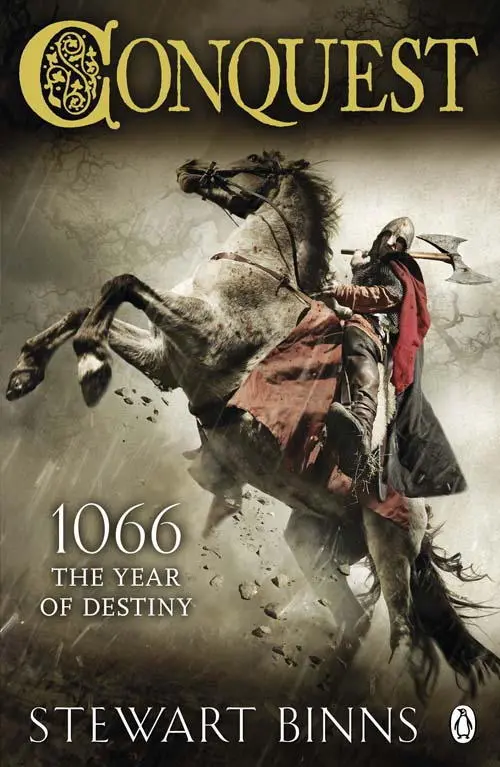
- Название:Conquest
- Автор:
- Издательство:Penguin Books
- Жанр:
- Год:2011
- Город:London
- ISBN:978-0-141-96059-3
- Рейтинг книги:5 / 5. Голосов: 1
-
Избранное:Добавить в избранное
- Отзывы:
-
Ваша оценка:
Conquest: краткое содержание, описание и аннотация
Предлагаем к чтению аннотацию, описание, краткое содержание или предисловие (зависит от того, что написал сам автор книги «Conquest»). Если вы не нашли необходимую информацию о книге — напишите в комментариях, мы постараемся отыскать её.
The battle is hard fought and bloody, the lives of thousands have been spent, including that of King Harold. But England will not be conquered easily, the Anglo-Saxons will not submit meekly to Norman rule.
Although his heroic deeds will nearly be lost to legend, one man unites the resistance. His name is Hereward of Bourne, the champion of the English. His honour, bravery and skill at arms will change the future of England. His is the legacy of the noble outlaw.
This is his story.
Conquest — читать онлайн бесплатно полную книгу (весь текст) целиком
Ниже представлен текст книги, разбитый по страницам. Система сохранения места последней прочитанной страницы, позволяет с удобством читать онлайн бесплатно книгу «Conquest», без необходимости каждый раз заново искать на чём Вы остановились. Поставьте закладку, и сможете в любой момент перейти на страницу, на которой закончили чтение.
Интервал:
Закладка:
22. England Beckons
It had been obvious for some time that Alphonso and the maid Cristina had become close. They were often together with Rodrigo, Jimena and Hereward – and it was evident that the two of them had found more than friendship.
As they prepared to break camp, Doña Jimena gave Cristina the evening off to spend time with Alphonso and, summoning the finest fare their winter quarters allowed, organized a final dinner for Rodrigo and Hereward.
After an excellent meal and much good humour, Rodrigo attempted to usher Jimena away to her bed. ‘We are going to talk of war and the deeds of violent men, Jimena. You should go to bed.’
‘Am I not betrothed to you, Rodrigo Diaz, the greatest warrior in Spain? Should I not know about war and the deeds of violent men?’
Rodrigo relented. Spending time with Jimena away from court had perhaps convinced him that she did not always want to be treated like a genteel noblewoman.
He turned to Hereward. ‘When we talked in the cathedral all those weeks ago, you told me about your own personal relic. I said that one day we would talk about it.’
‘You have a good memory, Rodrigo. It is something that has caused me much anguish, has led me to doubt my wife and is still something that I find difficult to understand. It could carry a message of great importance, or it could be no more than a cheap bauble. Torfida had no doubts about its worth. The only mystery for her was whether its message came from God, or whether it was a clever symbol of man’s potential to solve his own riddles. Either way, she never doubted its significance.’
Hereward took the Talisman from his neck and passed it to Rodrigo, who examined it carefully.
‘It is the image of Lucifer. How can this be a relic?’ Rodrigo passed it to Jimena.
‘How can you carry such a thing, Hereward? It is the image of the Devil; surely it’s a pagan fetish?’
Hereward outlined his story, beginning with his encounter with Torfida’s father, the Old Man of the Wildwood. He described how he had found her in Hereford and how she had explained the Talisman’s origins. He told them about the strange reaction of Gruffydd ap Llywelyn, of Macbeth’s sad demise while wearing it, and how he had been convinced that his journey as the keeper of the Talisman had ended when he passed it to Harold, King of England.
‘The end of the story is a little indelicate for Jimena’s tender years.’
‘Fear not, Hereward, you may speak frankly in front of Jimena.’
Hereward continued quickly, to spare his own shame, as he described the Talisman’s return to him by Edith Swan-Neck. He related the trauma of Torfida discovering them in the forest, her disappearance and illness and, finally, her tragic death.
As he finished his story, Jimena exclaimed,‘The thing is a curse! Give it to the Bishop of Oviedo in the morning. He can bury it in the cathedral crypt; it will never haunt you again.’
‘It is not as simple as that, Jimena. It is at least a thousand years old, and I am entrusted with its safekeeping. Besides, in her death throes, Torfida sent me a message. I keep it with me always.’ He took a small, tightly wrapped linen bundle from his bag, unfolded it carefully and handed the wooden inscription to Jimena.
The young woman’s Latin was perfect; she read it aloud.
Hereward’s eyes filled with tears as he continued his story. ‘Her death and her message helped me understand the symbolism of the Talisman. It carries five messages of abiding truth that are the key to wisdom and kingship. The first is courage – to overcome our fears and anxieties. The second is discipline – to control the darkness within us. The third is humility – to know that only God can work miracles. The fourth is sacrifice – to forfeit ourselves for God and for one another, as Christ did. The fifth is wisdom – to understand the stone, not to fear it. At first, I thought of it as a lucky charm from which the wearer would acquire the gifts it holds, but Torfida helped me understand that it is a catechism, a constant reminder of the truths it carries. It doesn’t protect you, it only helps you protect yourself.’
Jimena and Rodrigo looked at one another.
Rodrigo spoke first. ‘Torfida was right, you are destined to be its next recipient; no one could be more worthy.’
Jimena pressed Hereward’s arm. ‘They were Torfida’s dying words; you must believe in the Talisman and accept her wisdom that you are the one to wear it’.
Hereward’s two Castilian friends embraced him as Rodrigo placed the Talisman over his friend’s head.
‘I can’t thank both of you enough for your friendship; it is more than I could have dreamed of. I came here knowing it was my duty to go back to England, but I also knew that I wasn’t ready in mind or body. You have helped me become a soldier again – and a much better one – but, most importantly, you have helped me clear my mind and revive my spirit. I am now ready to face the task ahead of me. My eternal thanks to you both.’
They returned to the Great Hall of Count Diego for a farewell banquet. It was an evening of good humour and fine food. Count Diego, despite his stern demeanour, was a good host, and Doña Viraca brought the dignity and manners appropriate to the high table of an important city.
At dawn the next morning, Hereward and Alphonso were ready to leave. Alphonso’s romance with Cristina had become serious. Within twenty-four hours of their return from the winter camp, she had gathered all her worldly possessions, obtained permission to leave from her mistress and even been granted a small dowry.
She was charming, hung on Alphonso’s every word and clung to him like a leech. Cristina would be a source of great delight at St Cirq Lapopie.
Rodrigo and Jimena had risen early to bid them farewell. Jimena hugged Cristina and wished her much love and happiness and then gave Alphonso a stern reminder about his responsibilities to care for her.
She turned to Hereward and kissed him on his cheek in a fond embrace. ‘God’s speed to England. If Rodrigo ever forgets that one day he is supposed to marry me, I promise to come to England as a poor unfortunate spinster and throw myself on your mercy.’
Rodrigo walked with Hereward to his horse, both men contemplating all that had been said during the course of their winter together.
Hereward voiced his thoughts first. ‘In truth, my mission in England has little chance of success. The English may already be a beaten people. The Saxons to the south are overrun, the Celts are mercurial and will probably only fight if William crosses into their own territory, and the Anglo-Danes, who live mainly in the northern realms of the earls Edwin and Morcar, have been badly led and failed England at the moment of its greatest need. As for foreign support, Denmark is the solitary possibility, but their only motivation will be plunder.’
‘What of the remnants of Harold’s army?’
‘So many were killed with Harold. He does have sons, and some housecarls will rally to them. However, the true heir is Edgar of the Cerdician line. When I get back to Aquitaine, I will know if he has survived and if he has the stomach to fight for his birthright.’
‘If anyone can do it, you can. I am very tempted to come with you, but my mission is here in Spain and I have Jimena to think of.’
The two men parted with one last warrior’s embrace.
Hereward did not allow himself even a moment to savour the prospect of returning to England with The Cid at his side. ‘We would be a formidable partnership, but you must follow the path that fate has ordained for you.’
‘So must we both.’
In order to significantly reduce the journey time from Oviedo to Cahors, passage had been arranged on a merchant ship from the nearby port of Gigon, bound for Bordeaux. Strong winds off the Atlantic carried them along Spain’s northern coast and across the Bay of Biscay at a good rate of knots.
Читать дальшеИнтервал:
Закладка:
Похожие книги на «Conquest»
Представляем Вашему вниманию похожие книги на «Conquest» списком для выбора. Мы отобрали схожую по названию и смыслу литературу в надежде предоставить читателям больше вариантов отыскать новые, интересные, ещё непрочитанные произведения.









Обсуждение, отзывы о книге «Conquest» и просто собственные мнения читателей. Оставьте ваши комментарии, напишите, что Вы думаете о произведении, его смысле или главных героях. Укажите что конкретно понравилось, а что нет, и почему Вы так считаете.