Stewart Binns - Crusade
Здесь есть возможность читать онлайн «Stewart Binns - Crusade» весь текст электронной книги совершенно бесплатно (целиком полную версию без сокращений). В некоторых случаях можно слушать аудио, скачать через торрент в формате fb2 и присутствует краткое содержание. Город: London, Год выпуска: 2012, ISBN: 2012, Издательство: Penguin Books, Жанр: Историческая проза, на английском языке. Описание произведения, (предисловие) а так же отзывы посетителей доступны на портале библиотеки ЛибКат.
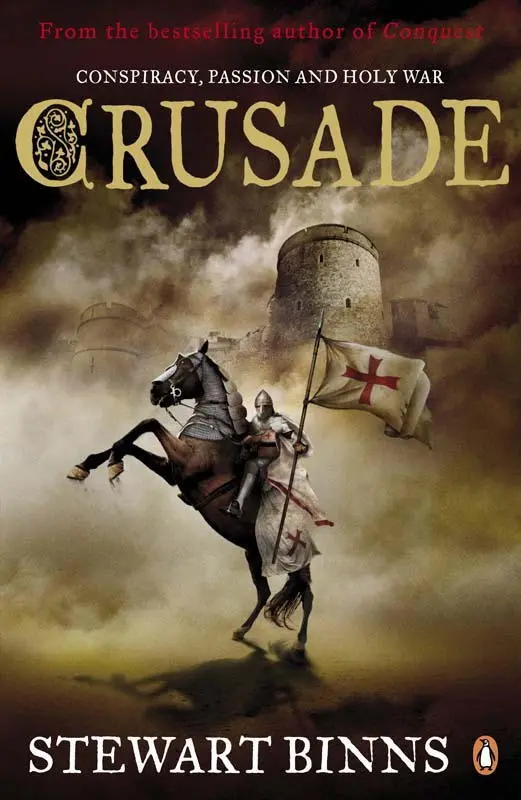
- Название:Crusade
- Автор:
- Издательство:Penguin Books
- Жанр:
- Год:2012
- Город:London
- ISBN:978-0-241-95758-5
- Рейтинг книги:3 / 5. Голосов: 1
-
Избранное:Добавить в избранное
- Отзывы:
-
Ваша оценка:
Crusade: краткое содержание, описание и аннотация
Предлагаем к чтению аннотацию, описание, краткое содержание или предисловие (зависит от того, что написал сам автор книги «Crusade»). Если вы не нашли необходимую информацию о книге — напишите в комментариях, мы постараемся отыскать её.
In the face of chaos and death, Edgar and his allies form a secret brotherhood, pledging to fight for justice and freedom wherever they are denied. But soon they are called to fight for an even greater cause: the plight of the Holy Land. Embarking on the epic First Crusade to recapture Jerusalem, together they will participate in some of the cruellest battles the world has ever known, the savage Siege of Antioch and the brutal Fall of Jerusalem, and together they will fight to the death.
Crusade — читать онлайн бесплатно полную книгу (весь текст) целиком
Ниже представлен текст книги, разбитый по страницам. Система сохранения места последней прочитанной страницы, позволяет с удобством читать онлайн бесплатно книгу «Crusade», без необходимости каждый раз заново искать на чём Вы остановились. Поставьте закладку, и сможете в любой момент перейти на страницу, на которой закончили чтение.
Интервал:
Закладка:
Sweyn’s horse fell under a hail of arrows, one of which struck it in the neck, throwing Sweyn to the ground with a sickening thump. By the time he got to his feet he was still stunned and the Seljuks were almost on top of him, but Adela had ridden back to get him and offered him her hand to help him on to her horse. With no chance of escape, she turned her mount towards the Turks and managed to get one arrow away. It was an outstanding shot that took the leading cavalryman right out of his saddle. Adela’s mount then started to panic and reared up as it saw the Turkish horses only yards away, tipping Sweyn off its back and unseating Adela.
Sweyn hurt his shoulder in the fall and could not get up, so Adela stood over him with her sword drawn. She managed to deal with the first Seljuk to reach her by crippling his horse. After swaying away at the last moment to avoid the cavalryman’s lance, she crouched low to slice his mount’s fetlocks with her blade, bringing horse and rider crashing to the ground. By then, two more were about to strike. She managed to avoid the first lance by deflecting it with her sword, but the second one caught her on the top of her helmet.
She stumbled away before collapsing, blood streaming down her face, just as Sweyn, now getting to his feet, managed to use his shield to defend himself against the next attacker before he was caught across the back of the shoulder by a blade swung by a Turk who had come up behind him. He cried out in pain and fell forwards in a heap.
Adela, unable to see through the stream of blood running from a deep gash to her head, threw off her helmet and wiped the blood away with her sleeve. She then ran back to protect Sweyn, screaming obscenities as she went. The Seljuk, who had appeared behind her and was about to strike with his sabre, hesitated when he realized the Christian knight beneath him was a woman.
Adela turned and the two foes looked one another in the eye momentarily. Adela, covered in blood and with the fierce look of a determined warrior, set herself to defend the blow. But the Turk put up his hand to his comrades, returned his sabre to its scabbard and blessed himself before taking off his helmet and acknowledging Adela with a long and deliberate nod of his head. A handsome, swarthy man with a thick, curly black beard, he sported the red silk pennons of an officer tied to his conical helmet. Even though Adela was badly shaken, she nodded her head in reply and the Turk replaced his helmet. We were now only yards away ourselves; the Seljuks galloped off to seek their own escape.
Neither Adela nor Sweyn had suffered life-threatening wounds. Sweyn’s mail hauberk had absorbed most of the impact, but the bruising to his back was severe and there was the possibility of a broken shoulder blade.
Adela’s injury looked much worse, because of the amount of blood. She had a deep gash above her hairline, which would have left her hideously scarred had it been much lower. After the bleeding had stopped and she had been cleaned up, the damage did not appear too severe – other than to her helmet, which was in great need of the care and attention of the armourer.
Hereward was very impressed with the resolve they had shown and their martial skills.
‘You have been well trained and showed great courage. Adela, you saved your husband’s life; he should be very proud of you.’
‘I am, Hereward. And fear not, Adela will remind me of it every day!’
‘I feel honoured to be part of your Brethren. I would have had you both in the Varangian Guard in the blink of an eye.’
Adela did not complain of either dizziness or nausea, so it appeared her skull had not been damaged, but we knew from many battlefield injuries to the head that the full impact could well reveal itself later. As a precaution, she and Sweyn were sent back to the battlefield infirmary at the supply base established by the Emperor at Pelekanum.
When the Seljuk defenders at Nicaea saw what had happened to Qilich Arslan’s relieving army, they soon sued for peace. At this point, the first fissure occurred in the delicate relationship between Alexius and the leadership of the Crusaders. Led by Count Raymond, all the Latin Princes, except Robert and I, wanted to sack the city and exact revenge for the massacre of Peter the Hermit’s followers. When we tried to point out that it was the Christians who had initiated the brutal killing, our pleas fell on deaf ears. The Latins wanted blood and plunder – Muslim blood and Muslim treasure.
In a remarkable example of fortitude, the Emperor’s man, Tacitius, faced them down. Following strict orders from Alexius, he announced that the Christians were not to enter the city, that he would take the surrender on behalf of the Emperor, there would be no looting, and Qilich Arslan’s wife and family would be given safe escort to the east. He posted Byzantine guards at the doors of the Seljuk treasury, and the city gates were barred.
The Latin Princes fumed with anger. But, once again, Alexius played his hand well. Within hours, a huge convoy of carts appeared, laden with chests of gold and silver coin for the lords and knights, gifts of silk, jewellery and perfume for the women, and purses of bronze coin for the foot soldiers and non-combatants.
The stick of Tacitius had come close to creating a mutiny, but the gilded carrot had saved the day.
Wisely, the Emperor waited for two days to let the victorious Latins drink themselves into a stupor and then recover before summoning the Princes to Pelekanum to plan the next phase of the campaign. Again, the Council of War worked efficiently. Its main decision was to split the army in two for the long journey through Anatolia. The supply line would be getting longer, and so local foraging would be more important, putting huge pressure on local stocks of food and water. Two smaller armies on different routes would be less demanding. It was agreed that the two forces would join again at an old Byzantine fortress at Dorylaeum, just over a hundred miles to the south.
Qilich Arslan was still licking his wounds, but had not been idle. He had recruited his allies – Hassan of Cappadocia, several Persian princes and the Caucasian Albanians. He had swallowed his pride and appealed to his long-term enemies, the Danishmendid Turks, from the east, led by Prince Ghazi ibn Danishmend, promising them half the Crusader booty if they would help him achieve victory. Knowing that the Crusaders were carrying not only their own treasuries, but also the vast wealth that Alexius had bestowed on them, the offer was too good to turn down.
When Sultan Arslan learned that the Christians had split their army, he knew they had given him a chance for revenge.
Accompanied by Tacitius and his cohort of Byzantines, Duke Robert and Bohemond of Taranto headed the vanguard of the first half of the Crusader army on the march to the south at the end of June. Robert again asked us to act as a mobile corps, to do reconnaissance and act as liaison between the two armies. Other than the appalling heat, which was causing many casualties among the old and sick, the first two days were uneventful.
Sweyn had recovered well, as had Adela, although where the surgeons had had to shave her hair in order to stitch the gash on her head she now had a large bald patch. The ugly scar and three-inch-wide causeway from her forehead to the top of her head did little for her allure, but she cared not and covered it only when the midday sun became unbearable.
Then, early in the morning of the 1st of July 1097, a date I will remember all my days, Qilich Arslan and the massed ranks of the combined armies of all the Turks of Anatolia struck.
There had been no reports from our scouts, and our patrols had seen nothing untoward. We were in the centre of a wide, open plain with hills all around, not far from Dorylaeum, when we first became aware of an attack. The first hint was like a distant roll of thunder, but one that was continuous and quickly became much more ominous as the ground beneath us began to shudder.
Читать дальшеИнтервал:
Закладка:
Похожие книги на «Crusade»
Представляем Вашему вниманию похожие книги на «Crusade» списком для выбора. Мы отобрали схожую по названию и смыслу литературу в надежде предоставить читателям больше вариантов отыскать новые, интересные, ещё непрочитанные произведения.



Обсуждение, отзывы о книге «Crusade» и просто собственные мнения читателей. Оставьте ваши комментарии, напишите, что Вы думаете о произведении, его смысле или главных героях. Укажите что конкретно понравилось, а что нет, и почему Вы так считаете.