Dennis Lehane - The Given Day
Здесь есть возможность читать онлайн «Dennis Lehane - The Given Day» весь текст электронной книги совершенно бесплатно (целиком полную версию без сокращений). В некоторых случаях можно слушать аудио, скачать через торрент в формате fb2 и присутствует краткое содержание. Год выпуска: 2008, ISBN: 2008, Издательство: William Morrow & Company, Жанр: Историческая проза, Полицейский детектив, на английском языке. Описание произведения, (предисловие) а так же отзывы посетителей доступны на портале библиотеки ЛибКат.
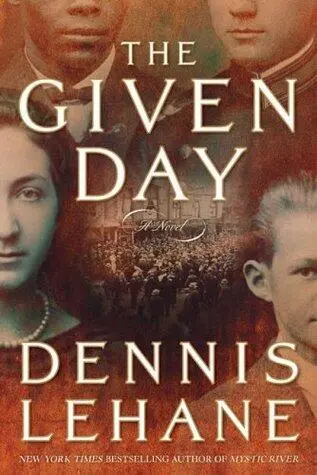
- Название:The Given Day
- Автор:
- Издательство:William Morrow & Company
- Жанр:
- Год:2008
- ISBN:9780688163181
- Рейтинг книги:4 / 5. Голосов: 1
-
Избранное:Добавить в избранное
- Отзывы:
-
Ваша оценка:
The Given Day: краткое содержание, описание и аннотация
Предлагаем к чтению аннотацию, описание, краткое содержание или предисловие (зависит от того, что написал сам автор книги «The Given Day»). Если вы не нашли необходимую информацию о книге — напишите в комментариях, мы постараемся отыскать её.
The Given Day — читать онлайн бесплатно полную книгу (весь текст) целиком
Ниже представлен текст книги, разбитый по страницам. Система сохранения места последней прочитанной страницы, позволяет с удобством читать онлайн бесплатно книгу «The Given Day», без необходимости каждый раз заново искать на чём Вы остановились. Поставьте закладку, и сможете в любой момент перейти на страницу, на которой закончили чтение.
Интервал:
Закладка:
“I’m going to read it upstairs,” he said.
Yvette patted his hand. “Just promise me you won’t jump.”
Luther laughed, the sound coming out high, like something that had been popped. “I … I won’t, ma’am.”
As he climbed the stairs, terror struck him. Terror that Yvette was wrong, that plenty of women wrote to say good-bye. He thought of folding the letter and putting it into his pocket and not reading it for a while. Until he was stronger, say. But even as the thought occurred to him he knew he had a better chance of waking up white tomorrow than waking up with that envelope still sealed.
He stepped out onto the roof and stood with his head down for a moment. He didn’t pray, but he didn’t quite not-pray either. He kept his head lowered and closed his eyes and let his fear wash over him, his horror at being without her for life.
Please don’t hurt me, he thought, and opened the envelope carefully and just as carefully pulled out her letter. Please don’t. He held it between the thumb and index finger of each hand, letting the night breeze dry his eyes, and then he unfolded it:
Dear Luther,
It is cold here. I now wash laundry for folks that send it down from Detroit Avenue in big gray bags. It is a kindness I can thank Aunt Marta for since I know folks can get there laundry cleaned any old way. Aunt Marta and Uncle James have been my salvation and I know the Lord works through them. They said to tell you they wish you well—
Luther smiled, doubting all hell out of that.
— and hope you are all right. My belly is big. It is a boy Aunt Marta says for my belly points to the right. I feel this to. His feet are big and kicking. He will look like you he will need you to be his daddy. You have to find your way home.
Lila. Your wife.Luther read it six more times before he could say for sure that he took a breath. No matter how many times he closed his eyes and opened them in hopes she had signed it “Love,” that word did not appear on the page.
And yet … You have to find your way home and he will need you to be his daddy and Dear Luther and most important … Your wife .
Your wife.
He looked back at the letter. He unfolded it again. Held it taut between his fingers.
You have to find your way home.
Yes, ma’am.
Dear Luther.
Dear Lila.
Your wife.
Your husband.
Babe Ruth and the white ball
Chapter twenty-four
At noon on the fifteenth of January, 1919, the United States Industrial Alcohol company’s molasses tank exploded in the North End. A vagrant child, standing beneath the tank, was vaporized, and the molasses flooded into the heart of the slum in waves three stories high. Buildings were heaved to the side as if by a callous hand. The railway trestle that ran along Commercial was hit with a scrap of metal the size of a truck. The center of the trestle collapsed. A firehouse was hurled across a city square and turned on its end. One fireman perished, a dozen were injured. The cause of the explosion was not immediately clear, but Mayor Andrew Peters, the first politician to arrive on the scene, stated that there was little doubt terrorists were to blame.
Babe Ruth read every newspaper account he could lay his mitts on. He skipped any long stretches where words like municipal and infrastructure were commonly used, but otherwise it tickled him to his core. Astounded him. Molasses! Two million gallons! Fifty-foot waves! The streets of the North End, closed off to automobiles, carts, and horses, stole the shoes of those who tried to walk them. Flies battled for pavement in swarms as dark and thick as candied apples. In the plaza behind the city stables, dozens of horses had been maimed by rivets that had flown like bullets from the exploding tank. They’d been found mired in the muck, neighing hideously, unable to rise from the sticky mess. In the middle of that afternoon, forty-five police gunshots punctuated their execution like the last blasts of a fireworks show. The dead horses were lifted by cranes and placed on the flatbeds of trucks and transported to a glue factory in Somerville. By the fourth day, the molasses had turned to black marble and residents walked with their hands pressed to walls and streetlamp poles.
Seventeen confirmed dead now and hundreds injured. Good God — the looks that must have been on their faces when they turned and saw those black waves curl up by the sun. Babe sat at the soda counter in Igoe’s Drugstore and Creamery in Codman Square waiting for his agent, Johnny Igoe. Johnny was in the back, primping for their meeting with A. L. Ulmerton, probably going too heavy on the petroleum jelly, the cologne, the toilet water. A. L. Ulmerton was the big cheese of Old Gold cigarettes (“Not a cough in a carload!”) and he wanted to talk to Babe about possible endorsements. And now Johnny was going to make them late with his showgirl fussing in back.
Babe didn’t really mind, though, because it gave him time to leaf through more stories on the flood and the immediate response to it: the crackdown on all radicals or subversives who might have been involved. Agents of the Bureau of Investigation and officers of the Boston Police Department had kicked down doors at the headquarters of the Lettish Workingman’s Society, the Boston chapter of the IWW, and Reed and Larkin’s Left Wing of the Socialist Party. They filled holding pens across the city and sent the overflow to the Charles Street Jail.
At Suffolk County Superior Court, sixty-five suspected subversives were brought before Judge Wendell Trout. Trout ordered the police to release all who had not been formally charged with a crime, but signed eighteen deportation orders for those who could prove no U.S. citizenship. Dozens more were held pending Justice Department review of their immigration status and criminal history, actions Babe found perfectly reasonable, though some others did not. When the labor lawyer James Vahey, twice a Democratic candidate for governor of the Commonwealth, argued before the federal magistrate that internment of men who had not been charged with a crime was an affront to the Constitution, he was upbraided for his harsh tone and the cases were continued until February.
In this morning’s Traveler, they’d compiled a photo essay that took up pages four through seven. Even though authorities weren’t confirming yet whether their wide net had caught the terrorists responsible, and that made Babe mad, the anger flared only for the briefest moment before it was tamped out by a delicious, itchy trill that thumped the top of his spine as he marveled at the sheer wreckage of it: a whole neighborhood smashed and tossed and smothered in the black-iron slathering of that liquid mass. Pictures of the crumpled firehouse were followed by one of bodies stacked along Commercial like loaves of brown bread and another of two Red Cross workers leaning against an ambulance, one of them with a hand over his face and a cigarette between his lips. There was a shot of the firemen forming a relay line to remove the rubble and get to their men. A dead pig in the middle of a piazza. An old man sitting on a stoop, resting the side of his head on a dripping-brown hand. A dead-end street with the brown current up to the door knockers, stones and wood and glass floating on the surface. And the people — the cops and firemen and Red Cross and doctors and immigrants in their shawls and bowlers, everyone with the same look on their faces: how the fuck did this happen?
Babe saw that look on people’s faces a lot lately. Not for any particular reason, either. Just in general. It was like they were all walking through this crazy world, trying to keep pace but knowing they couldn’t, they just couldn’t. So part of them waited for that world to come back up behind them on a second try and just roll right over them, send them — finally — on into the next one.
Читать дальшеИнтервал:
Закладка:
Похожие книги на «The Given Day»
Представляем Вашему вниманию похожие книги на «The Given Day» списком для выбора. Мы отобрали схожую по названию и смыслу литературу в надежде предоставить читателям больше вариантов отыскать новые, интересные, ещё непрочитанные произведения.









Обсуждение, отзывы о книге «The Given Day» и просто собственные мнения читателей. Оставьте ваши комментарии, напишите, что Вы думаете о произведении, его смысле или главных героях. Укажите что конкретно понравилось, а что нет, и почему Вы так считаете.