Dennis Lehane - The Given Day
Здесь есть возможность читать онлайн «Dennis Lehane - The Given Day» весь текст электронной книги совершенно бесплатно (целиком полную версию без сокращений). В некоторых случаях можно слушать аудио, скачать через торрент в формате fb2 и присутствует краткое содержание. Год выпуска: 2008, ISBN: 2008, Издательство: William Morrow & Company, Жанр: Историческая проза, Полицейский детектив, на английском языке. Описание произведения, (предисловие) а так же отзывы посетителей доступны на портале библиотеки ЛибКат.
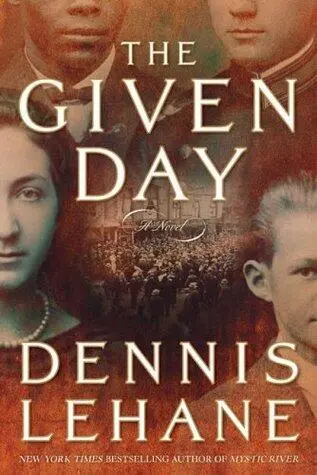
- Название:The Given Day
- Автор:
- Издательство:William Morrow & Company
- Жанр:
- Год:2008
- ISBN:9780688163181
- Рейтинг книги:4 / 5. Голосов: 1
-
Избранное:Добавить в избранное
- Отзывы:
-
Ваша оценка:
The Given Day: краткое содержание, описание и аннотация
Предлагаем к чтению аннотацию, описание, краткое содержание или предисловие (зависит от того, что написал сам автор книги «The Given Day»). Если вы не нашли необходимую информацию о книге — напишите в комментариях, мы постараемся отыскать её.
The Given Day — читать онлайн бесплатно полную книгу (весь текст) целиком
Ниже представлен текст книги, разбитый по страницам. Система сохранения места последней прочитанной страницы, позволяет с удобством читать онлайн бесплатно книгу «The Given Day», без необходимости каждый раз заново искать на чём Вы остановились. Поставьте закладку, и сможете в любой момент перейти на страницу, на которой закончили чтение.
Интервал:
Закладка:
“Cough-lin! Cough-lin! Cough-lin!”
He found Mark Denton’s face in the crowd and saw a grim smile there, a confirmation of something, of previously held suspicions maybe, of fate.
“Cough-lin! Cough-lin! Cough-lin!”
“To Stephen O’Meara!” Danny shouted, raising his glass again to a ghost, to an idea. “And to his dream!”
When he stepped away from the megaphone, the men besieged him. Several even tried to lift him above the fray. It took him ten minutes to reach Mark Denton, who placed a fresh beer in his hand and leaned in to shout into his ear above the crowd noise. “You set a hell of a table.”
“Thanks,” Danny shouted back.
“You’re welcome.” Mark’s smile was taut. He leaned in again. “What happens if we don’t deliver, Dan? You thought of that? What happens?”
Danny looked out at the men, their faces sheened with sweat, several reaching past Mark to slap at Danny’s shoulder, to raise their glasses to him. Exhilarating? Hell, it made him feel like kings must feel. Kings and generals and lions.
“We’ll deliver,” he shouted back at Mark.
“I sure as hell hope so.”
Danny had a drink with Eddie McKenna at the Parker House a few days later, the two of them lucky to find chairs by the hearth on a bitter evening of black gusts and shuddering window frames. “Any news on the new commissioner?”
McKenna fingered his coaster. “Ah, he’s a lackey for the fucking Brahmins, through and through. A purple-veined whore wearing virgin’s clothes, he is. You know he went after Cardinal O’Connell himself last year?”
“What?”
McKenna nodded. “Sponsored a bill at the last Republican Convention to pull all public funding from parochial schools.” He raised his eyebrows. “They can’t take our heritage, they go after our religion. Nothing’s sacred to these Haves. Nothing.”
“So the likelihood of a raise …”
“The raise is not something I’d concern myself with for a bit.”
Danny thought of all the men in Fay Hall the other morning chanting his name and he resisted the urge to punch something. They’d been so close. So close.
Danny said, “I got a meeting with Curtis and the mayor in three days.”
McKenna shook his head. “There’s only one thing to do during regime change — keep your head down.”
“What if I can’t?”
“Ready it for a new hole.”
Danny and Mark Denton met to discuss strategy for their morning meeting with Mayor Peters and Commissioner Curtis. They sat at one of the tables in the back of the Blackstone Saloon on Congress Street. It was a dive, a well-known cops’ bar where the other men, sensing that Mark and Danny held keys to their fate, left them alone.
“A raise of two hundred a year is no longer enough,” Mark said.
“I know,” Danny said. Cost of living had risen so dramatically in the last six months that all that prewar figure would do was restore the men to the poverty level. “What if we come in asking for three hundred?”
Mark rubbed his forehead. “It’s tricky. They could get to the press before us and say we’re greedy. And Montreal definitely hasn’t helped our bargaining position.”
Danny reached through the stack of papers Denton had fanned across the table. “But the numbers bear us out.” He lifted the article he’d clipped from last week’s Traveler on the leaps in the prices of coal, oil, milk, and public transportation.
“But if we ask for three hundred when they’re still digging in their heels on two?”
Danny sighed and rubbed his own forehead. “Let’s just throw it on the table. When they balk, we can come down to two-fifty for veterans, two-ten for new recruits, start building a scale.”
Mark took a sip of his beer, the worst in the city, but also the cheapest. He rubbed the foam off his upper lip with the back of his hand and glanced at the Traveler clipping again. “Might work, might work. What if they flat out rebuff us? They say there’s no money, none, zip?”
“Then we have to come at them on the company-store issue. Ask if they think it’s right that policemen have to pay for their own uniforms and greatcoats and guns and bullets. Ask them how they expect a first-year patrolman working for the 1905 wage and paying for his own equipment to feed his children.”
“I like the children.” Mark gave him a wry smile. “Be ready to play that up if we meet any reporters on the way out and it hasn’t gone our way.”
Danny nodded. “Another thing? We’ve got to bring the average workweek down by ten hours and get time-and-a-half for all special details. The president’s coming back through here in a month, right? Getting off the boat from France and parading right through these streets. You know they’re going to put every cop on that regardless of what he’s already worked that week. Let’s demand time-and-a-half starting there.”
“We’re going to put their backs up with that.”
“Exactly. And once their backs are up, we say we’ll forgo all these demands if they just give us the raise they promised plus the cost-of-living increase.”
Mark stewed on that, sipping his beer, looking out at the snow falling past the graying windows of late afternoon. “We’ve got to hit them with the health-code violations, too,” he said. “I saw rats at the Oh-Nine the other night looked like bullets wouldn’t stun them. We hit them with that, the company-store thing, and the special details?” He sat back. “Yeah, I think you’re right.” He clinked his glass off Danny’s. “Now remember something — they will not say yes tomorrow. They’ll hem and haw. When we meet the press afterward, we act conciliatory. We say some progress has been made. But we also call attention to the issues. We mention that Peters and Curtis are fine men who are honestly trying to help us with the company-store problem. To which the reporters will say …?”
“What company-store problem?” Danny smiled, seeing it now.
“Precisely. Same thing on the cost of living. ‘Well, we know Mayor Peters surely hopes to address the disparity between what the men earn and the high price of coal.’”
“Coal’s good,” Danny said, “but it’s still a bit abstract. The children are our aces.”
Mark chuckled. “You’re getting a real feel for this.”
“Lest we forget” — Danny raised his glass — “I am my father’s son.”
In the morning he dressed in his only suit, one Nora had picked out during their secret days of courting in ’17. It was dark blue, a French-back, double-breasted pinstripe and, given the weight he’d lost trying to look like a hungry Bolshevik, too big for him. Still, once he added his hat and ran his fingers along the welt-edge brim to get the curl the way he wanted it, he looked smart, dapper even. As he fiddled with his high collar and made the knot in his tie a little wider to compensate for the gap between the collar and his throat, he practiced somber looks in the mirror, serious looks. He worried he looked too dapper, too much the young rake. Would Curtis and Peters take him seriously? He removed the hat and furrowed his brow. He opened and closed his suit jacket several times. He decided it looked best closed. He practiced the brow-furrow again. He added more Macassar oil to his hair and put the hat back on.
He walked to headquarters at Pemberton Square. It was a beautiful morning, cold but windless, the sky a bright band of steel and the air smelling of chimney smoke, melting snow, hot brick, and roast fowl.
He ran into Mark Denton coming along School Street. They smiled. They nodded. They walked up onto Beacon Hill together.
“Nervous?” Danny asked.
“A bit,” Mark said. “I left Emma and the kids home alone on Christmas morning, so it better be for something. How about you?”
Читать дальшеИнтервал:
Закладка:
Похожие книги на «The Given Day»
Представляем Вашему вниманию похожие книги на «The Given Day» списком для выбора. Мы отобрали схожую по названию и смыслу литературу в надежде предоставить читателям больше вариантов отыскать новые, интересные, ещё непрочитанные произведения.








Обсуждение, отзывы о книге «The Given Day» и просто собственные мнения читателей. Оставьте ваши комментарии, напишите, что Вы думаете о произведении, его смысле или главных героях. Укажите что конкретно понравилось, а что нет, и почему Вы так считаете.