James Salter - Cassada
Здесь есть возможность читать онлайн «James Salter - Cassada» весь текст электронной книги совершенно бесплатно (целиком полную версию без сокращений). В некоторых случаях можно слушать аудио, скачать через торрент в формате fb2 и присутствует краткое содержание. Город: Berkeley, Год выпуска: 2000, ISBN: 2000, Издательство: Counterpoint, Жанр: Историческая проза, на английском языке. Описание произведения, (предисловие) а так же отзывы посетителей доступны на портале библиотеки ЛибКат.
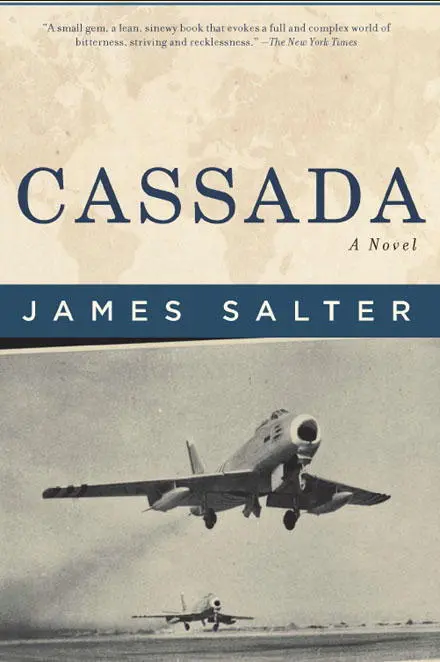
- Название:Cassada
- Автор:
- Издательство:Counterpoint
- Жанр:
- Год:2000
- Город:Berkeley
- ISBN:978-1-61902-129-7
- Рейтинг книги:5 / 5. Голосов: 1
-
Избранное:Добавить в избранное
- Отзывы:
-
Ваша оценка:
Cassada: краткое содержание, описание и аннотация
Предлагаем к чтению аннотацию, описание, краткое содержание или предисловие (зависит от того, что написал сам автор книги «Cassada»). Если вы не нашли необходимую информацию о книге — напишите в комментариях, мы постараемся отыскать её.
, Salter captures the strange comradeship of loneliness, trust, and alienation among military men ready to sacrifice all in the name of duty and pride.
After futile attempts at ordinary revision, Salter elected to begin with a blank page, to compose an entirely new novel based upon the characters and events of his second long unavailable novel,
. The result,
, is a masterpiece.
Cassada — читать онлайн бесплатно полную книгу (весь текст) целиком
Ниже представлен текст книги, разбитый по страницам. Система сохранения места последней прочитанной страницы, позволяет с удобством читать онлайн бесплатно книгу «Cassada», без необходимости каждый раз заново искать на чём Вы остановились. Поставьте закладку, и сможете в любой момент перейти на страницу, на которой закончили чтение.
Интервал:
Закладка:
All of it echoed the war that had been fought here, not so many years earlier, along the narrow band of desert near the sea. The same brown tents, the sun, the dust, the overriding focus. In all likelihood the same bus, a tilting wreck with an Arab driver and no fixed schedule. Usually it would leave just when someone was coming to board or running towards it. The driver, a hand on the door lever, would start the engine in no apparent hurry and, as if unable to hear the shouts, swing the door shut and drive off. Twenty minutes later, sometimes more, at the far end of the parking area, white dust rising behind, the bus would return, the brakes squealing as it slowly came to a stop.
Struggling with their bags, pilots climbed aboard and lurched down the aisle. In the back, Grace sat down near Wickenden.
“Five dollars a man, what do you say?”
Wickenden shook his head.
“Five dollars, the same as last time. That’s fair enough.”
Wickenden only smiled a little, like a man reading a book.
“How about it?” Grace said. “That’s reasonable. What’s wrong? Don’t you think you can outshoot us?”
Harlan, grinning, turned in his seat. Wickenden looked out the window.
“Don’t you have any confidence in your boys?”
“I have confidence in them,” Wickenden said. “More than I have in yours.”
“OK then.”
“I also have a new man who’s never fired before.”
“Who? Cassada?” He had not flown a plane down. He was coming, with several others, in a transport. “Hell, he’ll probably make expert,” Grace said.
“I’m sure.”
The bus was full. “Hey, driver,” they were beginning to call, “let’s go!”
“I’m just as bad off,” Grace said. “I’ve got Fergy.”
“He’s an experienced man,” Wickenden countered wearily.
“You’re damned right!” Ferguson called out.
“You know yourself,” Grace went on, ignoring this, “that it’s usually two weeks before he can even find the tow ship much less get hits.”
“That was one day when the visibility was lousy!” Ferguson called.
“Driver! Let’s go!” they were shouting.
The driver sat with his hands in his lap. He was wearing the jacket from a blue suit, chalky and worn. It looked as if he’d been carrying bags of flour. He sat staring ahead as if that were his only duty.
“Then it’s another two weeks before you can get him to come in any closer than fifteen hundred feet,” Grace went on. “You know that.” He had a white spot of bone in his nose that gleamed when he smiled.
“Driver! Let’s go!”
“You’re no worse off than I am,” Grace said.
Wickenden’s mouth was set in a line.
“Everybody else is willing. Reeves is, I know.”
Silence.
“How about it?”
Instead of answering, Wickenden raised his hands to his mouth and in a surprisingly powerful voice commanded, “Let’s get going, driver!”
As if in response the driver bent forward and lazily turned the ignition key. The engine started. With a jolt the bus began to move.
Grace had given up. Most of it had only been for show; he knew Wickenden wouldn’t gamble—too humiliating if he lost. Wickenden liked to read military history. He could explain that the essence of generalship was to fight only when you were thoroughly prepared and certain you could win. Maybe that was what they taught them up there, Grace thought. It certainly wasn’t like the ROTC.
Chapter III
These were the days, the airplanes clean—without external tanks—at their fastest and most maneuverable, the maintenance hardworking, weather flawless, the competition intense. In North Africa it was gunnery and only gunnery. The first tow ship took off early at eight, climbing at a steep angle with the target, a long, fabric panel, trailing behind. A few minutes later the first flight of firing ships, trim as hornets, followed.
Isbell was leading. The three others were in string, behind. They hadn’t spotted the tow ship yet. Finally they found it crossing the shoreline, insect small, and circled above watching it over the dark water, slow, deliberate, like a ship sailing to Malta with, instead of wake, the dash of white behind.
The sun was always bad early in the day, naked and low, the reflections drifting across the windshield glass. Sometimes they blanked out the target, even the tow ship, in sky that had a soft blue cast to it, the light pale and lacking contrast. But it was smooth then. The air was still. Not a tremor.
Banking from side to side, hand held up to block the sun, Isbell kept the tow ship in sight. The familiar excitement mounting within, he watched it reach altitude and roll out on course.
“Red Tow on station, on course.”
“We have you in sight, Red.”
“Roger. You’re cleared in to fire.”
Isbell led them alongside, several thousand feet above.
“Lead in,” he called and started down towards the strip of white, an inch long it seemed.
The tow ship was at twenty thousand feet, ten or fifteen miles from shore, red desert to the south, hard blue sea below. There was a full, damp quality to the air. Long streamers curved through it marking one’s path. All unhurried, all unalterable. There was a rhythm, mostly of pauses but regular, like section hands driving a spike.
“Two in,” Phipps called.
Isbell had reversed his turn and was coming in from the rear of the target which shone in the light like a grail. His gunsight had locked on. His speed was increasing. He quickly checked it, three forty. He could feel the G’s as he held the turn and then, in a rush, the climax when he was in range for a second or two with the target suddenly expanding in size until the final instant when he broke off.
“Lead off,” he called.
“Three in,” he heard and as he was climbing back up, “Two off.”
He had not fired on the initial pass, but on the five following ones, all just so, not a single bad one, bursts of about a second, long and even. He was getting hits, he was sure of it. It felt exactly right. The ship seemed firm under his hand, obedient to the last moment, the white rectangle slowly enlarging, not much at first then faster and faster like an express going by. The bullets left traces of smoke as they vanished into the cloth.
If the sight was any good, that was the only thing. When the aircraft were listed he had given Cassada his choice, then Phipps, then Harlan. He had taken the one that was left.
“I have a feeling I’m going to hit today,” Cassada had said.
“Glad to hear it.”
“I just have the feeling.”
On the way back, as they were joining up, Isbell asked, “Red Four? How’d you do?”
“I got hits,” Cassada said confidently.
They came in over the bay, the boats at anchor beneath them, the buoys, and turned just short of the city, white in the early day, to line up with the runway five miles off. Isbell looked to the side. They were in echelon, one motionless canopy beyond the other.
“Red Lead,” he called as he whipped to the side, “on the break.”
After debriefing they stood around and waited for the tow ship to come back. Harlan had picked up some pebbles and was shaking them in his fist.
“How’d you do?” Isbell asked.
Harlan shrugged. “All right, I guess.”
“What color were you firing?”
The heads of the bullets were dipped in paint to identify who had fired them.
“Blue,” Harlan said.
“Yellow,” Cassada murmured, almost to himself, as if to cards or dice.
Along the far side of the runway, the tow ship came in sight, flying low, ready to drop.
“What color did you say?” Isbell asked.
“Yellow,” Cassada repeated.
A truck came from the direction of the runway, the dust rising. It pulled up and the bundled target was thrown off. It was unrolled and hung lengthwise on the scoring board. Isbell was at the tail end hooking the nails through. The end was slightly frayed but it was still almost full length, twenty-eight feet. They stood with the first look at it. There were red and blue spread through it and one burst of green in front near the bar, but no yellow.
Читать дальшеИнтервал:
Закладка:
Похожие книги на «Cassada»
Представляем Вашему вниманию похожие книги на «Cassada» списком для выбора. Мы отобрали схожую по названию и смыслу литературу в надежде предоставить читателям больше вариантов отыскать новые, интересные, ещё непрочитанные произведения.



Обсуждение, отзывы о книге «Cassada» и просто собственные мнения читателей. Оставьте ваши комментарии, напишите, что Вы думаете о произведении, его смысле или главных героях. Укажите что конкретно понравилось, а что нет, и почему Вы так считаете.