Stewart Binns - Anarchy
Здесь есть возможность читать онлайн «Stewart Binns - Anarchy» весь текст электронной книги совершенно бесплатно (целиком полную версию без сокращений). В некоторых случаях можно слушать аудио, скачать через торрент в формате fb2 и присутствует краткое содержание. Город: London, Год выпуска: 2013, ISBN: 2013, Издательство: Penguin Books, Жанр: Историческая проза, на английском языке. Описание произведения, (предисловие) а так же отзывы посетителей доступны на портале библиотеки ЛибКат.
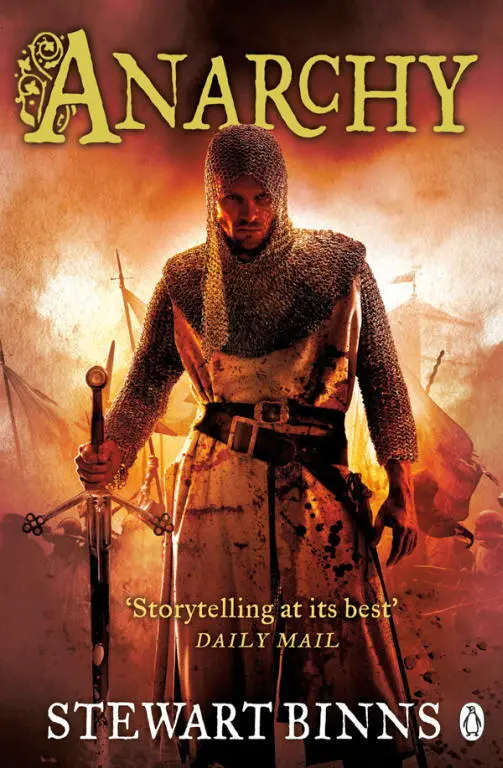
- Название:Anarchy
- Автор:
- Издательство:Penguin Books
- Жанр:
- Год:2013
- Город:London
- ISBN:978-0-718-19460-4
- Рейтинг книги:3 / 5. Голосов: 1
-
Избранное:Добавить в избранное
- Отзывы:
-
Ваша оценка:
Anarchy: краткое содержание, описание и аннотация
Предлагаем к чтению аннотацию, описание, краткое содержание или предисловие (зависит от того, что написал сам автор книги «Anarchy»). Если вы не нашли необходимую информацию о книге — напишите в комментариях, мы постараемся отыскать её.
The Making of England
Ruthless brutality, greed and ambition:
The year is 1186, the thirty-second year of the reign of Henry II.
Gilbert Foliot, Bishop of London, has lived through long Henry’s reign and that of his grandfather, Henry I. He has witnessed the terrifying civil war between Henry II’s mother, the Empress Matilda, and her cousin, Stephen; a time so traumatic it becomes known as the Anarchy.
The greatest letter writer of the 12th Century, Folio gives an intimate account of one of England’s most troubled eras. Central to his account is the life of a knight he first met over fifty years earlier, Harold of Hereford.
Harold’s life is an intriguing microcosm of the times. Born of noble blood and legendary lineage, he is one of the nine founders of the Knights Templar and a survivor of the fearsome battles of the Crusader States in the Holy Land.
Harold is loyal warrior in the cause of the Empress Matilda. On his broad shoulders, Harold carries the legacy of England’s past and its dormant hopes for the future.
Stewart Binns’
is a gripping novel in the great tradition of Conn Iggulden and Bernard Cornwell, and is the third in
trilogy, following
and
.
Anarchy — читать онлайн бесплатно полную книгу (весь текст) целиком
Ниже представлен текст книги, разбитый по страницам. Система сохранения места последней прочитанной страницы, позволяет с удобством читать онлайн бесплатно книгу «Anarchy», без необходимости каждый раз заново искать на чём Вы остановились. Поставьте закладку, и сможете в любой момент перейти на страницу, на которой закончили чтение.
Интервал:
Закладка:
Just as I was about to leave Maud’s chamber, Greta appeared with news that Count Geoffrey would like to see us. Even though the conversation was certain to be a difficult one, we had no choice but to agree.
Geoffrey conducted the discussion without rancour – a reflection of his increasing maturity and the pragmatism with which he approached his wife’s campaign.
‘I thought it best that the three of us speak together – to avoid any misunderstanding, or bad blood.’
He walked over to the window and stared out towards the town of Argentan below. He had grown taller and filled out since the early days of his marriage to Maud; he now looked every inch the noble warrior.
‘We can only win this fight together, so we must have an understanding.’
I glanced at Maud, who was looking pensive. She started to walk over towards Geoffrey, but he put his hand up to stop her. Then he drew a deep breath.
‘Of course, you humiliated me as a boy when you ran home to your father…’
He paused. These were traumatic memories for him.
‘But you came back. I am thankful for that–’
He stopped abruptly and flashed a despairing look at Maud.
‘I was too young. Perhaps it could work now, but it’s too late – you are now with your lover, the “noble” Earl of Huntingdon.’
He turned to me; there was no doubting the scorn in his eyes.
‘What a wicked web you have woven.’
Maud interrupted before I could speak.
‘Don’t blame Hal, blame me! It wasn’t easy for me, either. Like you, I was a pawn in my father’s game.’
Geoffrey’s face softened. He understood Maud’s position only too well.
‘We are all pawns in our fathers’ games. But I have no reason for bitterness – I have my two sons, and Henry will one day be King of England and Duke of Normandy. Through me, he will rule lands that will extend his realm far to the west and south. His will be a realm to rival the Holy Roman Empire. I will do everything I can to keep him safe until that day dawns.’
He looked at me – but this time, if not with warmth, at least with less hostility.
‘I surmise that the new baby is yours; I’m glad he will be called William, it is a good name. But we must, for everybody’s sake, treat the three boys exactly the same, as if they are all mine. There must be no doubt about the integrity of our family’s heritage. Do you agree?’
‘I do.’
Maud grabbed Geoffrey’s arm.
‘We must hold firm, all three of us – for the sake of the boys and for a future Anglo-Norman domain.’
Maud and Geoffrey embraced warmly. I offered him my hand, which he accepted before bidding us farewell.
‘Until September. I entrust the boys to your care; look after them.’
Maud and I slumped into our chairs after he left. She had tears in her eyes as she spoke.
‘He’s right; we have woven a wicked web. Will God ever forgive us?’
‘For which sin? For our adultery, and for conceiving Henry and little Geoffrey? Or for letting your husband think he is their father?’
My stark summary was too much for Maud, who collapsed in convulsions of anguish.
‘I am a wicked woman, God will never forgive me.’
I cradled her in my arms and rocked her like an infant.
‘God will judge you at the end of your journey, not halfway through. Wait until we reach the end of the road before judging yourself.’
I too felt pangs of guilt for my selfish duplicity. It had been easier when Geoffrey was a callow youth. But now he was a man who had developed many admirable qualities, and he was also a crucial ally. I looked at the Talisman around Maud’s neck. Our journey still had a long way to go before we reached the end. I hoped that our actions, although sinful and selfish, may prove to be vindicated – at least, to us.
26. Battle of the Standard
Count Geoffrey launched his campaign in Normandy on 21 September 1136. Maud was in the vanguard of the army whenever it was safe, looking magnificent in her long flowing cape of red velvet. Underneath her cape she wore a red leather jerkin, with cavalry leggings and boots. Over a plain white silk wimple and veil she fixed a small gold ducal coronet, which we acquired from the monks at Mont St Michel. Although she had neither armour nor weapons, she carried a jewel-encrusted mace, which she held aloft through every village, town and city we entered.
I was very proud of her. She looked like the warriors of fable: the great Zenobia, Queen of Palmyra, or the legendary Boudicca, Queen of the Iceni. She inspired confidence in our men, and she commanded respect everywhere we went.
Our army was small but mobile: 80 knights, 150 cavalry, 100 archers and crossbowmen, and 200 infantry. Geoffrey’s strategy was simple. He relied on speed of movement, swiftness of action and maximum disruption. It was not the most wholesome form of warfare; intimidation until submission was the main objective. This involved wholesale looting and burning, with harsh reprisals for anyone who resisted.
When a fortification fell, its lord had to either declare a humiliating surrender and accept Duchess Matilda as his liege lady, or face execution, the destruction of his castle and the sequestration of his land and property. Few resisted. But when they did, Geoffrey did not hesitate to act ruthlessly.
The campaigning continued throughout the winter of 1136 and into the spring of 1137. Eventually, the harassment achieved its objective. In March 1137, Stephen brought an army across the Channel, landing at Saint-Vaast-la-Hougue on the Cotentin Peninsular, from where he marched south. It was a large force, made up mainly of Flemish mercenaries, and it was rumoured that he had almost emptied his treasury to pay for them. His objective was simple: to intercept our army and put an end to our challenge to his throne.
The battle never came. Stephen had some success in the Cotentin, but his Flemish mercenaries soon became difficult to control. A dispute over a butt of wine led to a mass brawl and fighting broke out wholesale between the Flemish and English contingents. Then, with morale plummeting, the bloody flux infected Stephen’s army and he had to order his entire force to retreat. As one witness put it – in explicit detail – the army left in its wake a trail of diarrhoea across the Norman countryside as wide as a tilt yard.
Stephen turned back towards home and, with his tail between his legs, embarked for England, furious and frustrated. The first part of our plan had been successful. Geoffrey could now be left to take Normandy in hand, while Maud and I could return to Argentan to plan our campaign in England.
The year 1138 offered renewed optimism for our cause. King David of Scotland intensified his punitive raids into the north of England, letting loose his more ferocious highland kinsmen on the wretched English burghs and monasteries. Maud was upset to hear of some of the brutality and desecration being committed in her name and sent messages to her uncle pleading for moderation. But she had asked him to release his dogs of war and, once off the leash, they were difficult to control.
In the spring, Robert of Gloucester played his decisive opening gambit. With Stephen humiliated in Normandy and King David causing unrest in the north, he instigated challenges to Stephen among several lords along the Welsh Marches and in the south-west. Stephen took the bait and headed west with a large force. Castles were besieged and surrendered as the King went round the country putting out the fires of dissent. Earl Robert’s tactic was working perfectly. Although the violence was only minor, and the dissent little more than token, the impression created throughout the realm was that King Stephen’s authority was under serious threat.
Читать дальшеИнтервал:
Закладка:
Похожие книги на «Anarchy»
Представляем Вашему вниманию похожие книги на «Anarchy» списком для выбора. Мы отобрали схожую по названию и смыслу литературу в надежде предоставить читателям больше вариантов отыскать новые, интересные, ещё непрочитанные произведения.









Обсуждение, отзывы о книге «Anarchy» и просто собственные мнения читателей. Оставьте ваши комментарии, напишите, что Вы думаете о произведении, его смысле или главных героях. Укажите что конкретно понравилось, а что нет, и почему Вы так считаете.