John Passos - Mr. Wilson's War
Здесь есть возможность читать онлайн «John Passos - Mr. Wilson's War» весь текст электронной книги совершенно бесплатно (целиком полную версию без сокращений). В некоторых случаях можно слушать аудио, скачать через торрент в формате fb2 и присутствует краткое содержание. Год выпуска: 1962, ISBN: 1962, Издательство: Doubleday, Жанр: Историческая проза, Биографии и Мемуары, на английском языке. Описание произведения, (предисловие) а так же отзывы посетителей доступны на портале библиотеки ЛибКат.
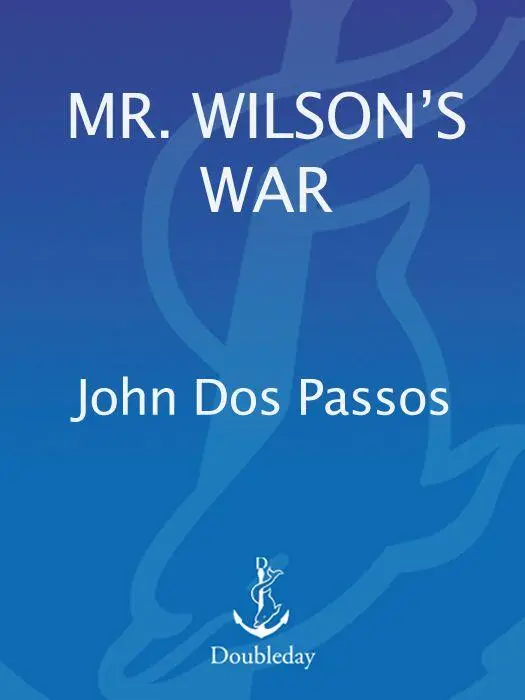
- Название:Mr. Wilson's War
- Автор:
- Издательство:Doubleday
- Жанр:
- Год:1962
- ISBN:9780385028288
- Рейтинг книги:3 / 5. Голосов: 1
-
Избранное:Добавить в избранное
- Отзывы:
-
Ваша оценка:
Mr. Wilson's War: краткое содержание, описание и аннотация
Предлагаем к чтению аннотацию, описание, краткое содержание или предисловие (зависит от того, что написал сам автор книги «Mr. Wilson's War»). Если вы не нашли необходимую информацию о книге — напишите в комментариях, мы постараемся отыскать её.
Foremost in the cast of characters is Woodrow Wilson, the shy, brilliant, revered, and misunderstood “schoolmaster”, whose administration was a complex of apparent contradictions. Wilson had almost no interest in foreign affairs when he was first elected, yet later, in proposing the League of Nations, he was to play a major role in international politics. During his first summer in office, without any…
Mr. Wilson's War — читать онлайн бесплатно полную книгу (весь текст) целиком
Ниже представлен текст книги, разбитый по страницам. Система сохранения места последней прочитанной страницы, позволяет с удобством читать онлайн бесплатно книгу «Mr. Wilson's War», без необходимости каждый раз заново искать на чём Вы остановились. Поставьте закладку, и сможете в любой момент перейти на страницу, на которой закончили чтение.
Интервал:
Закладка:
McAdoo and Lansing, who were trying to get bipartisan support for the war effort, suggested Elihu Root as the eminent figure. Woodrow Wilson for years had considered Senator Root a hidebound reactionary, but his name was somewhat sweetened by a speech he made soon after the declaration of war wholeheartedly backing up the Administration. Mr. Root, who was seventyone, confided in his wife that the last thing in the world he wanted to do was travel ten thousand miles to Petrograd; but that, at a moment when young men were being asked to risk their lives, he felt he could not refuse any service required of him.
Elihu Root was no more ignorant of Russia than anybody else. No man of any political prominence could be found who spoke the language. The few men Lansing was able to consult who had visited the country felt that, with encouragement from the United States and a sizeable loan, the Russians would develop in due time into a proper democracy.
The President’s desk was piled so high with pressing problems he could not give the Russian situation much thought. He did considerable worrying about Socialist representation on the commission. Socialistic agitators were said to be swaying the Russian masses, so he decided that an American Socialist must be sent along to talk to them in their own language. The trouble was that most of the men suggested turned out to be unabashed pacifists. This, in the present mood of the Administration, was equivalent to being pro-German. After a good deal of correspondence, a wellmeaning magazine writer named Charles Edward Russell, who had taken the Woodrow Wilson line in the split which destroyed the American Socialist Party at its spring convention, was invited to go along.
Secretary Baker, possibly feeling that the Chief of Staff’s knowledge of the Indian sign languages would be more useful in Russia than it was proving to be in the War Department, was quite willing to relinquish the services of General Hugh Scott. There was added an admiral; Cyrus McCormick, the grandson of the inventor, whose International Harvester Company was reputed to be popular in the Russian wheatbelt; a vice president of the A.F. of L., a banker, and an inspirational expert from the Young Men’s Christian Association.
These gentlemen received a formal sendoff from the White House and embarked on a special train to Seattle. Mrs. Root saw that two hundred gallons of Poland Water, two cases of Haig & Haig and two hundred and fifty of his favorite cigars packed in a tin box were included in the senator’s baggage, along with some provision of the gargle he used for his sore throats.
To prepare their way Secretary Lansing cabled Ambassador Francis to assure the Provisional Government that: “… the High Commissioners of the United States will present themselves in the confident hope that the Russian Government and people will realize how sincerely the United States hopes for their welfare and desires to share with them in their future endeavours to bring victory to the cause of democracy and human liberty.”
After the train crossed the Missouri River General Scott, who hated desk work at the War Department, was in his element. He listened eagerly as a boy to the wise adages on politics and statesmanship that fell from the lips of Senator Root; and, as the train puffed up the steep grades in the valley of the Yellowstone River, pointed out with shining eyes his old campsites during the Indian wars.
At Seattle, after an ovation from the local patriotic organizations, they put to sea on the old cruiser Buffalo which had been hastily converted into a troop transport. The skipper steered the great circle course so religiously that the Buffalo nearly capsized in the rough waters north of the Aleutians and Mr. Root was thrown out of his bunk. General Scott, who was suffering from seasickness, only clung to his with the greatest difficulty. Finally, after a great detour to avoid an unexpected iceflow off Kamchatka, the Buffalo staggered into the Sea of Japan and, after a fruitless search for a pilot, steamed unannounced into the harbor of Vladivostok.
As no port authorities came out to greet them, the commission went ashore in the Buffalo’s whaleboat and landed with some difficulty on a cobbly beach. There they were met by a gang of rumlooking fellows who claimed to be the port’s revolutionary committee. It was all the commission’s two interpreters could do to convince them that the Americans should be allowed to land. Eventually a Russian general of the old regime appeared and explained that these were eminent guests of the Russian people and that the Czar’s own imperial train was waiting to carry them to Petrograd.
They spent just enough time in Vladivostok to note the universal indecision and disintegration that paralyzed all business. Quantities of war material, paid for out of American loans, was piled up on the docks. There were hundreds of locomotives waiting for mechanics to put them in commission and eight thousand automobiles still in their original crates.
The commissioners spent ten days on the Trans-Siberian Railroad.
General Scott marvelled at the great quantities of waterfowl he saw and wished for a bird dog and shotgun. He enjoyed trying to communicate with the various types of aborigines that crowded the platforms during the long waits in distant stations. He had a knack with primitive peoples. “I’m a firm believer in democracy,” said Mr. Root after walking around one village, “but I don’t like filth.”
It was the middle of June before they reached Petrograd. They were welcomed politely by members of the Provisional Government Senator Root and General Scott were housed in Catherine the Great’s state apartments in the Winter Palace.
Crowds everywhere, soldiers, sailors, workers. No work going on. Wild inflation of the currency. Food getting scarce but no violence. Speeches. “There is no governing power but moral suasion,” Root wrote his wife, “and the entire people seem talking at once.”
Senator Root and the rest of them added to the flow of oratory in a forlorn effort to counter the pacifist propaganda, spread, so they claimed, by thousands of German agents. Among other material, the Germans were distributing cartoons out of the Hearst press that ridiculed Senator Root himself as an old mossback.
Meanwhile General Scott was taken on an inspection tour of military installations. He was horrified by what he saw. The barracks of even the crack regiments of the imperial guard were rough and dirty. The men had no bedding but the single blanket they carried as part of their equipment. Discipline was gone. At the Putilov arms works the manager who was showing Scott around was not allowed into a section of the plant barricaded off for a mass meeting.
General Scott went as far as Tarnopol in Galicia to view the offensive which Kerensky, the loquacious young Socialist lawyer now in complete control of the Provisional Government, ordered Brusilov to attempt, largely to impress the American mission. Scott stumbled around through the wheatfields deafened by the heavy artillery and saw thousands of Austrian prisoners being herded to the rear. The offensive he was told was a success.
Back in Petrograd he noted that the disorganization of the city was worse. Mr, Root was complaining that he couldn’t get a response from Washington to his plea for a hundred thousand dollars to set up an American propaganda agency. Scott found the members of the mission bubbling with enthusiasm for young Kerensky’s energy and magnetism. “Too radically inclined to suit me” was the general’s comment.
Petrograd was being organized but not according to the hopes of the American Mission. They learned that Lenin and Trotsky, two German agents, as they were described, were influencing the soldiers of a machinegun regiment and the workers of the Putilov plant. Already they were said to control most of the workingclass quarters of Petrograd. Senator Root’s advice to Kerensky was to arrest Lenin immediately. “Any government would have arrested, tried, imprisoned and executed him,” he complained in a letter home. General Scott agreed. Kerensky would have been very glad to arrest Comrade Lenin but he couldn’t get his hands on him.
Читать дальшеИнтервал:
Закладка:
Похожие книги на «Mr. Wilson's War»
Представляем Вашему вниманию похожие книги на «Mr. Wilson's War» списком для выбора. Мы отобрали схожую по названию и смыслу литературу в надежде предоставить читателям больше вариантов отыскать новые, интересные, ещё непрочитанные произведения.


Обсуждение, отзывы о книге «Mr. Wilson's War» и просто собственные мнения читателей. Оставьте ваши комментарии, напишите, что Вы думаете о произведении, его смысле или главных героях. Укажите что конкретно понравилось, а что нет, и почему Вы так считаете.