John Passos - Mr. Wilson's War
Здесь есть возможность читать онлайн «John Passos - Mr. Wilson's War» весь текст электронной книги совершенно бесплатно (целиком полную версию без сокращений). В некоторых случаях можно слушать аудио, скачать через торрент в формате fb2 и присутствует краткое содержание. Год выпуска: 1962, ISBN: 1962, Издательство: Doubleday, Жанр: Историческая проза, Биографии и Мемуары, на английском языке. Описание произведения, (предисловие) а так же отзывы посетителей доступны на портале библиотеки ЛибКат.
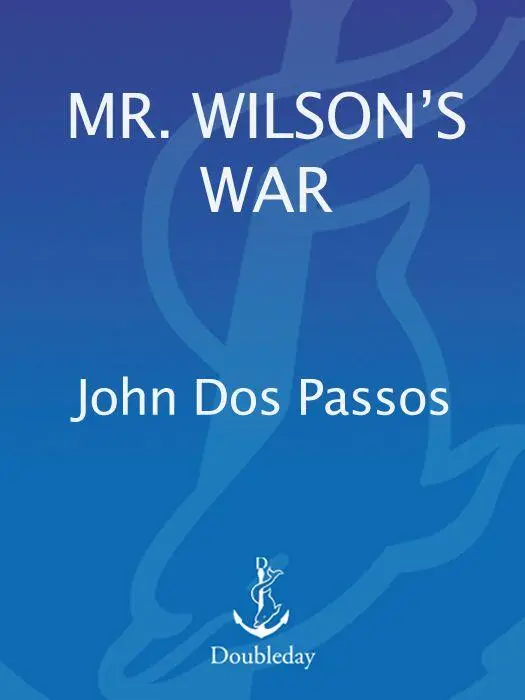
- Название:Mr. Wilson's War
- Автор:
- Издательство:Doubleday
- Жанр:
- Год:1962
- ISBN:9780385028288
- Рейтинг книги:3 / 5. Голосов: 1
-
Избранное:Добавить в избранное
- Отзывы:
-
Ваша оценка:
Mr. Wilson's War: краткое содержание, описание и аннотация
Предлагаем к чтению аннотацию, описание, краткое содержание или предисловие (зависит от того, что написал сам автор книги «Mr. Wilson's War»). Если вы не нашли необходимую информацию о книге — напишите в комментариях, мы постараемся отыскать её.
Foremost in the cast of characters is Woodrow Wilson, the shy, brilliant, revered, and misunderstood “schoolmaster”, whose administration was a complex of apparent contradictions. Wilson had almost no interest in foreign affairs when he was first elected, yet later, in proposing the League of Nations, he was to play a major role in international politics. During his first summer in office, without any…
Mr. Wilson's War — читать онлайн бесплатно полную книгу (весь текст) целиком
Ниже представлен текст книги, разбитый по страницам. Система сохранения места последней прочитанной страницы, позволяет с удобством читать онлайн бесплатно книгу «Mr. Wilson's War», без необходимости каждый раз заново искать на чём Вы остановились. Поставьте закладку, и сможете в любой момент перейти на страницу, на которой закончили чтение.
Интервал:
Закладка:
Pershing knew it was up to him. The War Department had made no preparations. The officers at the War College had been trying to work up a sketchy sort of plan for the supply of troops abroad during the winter, but General Tasker Bliss, alternating as Chief of Staff with the old Indian negotiator Hugh Scott, who was more interested in Indian sign languages than in administrative problems had, the day before Pershing sailed on the Baltic , written on the War College memorandum: “General Pershing’s expedition is being sent abroad on the urgent insistence of Marshal Joffre and the French mission that a force, however small, be sent to produce a moral effect … Our General Staff has made no plan (so far as known to the Secretary of War) for prompt dispatch of reinforcements to General Pershing, nor the prompt dispatch of considerable forces to France … What the French General Staff is now concerned about is the establishment of an important base and line of communication for a much larger force than General Pershing will have. They evidently think that having yielded to the demand for a small force for moral effect, it is quite soon to be followed by a large force for physical effect. Thus far we have no plans for this.”
During his first days in France Pershing learned that he would have to deal not only with procrastination in Washington but with deepseated, if tactfully expressed, opposition among the French and British commands. The French and British wanted American recruits to use — as the British were using the Canadians and Australians and New Zealanders, and as the French were using their colonial troops — to ease the drain on their own manpower in fighting a war of attrition.
If Pershing had been a more imaginative man he would have been appalled by the difficulties of his position. Being a man of single mind he managed to ignore the pressures and embarrassments and hindrances that lurked under the torrents of fair words with which the Allied authorities greeted him on every hand. This was his opportunity to realize the ambitions which had been instilled in him when he entered West Point as a raw young rural schoolteacher without a prospect in the world. His orders were to lead an American Army against the Germans and he intended to carry them out to the letter.
His first business was to pick an objective. Where could an American army be used most effectively “to carry on the war,” in the terms of Secretary Baker’s orders, “vigorously … and towards a victorious conclusion”?
Except for small French and Belgian forces defending the fraction of Belgian soil left free from German occupation, the British under Haig held an entrenched line that stretched south from the channel coast to St. Quentin. Their General Plumer had, early in June, managed somewhat to offset Nivelle’s defeat on the Aisne by a successful mining operation, through which he captured the high ground the Germans held in front of the Flemish village of Messines. Messines was to the right of Ypres, where Haig, on whose patient shoulders the whole weight of holding the Germans back now rested, was planning great efforts for later in the summer. Since the fizzle of the Nivelle plan there had been no further effort to unify the French and British commands.
From St. Quentin east the French armies, riddled by defeatism and mutiny, had tenuous hold — how tenuous the Germans, fortunately for the Allies, did not know — on the trenches and fortifications leading through Soissons to Rheims and Verdun, and on past Nancy to the Swiss border.
It didn’t take Pershing long to discover from his talks with Pétain that the French had no offensive plans on a large scale whatsoever. The most Pétain hoped for was to restore morale to the point of undertaking a local attack of limited risk in the Verdun sector.
Searching the map with fresh eyes Pershing found what he hoped might turn out to be a weak spot in the German position. That was the salient east of Verdun that thrust deep into French territory with its apex at St. Mihiel. Behind that salient was the old French fortress of Metz in Lorraine, which the Germans held as part of their spoil from the Franco-Prussian War.
To the northwest of Metz was a region known as the Bassin de la Briey where the iron ore was mined upon which the Germans depended for a great part of their steel production. To the northeast was the Saar valley which furnished most of their coal. The railroad lines that linked the sources of German raw materials ran roughly east and west An Allied breakthrough into the Bassin de la Briey would deal German industry a fatal blow. From the moment that General Pershing circled the St. Mihiel salient with his pencil on the map the course of the American campaign in France was decided.
Other considerations entered into the choice of the Lorraine front. It was the only region where lines of supply could be established independent of the French communications which all centered on Paris, and of the British, which radiated out from the channel ports. Accordingly Pershing arranged with the French to set up American ports of entry at St. Nazaire at the mouth of the Loire, at La Pallice a little further south on the Bay of Biscay; and at Bassens, across the Garonne river from Bordeaux in the estuary of the Gironde. American money would have to be spent and American labor imported to improve docking and warehousing facilities and to modernize the railroad line which ran up from St. Nazaire and La Pallice to Tours and thence crossed south of Paris in an easterly direction to Chaumont and Neufchâteau, which were small towns near enough the front to furnish staging areas. Another line would feed into the American sector from Bassens and Bordeaux through Issoudun and Bourges. If the need should arise a third route could be utilized up from Marseilles, France’s principal Mediterranean port, through Lyon and Dijon.
“The low morale and worn condition of the Allied armies,” wrote Pershing in the final summing up of his plans, “suggested that they might be unable to protect their communications, and therefore it was essential that we should have our own independent system.”
On June 28 General Pershing went down to St. Nazaire to meet the advance guard of his 1st Division. To everybody’s amazement, the fourteen merchantmen converted to troop transports slipped past the U-boats without a casualty. At lunch aboard the flagship Seattle , Admiral Gleaves, who commanded the convoying cruisers and destroyers, could only attribute their safe arrival to the hand of Providence.
The general, who had been lecturing all and sundry on the need for strict censorship of the news of military movements, was considerably put out by finding detailed descriptions of the landing of the American troops, including names of units and numbers of men, in the British and French newspapers next morning.
He was further disturbed by his inspection of the port facilities at St. Nazaire. Though they were reputed to be among the best in Europe, Pershing found the docks archaic. There was no warehouse space. Each freightcar shunting out from the loading area had to be turned by hand on a turntable. Neither the longshoremen nor the railroad workers nor the port officials showed the least intention of giving up their leisurely ways. Frenchmen just would not be hurried. American officers handling cargo were in despair. “All of us” wrote Pershing, philosophically, “were destined to experience many discouragements before the end of the war, in our efforts to improve conditions, both here and elsewhere.”
He set the marines to helping a detail of Negro stevedores handle cargo. Somehow the railroads were put in motion. By the time the distractions and celebrations of the Fourth of July interrupted the labors of his staff at Paris headquarters, the quais of the old port of St. Nazaire were humming with unaccustomed activity and something like twelve thousand troops were on their way in French boxcars (forty men eight horses) to a training area at Gondrecourt in the bleak Burgundian hills north of Chaumont. The smartestlooking detachment that could be found was routed through Paris to be shown to the Parisians on Independence Day.
Читать дальшеИнтервал:
Закладка:
Похожие книги на «Mr. Wilson's War»
Представляем Вашему вниманию похожие книги на «Mr. Wilson's War» списком для выбора. Мы отобрали схожую по названию и смыслу литературу в надежде предоставить читателям больше вариантов отыскать новые, интересные, ещё непрочитанные произведения.




Обсуждение, отзывы о книге «Mr. Wilson's War» и просто собственные мнения читателей. Оставьте ваши комментарии, напишите, что Вы думаете о произведении, его смысле или главных героях. Укажите что конкретно понравилось, а что нет, и почему Вы так считаете.